
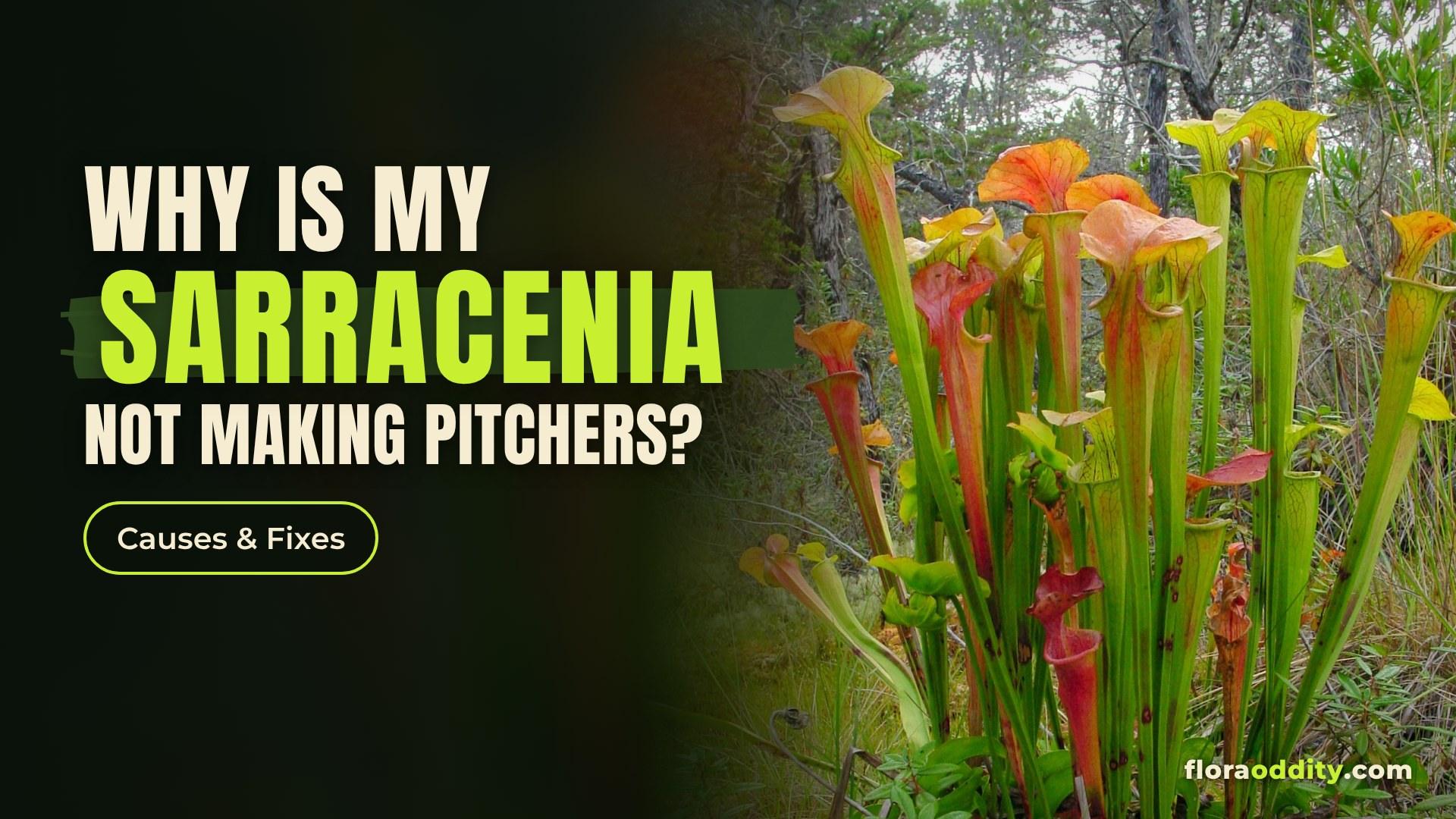
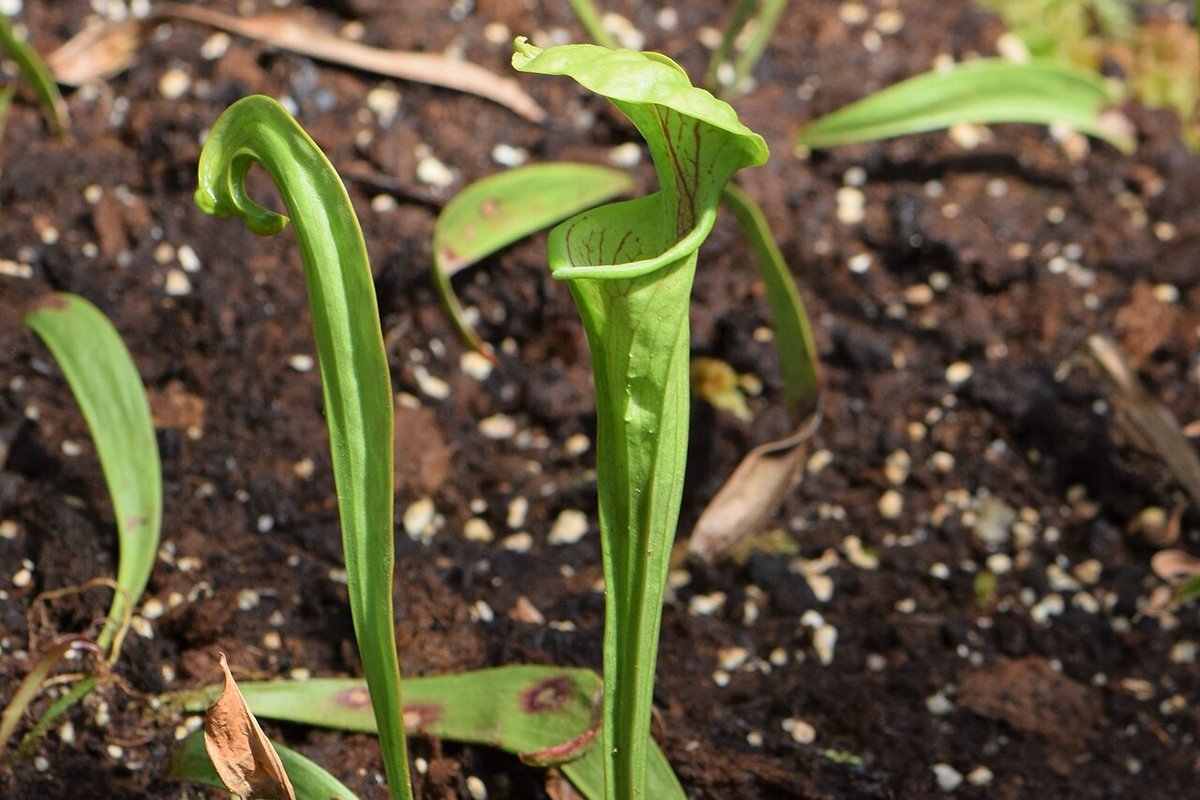
A Sarracenia that grows flat green leaves instead of pitchers, or pitchers that slump over like wet paper, is telling you something. Sometimes it is only telling you the date. Several species make leaves without pitchers every winter, and in spring a mature plant flowers before or alongside its first pitchers. Other times the message is about light, water, crowding or a bad winter, and those are things you can change.
If your Sarracenia is not making pitchers, or is making thin, floppy ones, this guide helps you sort the seasonal and species habits from the real problems. For the basics of growing these plants, see our Sarracenia care guide, and if you are not sure which species you have, start with its species section, because the answer often depends on it. If your pitchers are turning brown rather than failing to appear, our guide to Sarracenia pitchers turning brown covers that.
The Short Answer
Check the season and the species before you change anything. Flat, sword-shaped leaves in autumn and winter are phyllodia, a normal winter leaf on S. flava, S. oreophila and their hybrids. In spring, a mature plant flowers first and makes its pitchers after. Some plants pitcher early and then stop, while others save their best pitchers for late summer. If none of that fits, check the sun first: Sarracenia Northwest, a specialist nursery, names insufficient sunlight as “one of the first things to investigate” when a plant is not producing strong, colorful pitchers. After light, look at the winter rest, the water and soil, how crowded the pot is, whether the plant was recently divided, and the new growth for pests.
Quick Diagnosis: Match What You See to the Cause
Find the row that matches your plant, then read the matching section below.

| What you see | Likely cause | What to do | Status |
|---|---|---|---|
| Flat, sword-like leaves with no pitcher openings in autumn and winter | Phyllodia, the normal winter leaves of some species and hybrids | Nothing. Leave them on; cut back before spring growth if you like | Normal |
| No pitchers yet in spring, but a flower bud or flower | The plant flowers first, then pitchers | Wait. Pitchers follow the flowers | Normal |
| Thin first pitchers in spring, better ones expected later | Late-season species or hybrid | Wait. Its best pitchers come in late summer | Normal |
| Good pitchers early, then few or none by midsummer | Early-season habit (S. flava, S. oreophila and hybrids) | Nothing. Expect phyllodia or a rest | Normal |
| Thin, pale, green leaves that rarely form pitchers | Too little direct sun | Full sun, 6 or more hours a day; cut off weak growth | Stress |
| Weak growth, few pitchers after a warm winter indoors | Missed or broken dormancy | Give a cool winter rest next year; wait for the plant to catch up | Stress |
| Slow decline, poor pitchers, after tap water or fertilizer | Minerals or fertilizer in the soil | Pure water; flush or repot into fresh peat mix | Problem |
| Weak pitchers in the middle of a big clump | Crowded pot, rhizomes overlapping | Divide just before spring growth | Stress |
| Small or few pitchers the season after dividing | Division or repotting stress | Wait; divide with at least three growth points | Stress |
| Twisted, curled or malformed new pitchers | Aphids or thrips on young growth | Inspect new growth and remove pests | Problem |
| Tall pitchers flopping in midsummer or after rain | Soft-growing hybrid, heavy catch, rain or low light | Stake or tie them; more sun; keep the pot very wet | Stress |
First, Check the Calendar
Three normal habits explain many plants with no pitchers.
Flat winter leaves: phyllodia
Barry Rice, author of the Carnivorous Plant FAQ, says that during the winter S. flava “produces tall sword-shaped leaves lacking pitchers, called phyllodia,” which let the plant photosynthesize through the season when there are fewer insects to catch. NC State Extension describes the same leaves as “long, slender, linear, winter leaves (phyllodia), resembling those of an iris.” S. oreophila makes them too: Rice notes that its phyllodia are curved rather than straight, and the US Fish and Wildlife Service says its pitchers “wither by late summer and are replaced by falcate phyllodia (flattened leaves), which persist until the next season.”
So flat leaves on these plants from late summer to spring are not a failure. Hybrids with S. flava or S. oreophila in them can do the same. Sarracenia Northwest, answering a grower whose plant had made no pitchers for three years, pointed out that “some of these leaves are what’s called phyllodia, non-carnivorous leaves.”
Flowers come first in spring
Rice describes the spring order clearly: “With the resumption of spring growth, the first thing the plant does is make flowers.” Only once pollination is over does the plant produce its new pitchers. The ICPS, writing about growing from seed, says Sarracenia flowers “usually appear in the spring slightly ahead of or with the first pitchers.” A mature plant with a flower bud and no pitchers in early spring is right on schedule.
Some plants pitcher early, others late
Carnivorous Plant Nursery says Sarracenia “grow pitchers in the Spring and then again in the Fall,” with S. flava making its best pitchers in spring and S. leucophylla its “biggest and best pitchers in the Fall.” It adds that S. rubra and S. alata “also have great fall pitchers.” Rice says S. leucophylla produces two crops, and that the spring crop is “often somewhat lanky and unimpressive,” while the late-summer pitchers “are much larger and robust.”
The early growers behave the other way. Rice writes that in cultivation S. flava “seems to put all its growing efforts into a few pitchers at the beginning of the year. After these pitchers are made, few further pitchers are produced.” S. oreophila goes further, with pitchers that “often die off long before summer is even half over.”
The Causes in Detail
If the calendar does not explain it, work through these. Light comes first, since Sarracenia Northwest calls it one of the first things to investigate.
Not enough direct sun
Rice believes that “the single underlying cause for most carnivorous plant deaths at the hands of beginning growers is inadequate lighting.” For Sarracenia, the signs are thin, pale leaves that do not form proper pitchers. In one Sarracenia Northwest case, a S. purpurea kept in an indoor terrarium was “showing all the signs of having been growing in poor lighting,” with “thin, elongated, green leaves that sometimes don’t form pitchers.” The nursery added that “the pitchers should be stout and dark red.” California Carnivores says pitchers “looking stretched out and too green” are not getting enough sun.
In the three-year case, the plant had been kept indoors, and Jeff Dallas of Sarracenia Northwest was blunt: “Lack of sunlight is why your plant isn’t making any pitchers.” His fix was to cut off all the foliage that was flopping over, keep the pot in its water tray, and put it in full sun, the kind “you need to grow tomatoes or vegetables.” He expected new pitchers “in a few weeks,” but warned that a plant moved in midsummer “might have to wait until next growing season” to look normal.
Sarracenia Northwest’s care guide asks for 6 or more hours of direct sun a day, with 4 hours as a minimum if the plant gets bright light for the rest of the day, and says plants with less direct sun “may remain healthy, but their pitchers will often be less robust and less colorful.” It does not recommend terrariums or year-round indoor growing. The ICPS adds that tall species are hard to grow under lights “unless you use mirrors or other reflective material to get light to sides of the tall leaves.”
A missed or broken dormancy
Sarracenia need their winter rest. Rice warns that a plant denied its dormancy “will simultaneously try to both grow and rest, and in the resulting confusion it will languish and perhaps even die.” He gives Sarracenia “a cool dormancy period of about three months,” with chilly temperatures and some sunlight. California Carnivores says dormancy is “essential to their health” and is triggered by shorter days and colder temperatures from October to February.
A winter that is too warm can also cause trouble. The ICPS says the winter storage spot should be cool to cold, because “if it is too warm the plants can start growing prematurely and have trouble with the transition to outdoors in the spring.” If your plant spent last winter in a warm room and is now weak, plan a proper rest this year. Our Sarracenia dormancy guide explains how.
If you bought the plant in winter, Rice suggests not forcing it into dormancy straight away. “If the plant wants to enter dormancy it will tell you,” he writes; it “will stop producing leaves, and it will just sit there.” Left alone, the plant “will synch up to the seasons naturally.”
Wrong water, soil or fertilizer
Bad water and fertilizer damage roots, and weak roots mean weak growth. Sarracenia Northwest recommends rainwater, distilled or reverse osmosis water, or tap water below 50 ppm of dissolved minerals, and warns that hard water “can cause minerals to accumulate in the soil.” NC State says pitcher plants “are sensitive to dissolved salts in chlorinated water” and that “fertilizers can burn the plant.”
The ICPS rhizome rot page explains the risk: burning the root tips “from over-fertilizing or watering the plants with water that is too salty” lets fungal pathogens climb up the roots. Its advice for adult plants is simple: “Do not soil fertilize your adult plants.” California Carnivores warns that regular potting soil will kill Sarracenia over time because of its “nutrients and fertilizers.” If your plant has been on tap water or in the wrong soil, switch to pure water and repot into a fresh peat mix.
A crowded pot
A well-grown Sarracenia eventually fills its pot, and then growth suffers. The ICPS explains that “you will get your best pitchers on the edge of the clump,” while in the middle “the rhizomes have a tendency to grow over each other resulting in weak growth.” It suggests dividing well-cared-for plants “about every three years.” Sarracenia Northwest makes the same point about light: in a large clump, “leaves in the middle won’t get as much sunlight, so those leaves will be floppy.” Crowding between pots matters too, as the floppy pitcher section below explains.
Stunted after division or repotting
A plant that was divided or repotted last year may make fewer, smaller pitchers for a while. The ICPS calls the time “just before the plants start growing in the spring” the “best and only good time of the year to divide Sarracenia,” and says plants divided at other times survive but “it can take them much longer to recover.” The size of each piece matters: divisions with at least three growth points “recover much better,” and give “nice pitchers the first year,” while single growth points “struggle for the first year or two.”
Pests on new growth
Pests can spoil pitchers before they open. Sarracenia Northwest says aphids and thrips “can feed on immature leaves and cause pitchers to emerge twisted, curled, or otherwise malformed,” and that because the damage happens while the pitcher is still developing, “the pests may be difficult to notice at first.” Look closely at the growth point and the youngest leaves. Our brown pitchers guide covers moth larvae, mealybugs and rot in more detail.
Floppy or Falling-Over Pitchers
Floppy pitchers have their own list of causes, and not all of them are problems.
Low light. This is the one to rule out first. Rice, writing about Venus flytraps, separates healthy thin spring leaves from “unhappy, thin, light-starved leaves” by their strength: light-starved leaves “tend to have floppy leaves that droop to the soil surface,” while normal ones “are sturdy and stiff.” For Sarracenia, Dallas told a grower near Atlanta whose new plants were very pale that “the floppiness is from light deprivation.” NC State says that when S. leucophylla grows in part shade, its “leaf coloring does not develop as it should and pitchers droop.”
Old pitchers shading new ones. Sarracenia Northwest once tried trimming old pitchers in summer instead of late winter. The new spring pitchers on the untrimmed plants “were very weak and floppy,” because the older pitchers shaded them as they emerged. As Jacob Farin of the nursery explains, “without sufficient sunlight, the base of the pitchers couldn’t develop properly and couldn’t support their own weight when they fully matured.” He describes another grower whose tall pitchers flopped late in the season “because his display was overcrowded.”
The plant’s genes. Some hybrids are simply floppy. Dallas says floppy pitchers vary “much between species and hybrids” and that “stuff with S. oreophila tends to get that trait.” Of the very vigorous hybrid ‘Extreme Green’ (S. flava x S. oreophila), he says that because of its fast growth “the tissues can be softer than slower growing plants like Sarracenia leucophylla.” The ICPS notes that some seedlings get “tall and skinny and fall over,” even when they are the plant you wanted.
A heavy catch, rain or wind. Dallas usually sees floppy hybrids fall over in midsummer “when the plant is loaded with insects,” and adds that “heavy rain will sometimes cause it.” The ICPS warns that overfilling pitchers with water when you feed them can make them fall over. Rice says Exyra moth larvae “eat the pitcher walls, causing the top of the pitcher to topple over.”
Dry soil. For the ‘Extreme Green’ growing in a bathtub garden, Dallas said that “keeping them very wet is also essential to maintaining good turgor in the pitchers.”
Spring weather. Dallas says quick swings between cloudy, cool days and hot, sunny ones can leave late-season plants with curvy spring pitchers, “which is absolutely out of your control.”
What helps: give the plant full sun, keep the pot wet, and support tall pitchers. Dallas says “you can stake them up or use something like a tomato ring,” and for wind he suggests using more than one stake and securing the pitchers “further up rather down low.” He adds that plenty of direct sunlight “will help strengthen the pitchers,” and notes that older pitchers get floppy at some point in the season anyway: “You see it in wild plants too.”
Species Habits Worth Knowing
- S. flava. A few big pitchers early, then few more; phyllodia in winter (Rice). Carnivorous Plant Nursery says its best pitchers come in spring.
- S. oreophila. Pitchers that are “a little more papery and flimsy than those of S. flava” and die off early, then curved phyllodia (Rice, US Fish and Wildlife Service). Rice adds that “its long dormancy makes it a somewhat slow grower.” Its hybrids can be floppy (Sarracenia Northwest).
- S. leucophylla. Lanky spring pitchers, then a much better late-summer crop (Rice, NC State).
- S. rubra and S. alata. Carnivorous Plant Nursery says both have “great fall pitchers.”
- Late-season hybrids. Dallas says they “produce their best pitchers in August and September when summer cools down,” and that “in spring, their pitchers tend to be thin, but they will still have color in them.”
What to Do Next Season
- Clear the way in late winter. Sarracenia Northwest cuts all old pitchers on most species down to the rhizome in mid to late winter so new growth gets full sun, but trims only brown pitchers on S. purpurea and S. psittacina. The ICPS prefers removing only brown parts during the year (see Where Sources Differ).
- Divide or repot crowded plants just before new growth starts, keeping at least three growth points per piece (ICPS).
- Put the plant in full sun from the start of the season, ideally 6 or more hours of direct sun (Sarracenia Northwest).
- Keep it wet with pure water and do not fertilize the soil (Sarracenia Northwest, ICPS).
- Check new growth for aphids and thrips as the first pitchers open (Sarracenia Northwest).
- Give it a cool winter rest of about three months (Rice).
Then judge the plant by the right month. An early-season plant should look its best in early summer; a late-season plant may not impress you until August.
Where Sources Differ
Each row gives only the context the sources themselves state.
| Topic | One view | Another view | Context the sources give |
|---|---|---|---|
| Old pitchers before spring | Sarracenia Northwest: cut all old pitchers down to the rhizome in mid to late winter, “even if the pitchers still look good” | ICPS: “best only to cut off the brown part of leaves,” because plants recover nutrients from old leaves | Sarracenia Northwest found old pitchers shaded new ones and made them floppy, and exempts S. purpurea and S. psittacina; the ICPS says cutting green leaves “can starve a plant that lacks a large rhizome” |
| Flower stalks | Carnivorous Plant Nursery: “generally a good idea to remove the flower spike” | ICPS: flowers need hand pollination if you want seed | Carnivorous Plant Nursery says a flower spike can weaken “a potted plant”; the ICPS page is about growing from seed |
| How wet | ICPS: pots should always sit in about 1.5 to 2.5 inches (4 to 6 cm) of water | Carnivorous Plant Nursery: “evenly moist, but not soaking wet” | Sarracenia Northwest says very wet soil helps pitcher “turgor,” answering a grower whose plant was in a bathtub garden |
| Light minimum | Sarracenia Northwest: 6 or more hours of direct sun, 4 at the least | NC State lists partial shade (2 to 6 hours of direct sun) among the genus’s light conditions | NC State’s S. leucophylla page says pitchers droop in part shade |
| When pitchers come | Carnivorous Plant Nursery: pitchers in spring “and then again in the Fall” | Rice: S. flava makes a few early pitchers, then “few further pitchers” | Rice is describing S. flava “in cultivation”; Carnivorous Plant Nursery also says S. flava has its best pitchers in spring |
Common Mistakes
- Mistaking phyllodia for a sick plant. Flat winter leaves on S. flava, S. oreophila and their hybrids are normal.
- Expecting pitchers before the flowers. In spring, a mature plant flowers first.
- Keeping the plant indoors to protect it. Sarracenia Northwest does not recommend terrariums or year-round indoor growing, and Dallas blamed lack of sunlight for a plant that made no pitchers for three years.
- Skipping winter. Rice warns that a plant denied its dormancy will languish and may even die.
- Fertilizing a plant that will not pitcher. The ICPS warns against soil fertilizing adult plants.
- Leaving last year’s pitchers to shade the new ones. Sarracenia Northwest found that old pitchers shading new growth made the new pitchers weak and floppy.
- Judging a late-season plant in May. Its best pitchers may not come until late summer.
FAQ: Sarracenia Not Making Pitchers
Why does my Sarracenia only have flat leaves?
If it is autumn or winter and the plant is S. flava, S. oreophila or a hybrid with either, those are phyllodia, normal winter leaves. If the flat or thin leaves appear in summer, light is the usual cause; move the plant into full sun.
How long after moving into full sun will pitchers appear?
In Sarracenia Northwest’s three-year case, Dallas expected new pitchers “in a few weeks,” but warned that a plant moved halfway through summer might not look normal until the next growing season.
Should I cut off floppy pitchers?
You can. Sarracenia Northwest told one grower to cut off all the foliage that was flopping over before moving the plant into full sun. For a healthy but floppy hybrid, it suggests staking or tying the pitchers instead.
My Sarracenia is flowering. Will it still make pitchers?
Yes. Rice says that in spring the first thing the plant does is make flowers, and once pollination is over it produces its new pitchers.
The Bottom Line
When a Sarracenia is not making pitchers, the reason is often the calendar: phyllodia in winter, flowers first in spring, or a species that pitchers early or late. If none of those fits, give it more sun before anything else, then check its winter rest, water, soil, crowding, recent division and new growth for pests. Floppy pitchers often mean low light, shading or a soft-growing hybrid, and staking, full sun and a wet pot help.
Sources & Further Reading
- International Carnivorous Plant Society: Growing Sarracenia
- International Carnivorous Plant Society: Dividing Sarracenia Step-by-Step
- International Carnivorous Plant Society: Sarracenia Rhizome Rot
- International Carnivorous Plant Society: Growing Sarracenia from Seed
- Barry Rice, The Carnivorous Plant FAQ: Introducing the North American pitcher plants
- Barry Rice, The Carnivorous Plant FAQ: Sarracenia flava
- Barry Rice, The Carnivorous Plant FAQ: Sarracenia leucophylla
- Barry Rice, The Carnivorous Plant FAQ: Sarracenia oreophila
- Barry Rice, The Carnivorous Plant FAQ: About light
- Barry Rice, The Carnivorous Plant FAQ: About dormancy requirements
- Barry Rice, The Carnivorous Plant FAQ: Should a plant bought in winter be forced into dormancy?
- Barry Rice, The Carnivorous Plant FAQ: Why are my plant’s leaves long and skinny?
- Sarracenia Northwest: How to Grow Sarracenia
- Sarracenia Northwest: Q&A 139, No Sarracenia Pitchers for 3 Years
- Sarracenia Northwest: Q&A 110, Sarracenia Not Growing Well in a Terrarium
- Sarracenia Northwest: Q&A 94, Floppy Sarracenia Pitchers
- Sarracenia Northwest: Q&A 106, Huge Sarracenia Extreme Green is Floppy
- Sarracenia Northwest: Q&A 111, Sarracenia with Curvy Pitchers
- Sarracenia Northwest: Q&A 137, Wind Blowing over Sarracenia
- Sarracenia Northwest: Q&A 159, Trim All Sarracenia Pitchers in Late Winter
- California Carnivores: American Pitcher Plants (Sarracenia) Growing Tips
- Carnivorous Plant Nursery: Growing Tips for Sarracenia
- NC State Extension Gardener Plant Toolbox: Sarracenia
- NC State Extension Gardener Plant Toolbox: Sarracenia flava
- NC State Extension Gardener Plant Toolbox: Sarracenia leucophylla
- US Fish and Wildlife Service: Green pitcher plant (Sarracenia oreophila)
Featured image based on a photo of green pitcher plants (Sarracenia oreophila) by Noah Elhardt via Wikimedia Commons, CC BY-SA 2.5, cropped with a dark gradient and typography added by FloraOddity. The adapted featured image is shared under the same licence.
Final articles are editorially reviewed and factual claims are checked against cited sources. Last reviewed: October 2026.

One Comment