
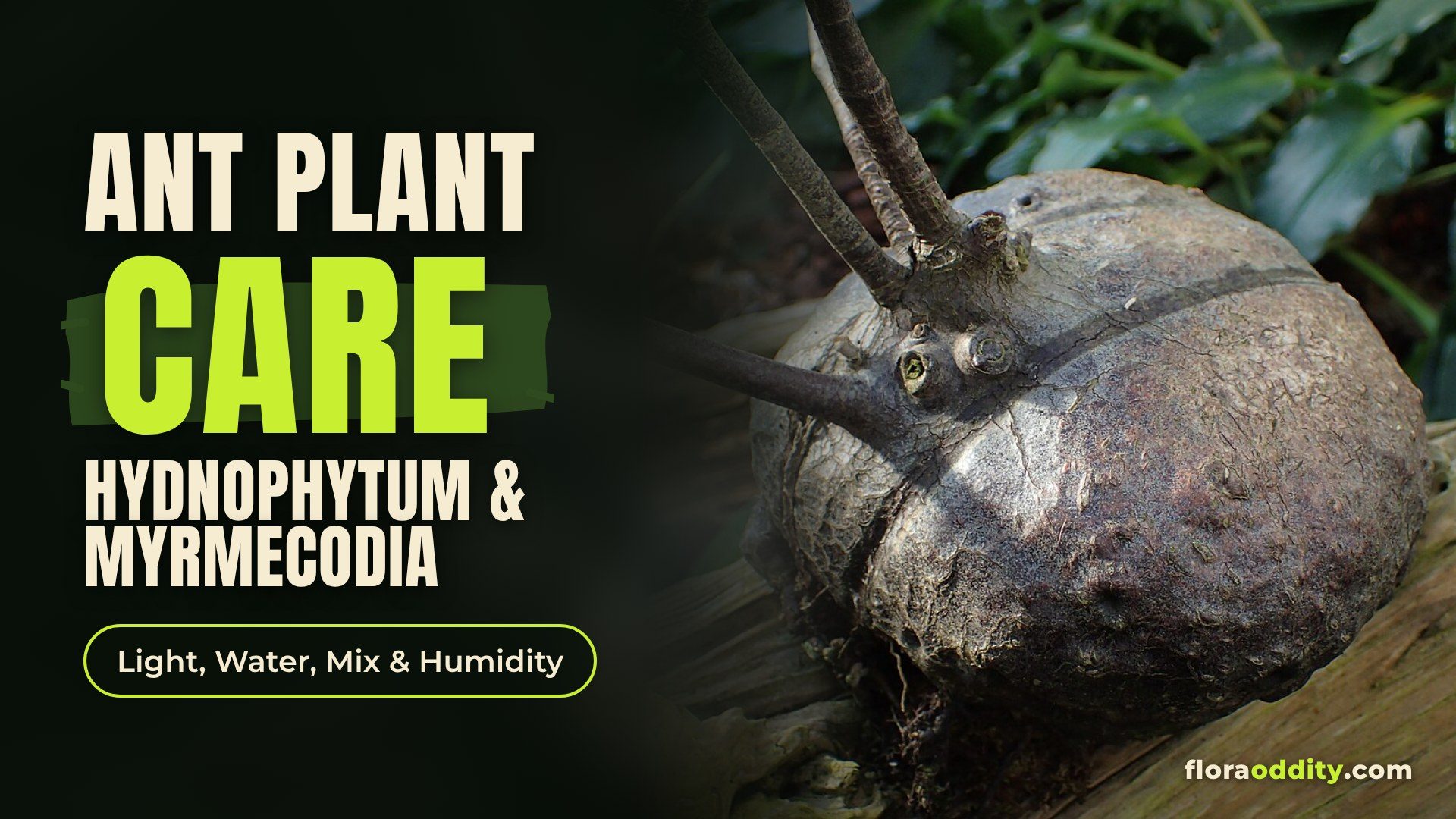
Ant plants look like something a fantasy illustrator would invent. A swollen, potato-like base sits on the side of a tree, riddled with holes, with a few leathery leaves sprouting from the top. In the wild, that base is a home for ants. In your living room, it is simply a plant with an unusual way of storing water, and that is the key to growing it well.
This guide covers the two ant plants you are most likely to find for sale, Hydnophytum and Myrmecodia. It explains what the swollen base actually is, how the two genera differ, and how to water, pot, and place them so the base stays firm instead of rotting.
The Short Answer
Give your ant plant bright, indirect light, a very open, fast-draining mix such as an orchid mix of bark, sphagnum moss, and perlite, and warmth all year. Water the mix, not the swollen base, and water again when the top of the mix has started to dry but before it dries out completely. Keep the humidity on the high side, cut back on water in cooler months, and handle the roots gently when you repot, because they are brittle. You do not need ants: both genera form their hollow, chambered base without them.
What Makes an Ant Plant Different
Most care mistakes come from treating an ant plant like an ordinary houseplant. A few minutes on how the plant is built makes every later decision easier.
The caudex is a swollen stem full of chambers
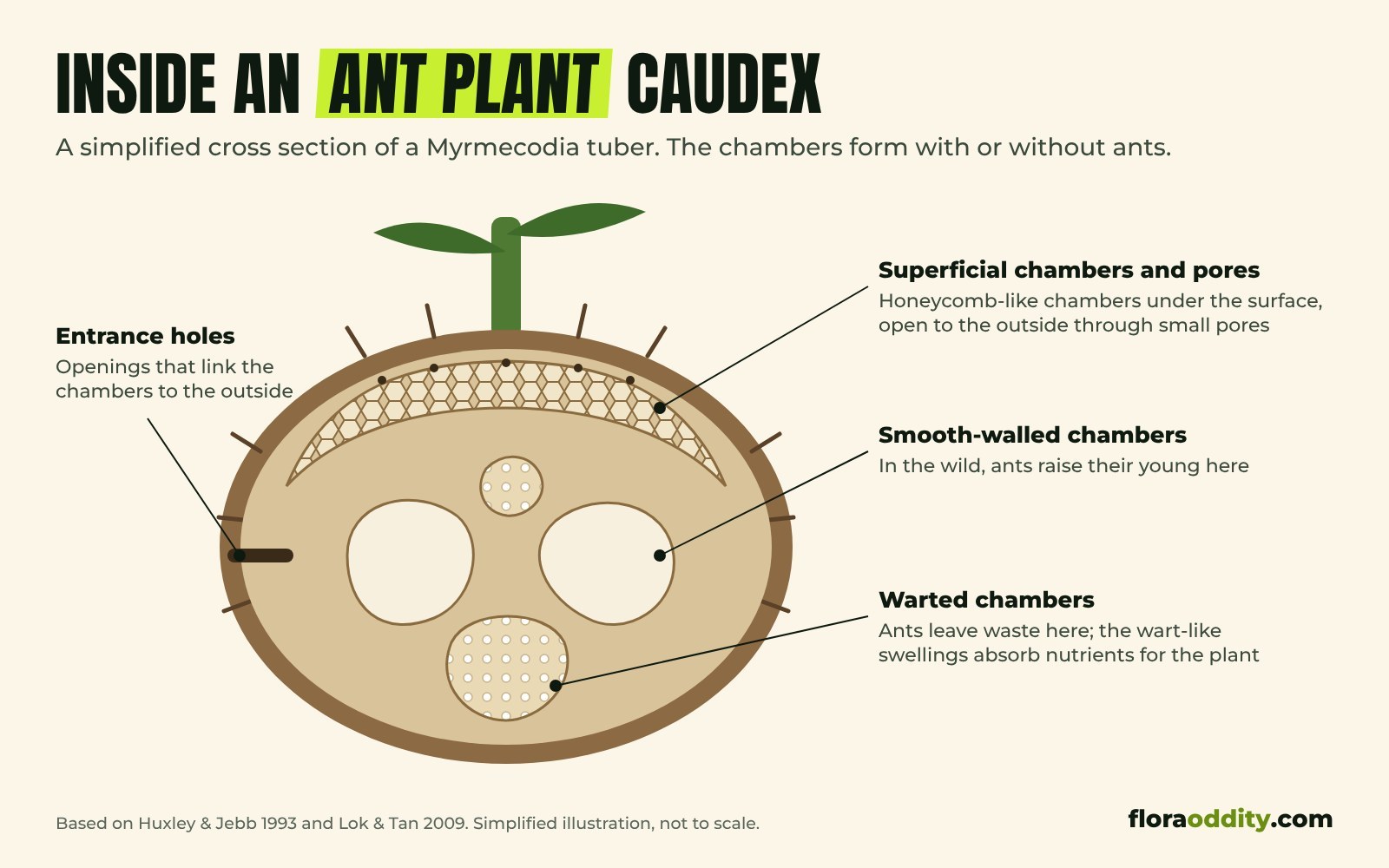
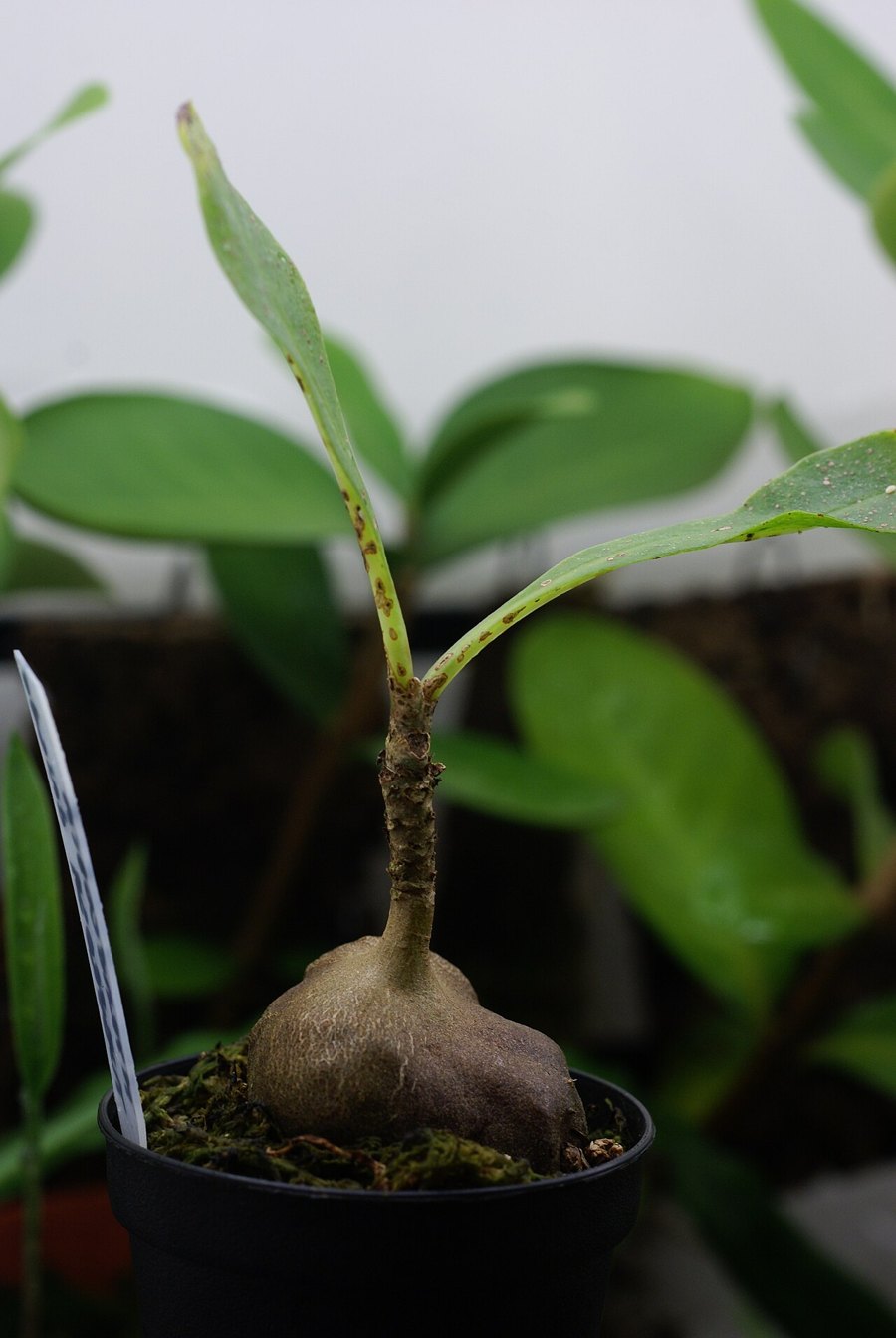
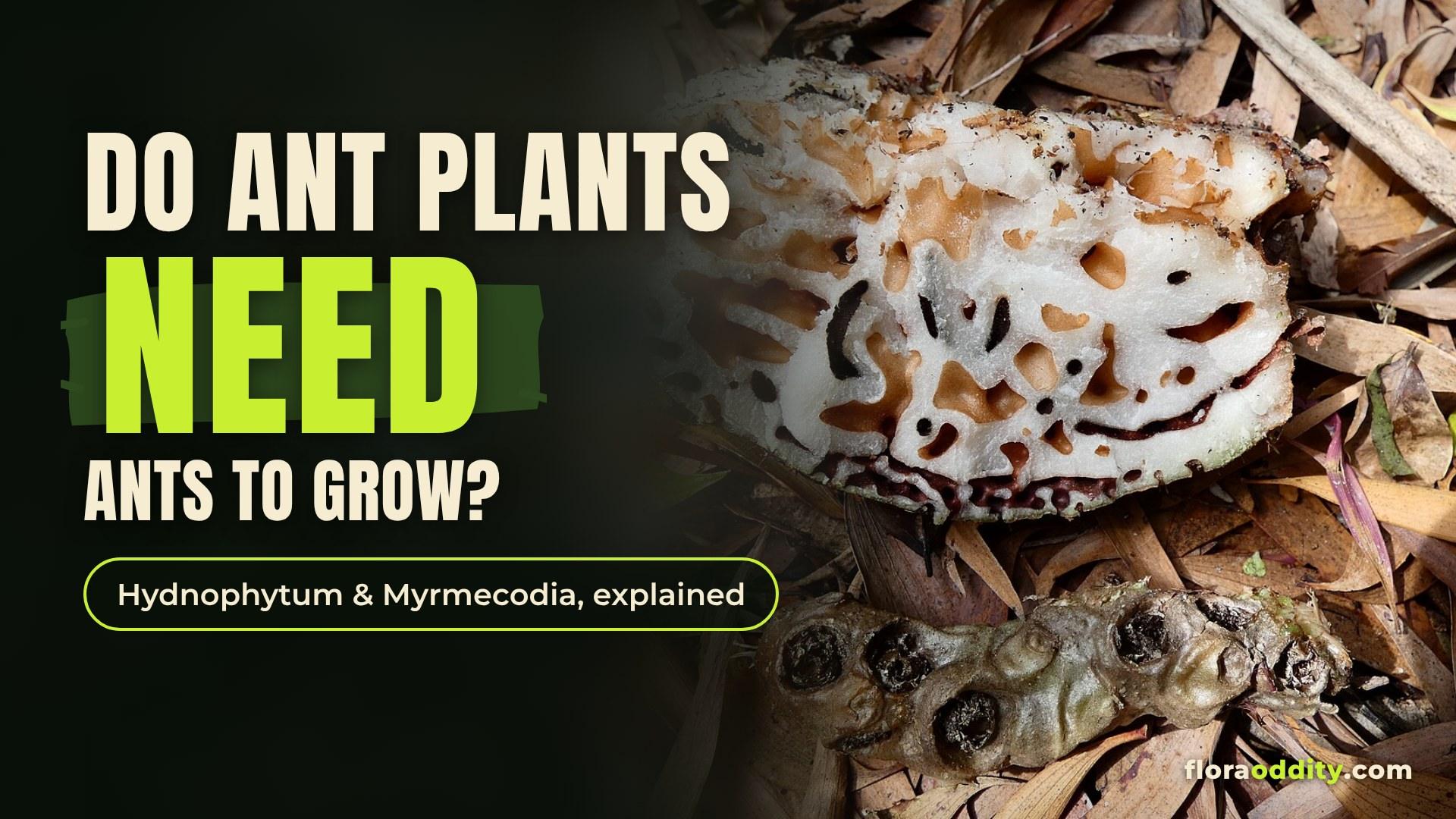
The swollen base is usually called a caudex or tuber. According to a review of these plants by Lok and Tan of the National University of Singapore, it starts when the young seedling’s stem swells just above the root, and tissue inside it dies to form the first hollow cavity. As the plant grows, more cavities are added, and the tuber becomes a maze of tunnels and chambers with entrance holes to the outside.
Hydnophytum and Myrmecodia are both epiphytes. In nature they grow on trees, not in soil. The caudex stores water, and Paraíso Plant Studio points out that this also makes it susceptible to rot, which is why a wet, airless pot is the biggest danger indoors.
Hydnophytum vs Myrmecodia
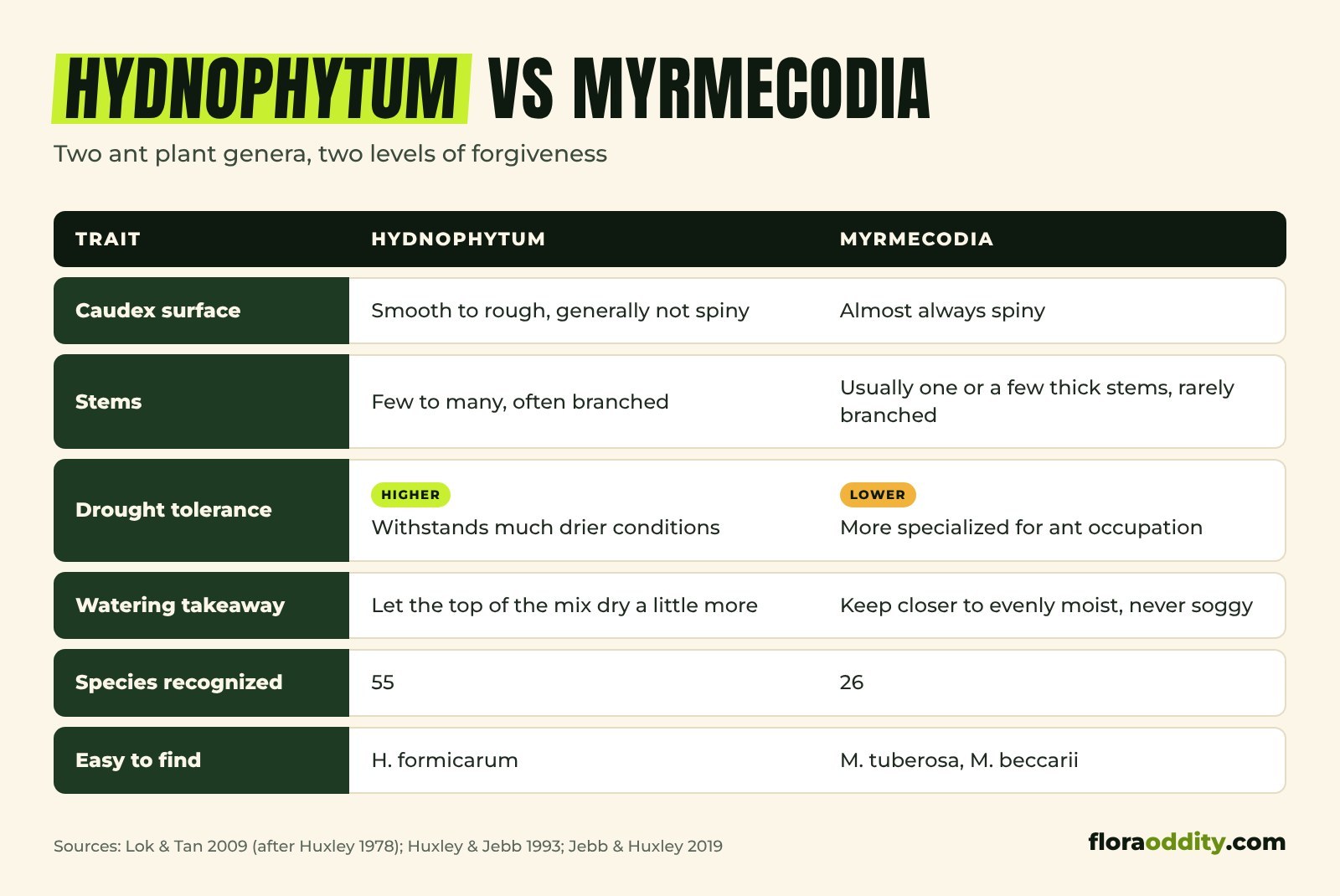
The two genera are closely related but not interchangeable, and the differences matter for care.
| Hydnophytum | Myrmecodia | |
|---|---|---|
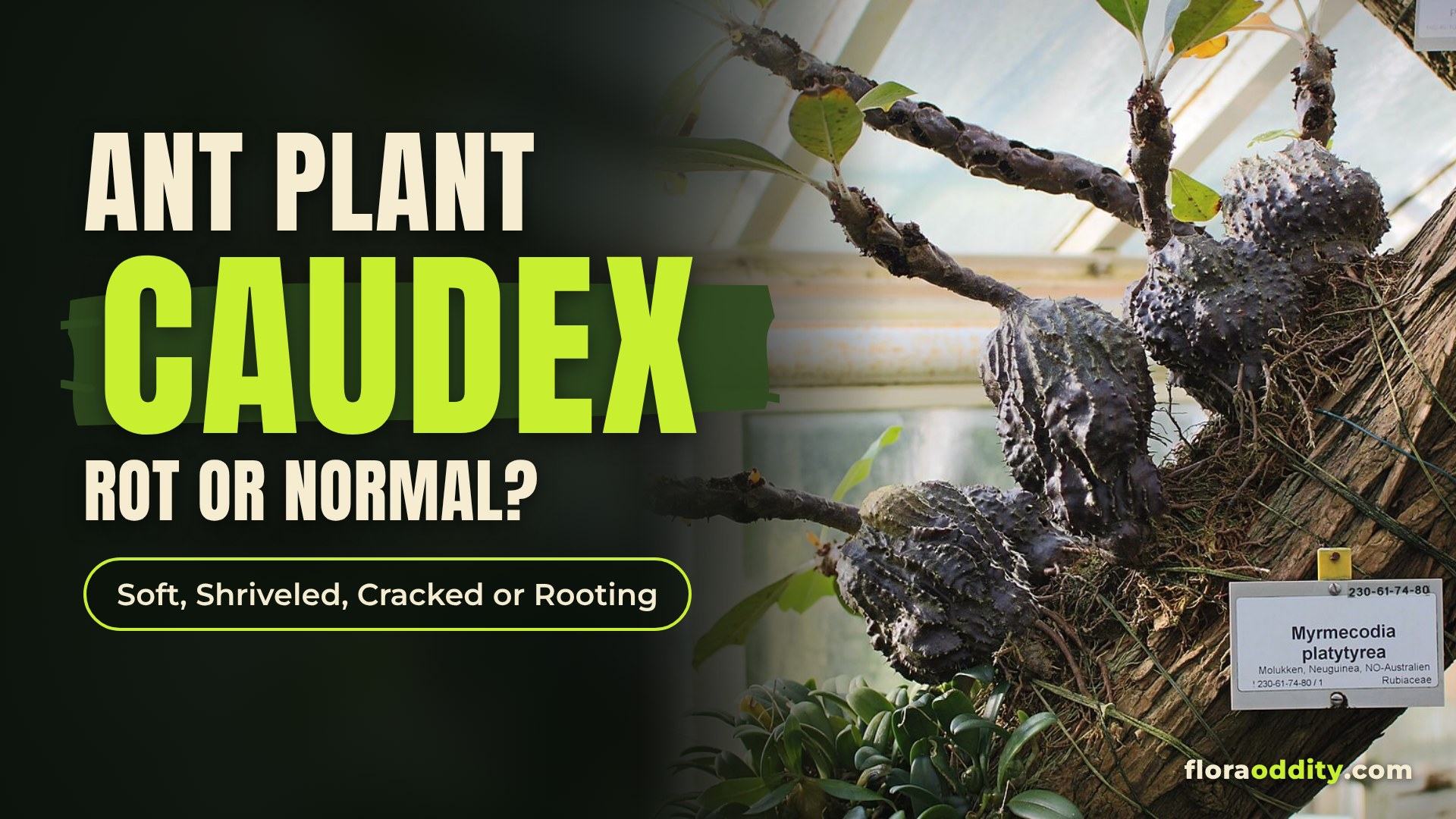
| Caudex surface | Smooth to rough, generally not spiny | Almost always spiny |
| Stems | Few to many, often branched | Usually one or a few thick stems, rarely branched |
| Drought tolerance | Higher; described as able to withstand much drier conditions | Lower; more specialized for ant occupation |
| Watering takeaway | Let the top of the mix dry a little more | Keep closer to evenly moist, never soggy |
| Species | 55 recognized | 26 recognized |
| Easy to find | Hydnophytum formicarum | Myrmecodia tuberosa, M. beccarii |
Lok and Tan, drawing on C. R. Huxley’s 1978 study of both genera, describe Hydnophytum as much more drought adapted than Myrmecodia, while Myrmecodia, whose name means “ant house”, has tubers that are more highly specialized for ant occupation. The species counts come from the botanical revisions of Myrmecodia (Huxley and Jebb, 1993) and Hydnophytum (Jebb and Huxley, 2019), which also describe the spiny Myrmecodia tuber and the usually unbranched, thick Myrmecodia stems.
In practice, this suggests that a Hydnophytum is the more forgiving plant if you sometimes forget to water, while a Myrmecodia is better kept on steadier moisture and humidity.
Do you need ants?
No. In their revision of Myrmecodia, Huxley and Jebb write that the plants “can be cultivated readily without the ants, and form apparently normal, chambered tubers.” Specialist nursery Jungle Leaves keeps its cultivated ant plants ant free and notes on its Myrmecodia tuberosa page that the caudex forms the same way without ants.
In the wild, the ants are part of the plant’s nutrition. Lok and Tan explain that ants raise their young in the smooth-walled chambers and leave their waste and insect remains in chambers lined with small, white, wart-like swellings, which are highly absorptive. Nutrients from that debris are absorbed through the warts and moved into the rest of the plant. Not every ant plant is occupied, though. The Hydnophytum revision lists several high-mountain species whose tubers are not inhabited by ants at all.
Indoors, the chambers simply stay empty, and there is no need to add ants. Our guide do ant plants need ants? looks at what the ants actually do for the plant in the wild.
Light
Ant plants want bright light, but not harsh, all-day sun through glass. LLIFLE’s entry for Hydnophytum formicarum recommends bright light with some protection from midday sun. Plant retailer PLNTS suggests an east or north facing window (in the Northern Hemisphere), notes that intense direct sun can scorch the leaves, and warns that a very dark spot causes stretched, leggy growth.
The plant’s own leaves give you useful feedback. Lok and Tan observed that wild plants growing in shade have thinner, larger leaves, while plants in full sun have smaller, more leathery ones. If new leaves are getting bigger and thinner and the stems are stretching, the plant wants more light. If leaves develop dry, scorched patches, it is getting too much direct sun.
A grow light works well, especially for plants kept in a cabinet or terrarium. If you are unsure how to judge light levels indoors, our guide on how much light a Nepenthes needs explains how to read a window and set up a grow light, and the same principles apply here.
Watering Around the Caudex
Watering is where most ant plants are lost, and almost always through too much water rather than too little.
Water the mix, not the caudex
PLNTS advises watering directly into the soil and keeping the caudex dry to prevent rot. Pour the water onto the mix around the base, let it drain completely, and never leave the pot standing in a saucer of water.
How often
There is no fixed schedule, because it depends on the pot, the mix, the light, and the temperature. What the sources describe is a rhythm: water again when the top of the mix has started to dry, but before the whole pot dries out.
- LLIFLE suggests watering when the mix is just barely moist.
- PLNTS suggests watering when the top layer feels dry, and waiting a day or two if the upper half is still very moist.
- Araflora, a specialist ant plant nursery, advises letting the mix dry out between waterings for Myrmecodia beccarii, while never leaving it standing in water.
These are not really contradictions. They describe the same idea with different margins, and the difference in drought tolerance between the genera may explain some of it. It makes sense to let a Hydnophytum get a little drier and to keep a Myrmecodia closer to evenly moist. Either way, a soggy pot is the danger.
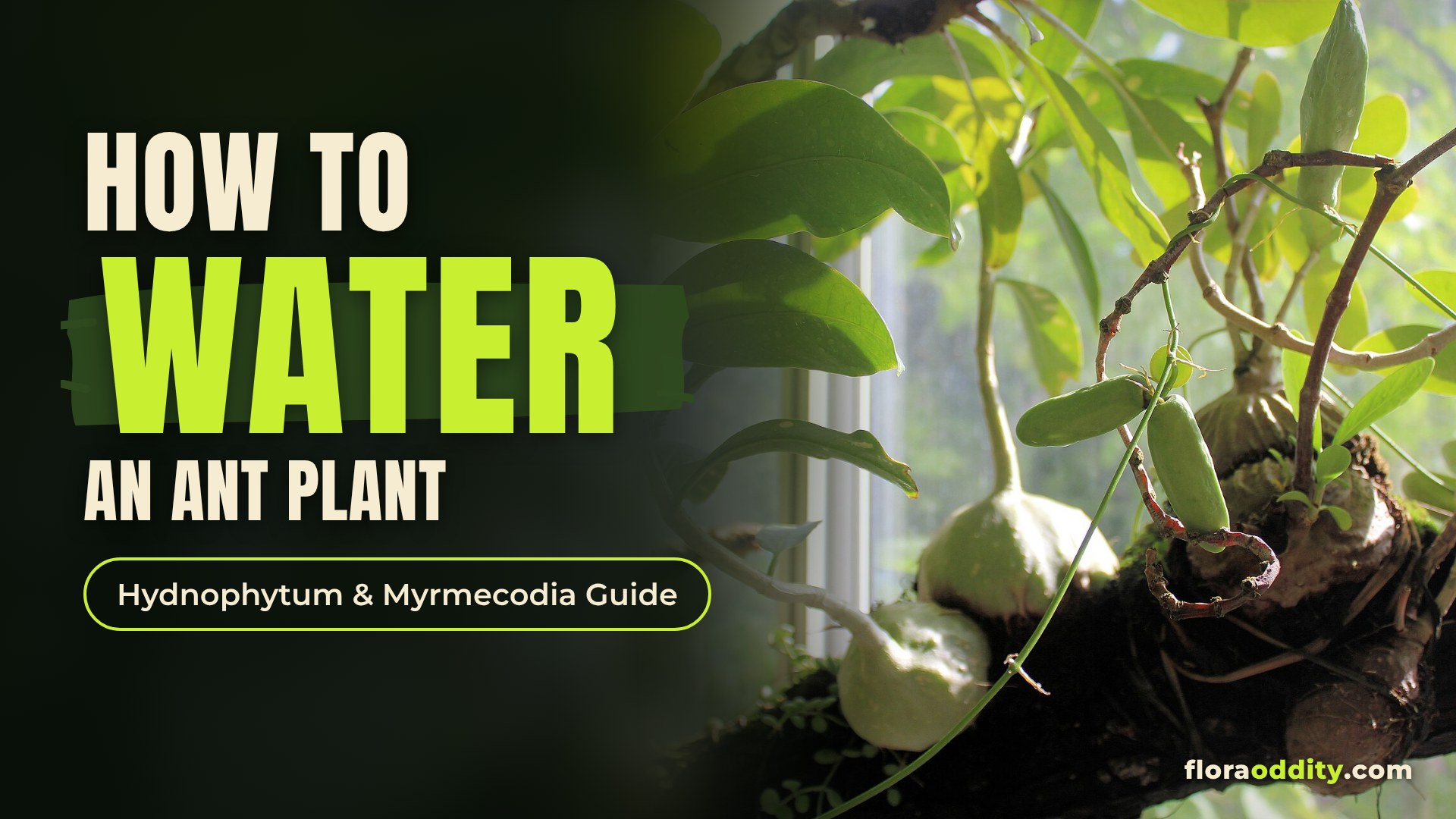
Paraíso Plant Studio notes in its ant plant care guide that the caudex stores water, and it recommends watering less in winter. When the plant is cooler and growing slowly, it uses far less water, so check the mix before every watering instead of following the calendar. Our guide on how to water an ant plant goes into more detail.
Signs you are getting it wrong
- Too wet: PLNTS lists yellowing, browning, or wilting leaves as signs of overwatering. Because the caudex is prone to rot, any part of it that turns soft needs attention right away; see our guide to ant plant caudex problems.
- Too dry: LLIFLE notes that these plants are quick to shed their leaves if they are allowed to dry out.
Potted vs mounted plants
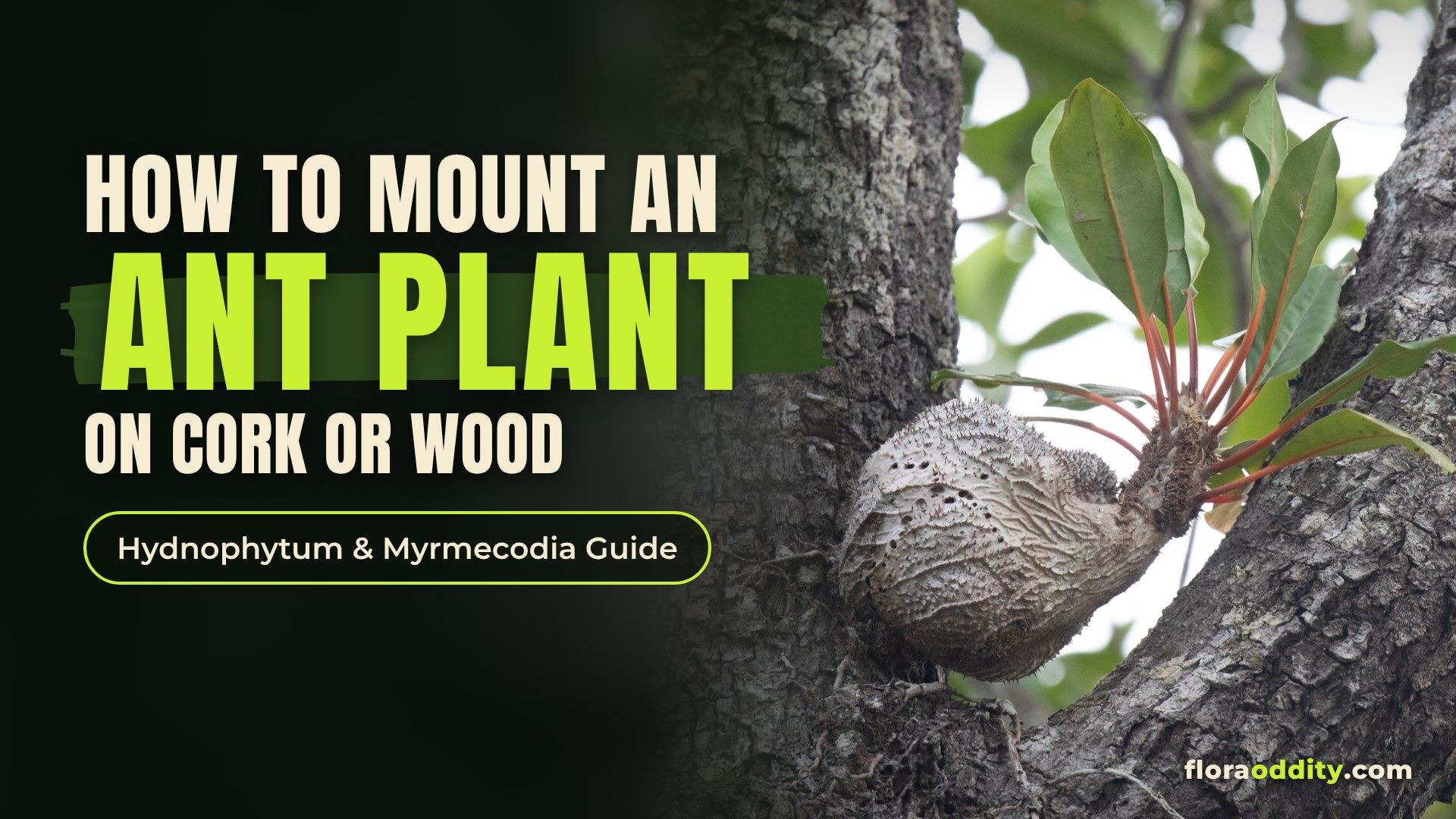
Some growers mount ant plants on cork or a piece of wood, the way they grow in nature. That looks spectacular, but LLIFLE points out that mounted plants need more frequent watering, and mounting works best where humidity is high, such as in a greenhouse or a large terrarium. For a windowsill, a pot is easier to manage. If you want to try it, our guide on how to mount an ant plant on cork walks through the steps.
Potting Mix and Containers
An ant plant needs a mix that holds some moisture but lets air reach the roots and drains almost instantly. LLIFLE recommends an open orchid style mix of sphagnum moss, chopped fir bark, and perlite. Paraíso suggests an orchid mix of fine fir bark and perlite, and Araflora uses a peat and coconut fiber mix for Myrmecodia beccarii. The common thread is structure and drainage, not one exact recipe.
A good starting point is a chunky orchid mix with some extra perlite, plus a little long-fiber sphagnum if your home is dry. Avoid ordinary potting soil, which stays dense and wet around the roots. Our guide to the best potting mix for Nepenthes explains how bark, sphagnum, and perlite each behave, and most of it applies to ant plants too.
For the pot itself:
- Use a pot with drainage holes. Clear orchid pots make it easy to see how wet the mix is.
- PLNTS recommends a pot only slightly larger than the caudex, and keeping most of the caudex above the surface of the mix.
- Jungle Leaves notes that some Myrmecodia have an elongated caudex that naturally grows horizontally or hangs, so support it in that position rather than forcing it upright.
Temperature and Humidity
Ant plants are tropical, and they need warmth all year. LLIFLE says they need warm temperatures and high humidity year round, and that they shed leaves if they become too cold.
The specific numbers vary by source, and it helps to see them side by side.
| Source | Temperature | Humidity |
|---|---|---|
| PLNTS (Hydnophytum, as a houseplant) | 64 to 75 °F (18 to 24 °C) | 50 to 70% |
| Araflora (Myrmecodia beccarii) | Around 79 °F (26 °C) in a greenhouse; minimum 59 °F (15 °C) | Around 75% |
The PLNTS figures describe a typical heated home, while Araflora’s describe a greenhouse aiming for the best possible growth. A reasonable target for most growers is to keep the plant in a warm room, away from cold windows in winter, and to give it as much humidity as you can without leaving the mix wet. Myrmecodia generally benefits more from the higher end of that range than Hydnophytum does.
To raise humidity, group plants together, use a humidifier, or grow smaller plants in a terrarium or plant cabinet with some airflow. Our guide on whether Nepenthes need high humidity covers what actually works indoors and what does not.
Feeding
Ant plants are light feeders. PLNTS suggests a houseplant fertilizer once a month during the growing season and warns that too much fertilizer does more harm than good. Araflora suggests a small amount of fertilizer more often for Myrmecodia beccarii. Whatever you choose, use it weak and stop in winter, when the plant is barely growing.
Repotting Without Breaking the Roots
LLIFLE warns that the roots of Hydnophytum and Myrmecodia are very brittle, so take great care when repotting. PLNTS suggests repotting every 2 to 3 years, or when roots start to come out of the drainage holes.
- Ease the plant out of the pot by squeezing or cutting the pot, not by pulling on the caudex.
- Remove only the old mix that falls away easily. Do not try to clean the roots.
- Set the plant in the new pot at the same height, with most of the caudex above the mix.
- Fill around the roots with fresh mix without packing it down, then water lightly.
If a few roots break, do not panic. LLIFLE notes that new roots can form from any part of the tuber that touches moist mix.
Which Ant Plant Should You Start With?
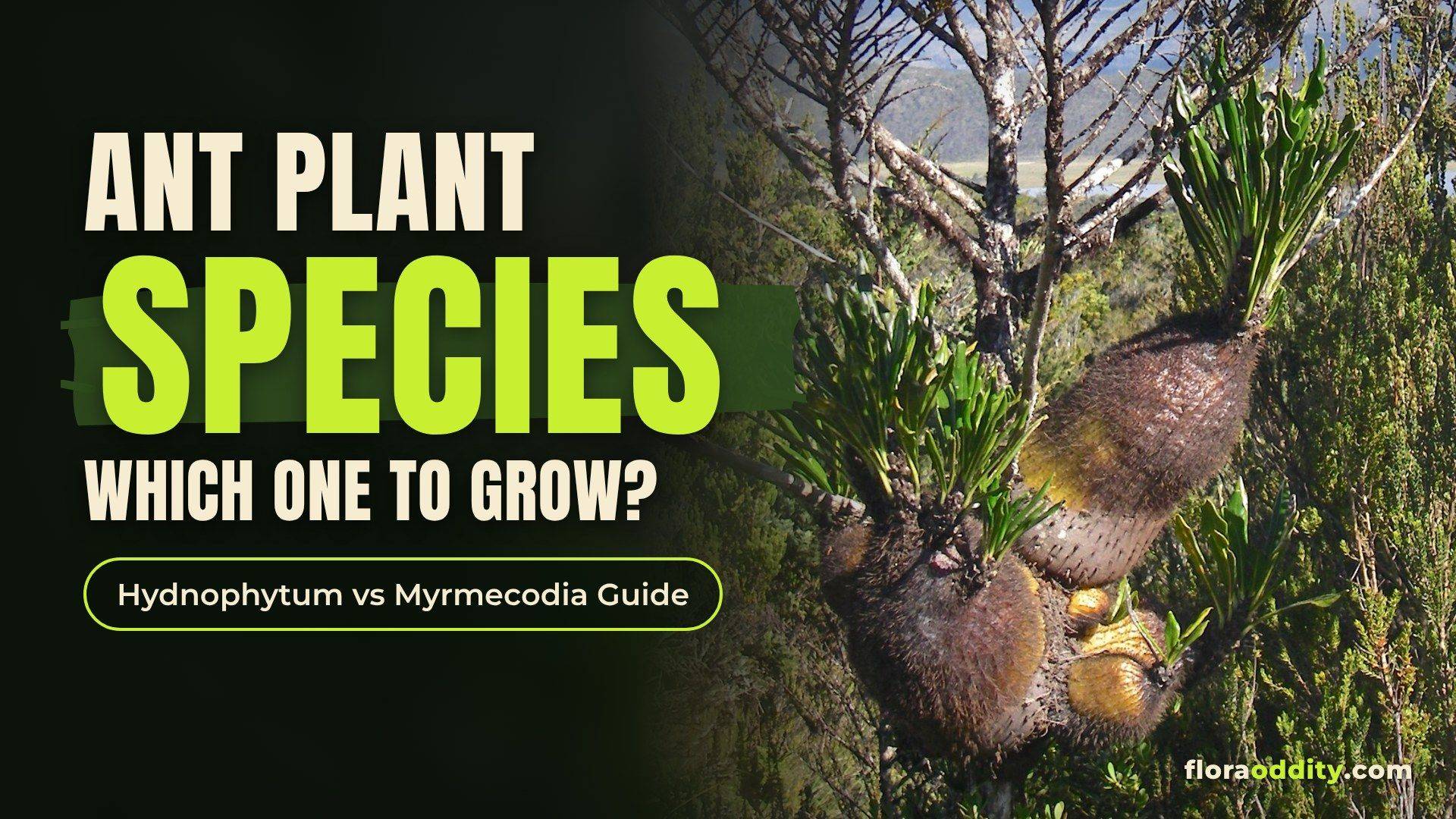
If you are buying your first ant plant, look for one of the species the trade already grows in quantity. Our ant plant species guide for beginners compares them one by one.
- Hydnophytum formicarum is widespread in the wild. The Hydnophytum revision records it in mangrove swamps, savannah forest, and heath forest on nutrient-poor soils, from sea level up to about 4,900 feet (1,500 m). That wide range of habitats, together with the genus’s drought tolerance, makes it a forgiving choice.
- Myrmecodia tuberosa is described by Jungle Leaves as one of the easiest Myrmecodia and a good ant plant for beginners, best in a terrarium or plant cabinet but able to adapt to a home after acclimatization.
- Myrmecodia beccarii is rated easy by Araflora. The Myrmecodia revision notes it as the only species in the genus with thick, fleshy leaves.
Treat nursery ratings as a grower’s guide rather than a guarantee. Conditions in your home matter more than the label.
Pests
LLIFLE lists scale insects and mealybugs as the main pests of ant plants. Check new plants carefully before they join your collection. Our guide to Nepenthes pests shows how to recognize mealybugs and scale and how to remove them gently, and the same methods suit ant plants.
Can You Propagate an Ant Plant?
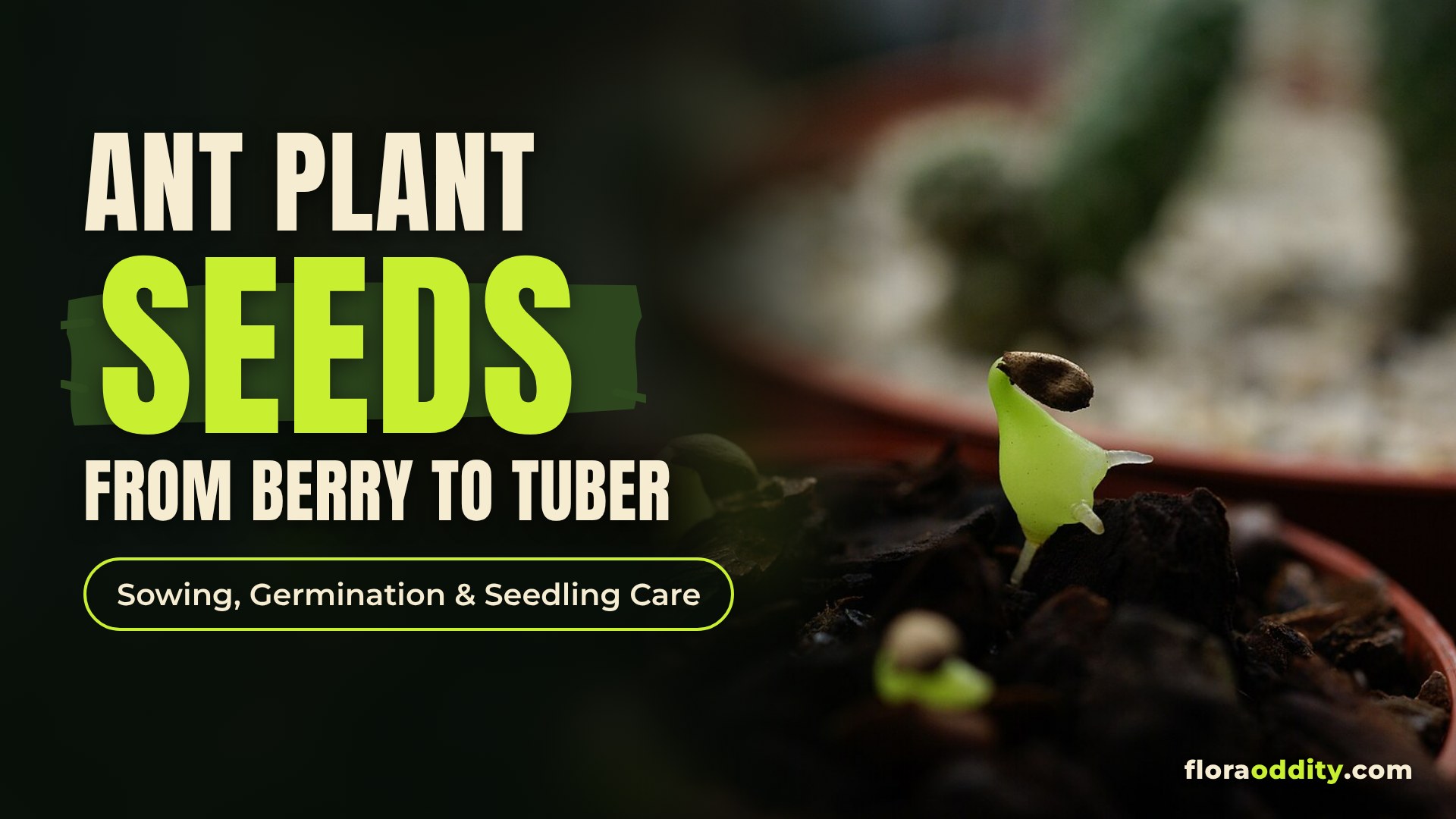
Yes, but cuttings will not give you the plant you probably want. LLIFLE notes that stem cuttings root and grow but do not form a tuber. The usual way to get new ant plants is from seed. Lok and Tan explain that both genera are self-pollinating, so a plant can set fruit without a pollinator, and LLIFLE adds that the seed stays viable only for a short time and should be sown on the surface of moist mix as soon as it is harvested. Our guide on how to grow ant plants from seed covers sowing, germination, and seedling care step by step.
Common Mistakes
- Watering onto the caudex. Water the mix around it instead.
- Using ordinary potting soil. It stays too dense and wet for an epiphyte.
- Watering on a schedule. Check the mix first, and water much less in winter.
- Burying the caudex. Keep most of it above the surface.
- Putting it in harsh midday sun. Bright, filtered light is the target.
- Letting it get cold. Cold drafts and cold windowsills lead to leaf drop.
- Rough repotting. The roots are brittle; move the plant with as little disturbance as possible.
- Expecting a cutting to form a caudex. Cuttings root, but only seedlings form the tuber.
FAQ: Ant Plant Care
Will an ant plant bring ants into my house?
No. Plants sold in nurseries are grown without ants, and indoors the chambers inside the caudex simply stay empty. The plant forms its chambers whether or not ants are present.
How big do ant plants get?
It depends on the species. Lok and Tan describe wild Hydnophytum formicarum tubers of 4 to 22 inches (10 to 55 cm) across, and the Hydnophytum revision records them up to about 24 inches (60 cm). Potted plants grow slowly and usually stay far smaller.
How often should I water an ant plant?
Water when the top of the mix has started to dry but before the whole pot dries out, and always let excess water drain away. PLNTS suggests that this typically works out to once or twice a week, depending on heat; in winter it will be much less often. Check the mix rather than following a fixed schedule.
Why is my ant plant dropping its leaves?
The most common causes are cold and drying out. LLIFLE notes that these plants are quick to shed leaves if they get too cold or too dry. Leaves that yellow while the mix stays wet point to overwatering instead.
Can I grow an ant plant from a cutting?
A stem cutting can root and grow, but it will not form the swollen, chambered caudex. To grow a new plant with a tuber, start from seed.
The Bottom Line
Ant plant care comes down to respecting the caudex. It is a water store built for life on a tree branch, so give the plant bright, filtered light, a fast-draining orchid style mix, warmth, and generous humidity, and water the mix around the caudex only when the top has started to dry. Hydnophytum is the more forgiving of the two genera, while Myrmecodia likes steadier moisture and humidity. And you can forget about the ants: your plant will build its chambers without them.
Sources & Further Reading
- Lok, A. F. S. L. and Tan, H. T. W. (2009). Tuberous, epiphytic, rubiaceous myrmecophytes of Singapore. Nature in Singapore 2: 231 to 236
- Huxley, C. R. and Jebb, M. H. P. (1993). The tuberous epiphytes of the Rubiaceae 5: A revision of Myrmecodia. Blumea 37: 271 to 334
- Jebb, M. H. P. and Huxley, C. R. (2019). The tuberous epiphytes of the Rubiaceae 7: A revision of the genus Hydnophytum. Blumea 64: 23 to 91
- LLIFLE Encyclopedia: Hydnophytum formicarum
- PLNTS: Hydnophytum care
- Paraíso Plant Studio: Ant Plant Hydnophytum care
- Araflora: Myrmecodia beccarii
- Jungle Leaves: Myrmecodia tuberosa
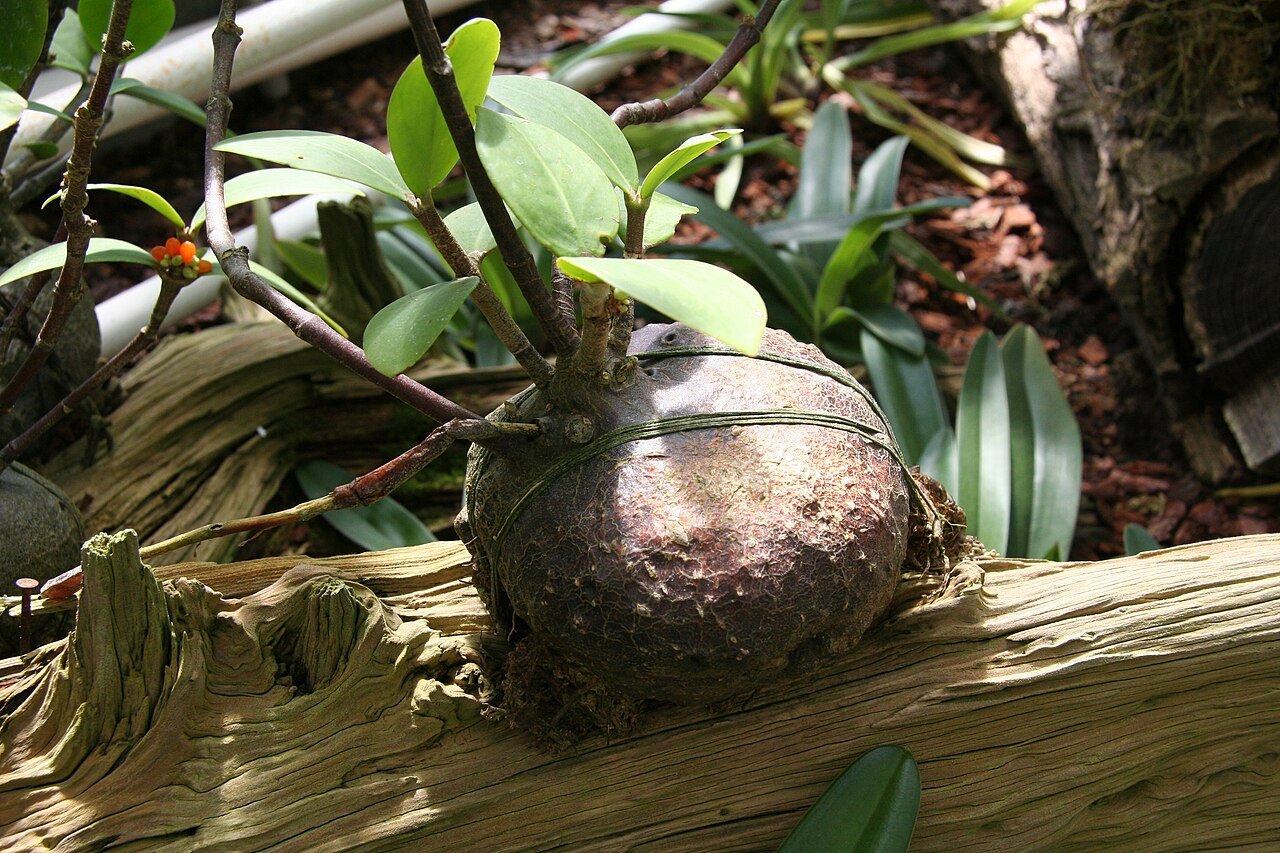
Featured image based on a photo of Hydnophytum formicarum by Krzysztof Ziarnek (Kenraiz) via Wikimedia Commons, CC BY-SA 4.0, with cropping and typography added by FloraOddity; the featured image is shared under the same license.
Final articles are editorially reviewed and factual claims are checked against cited sources. Last reviewed: October 2026.
6 Comments