
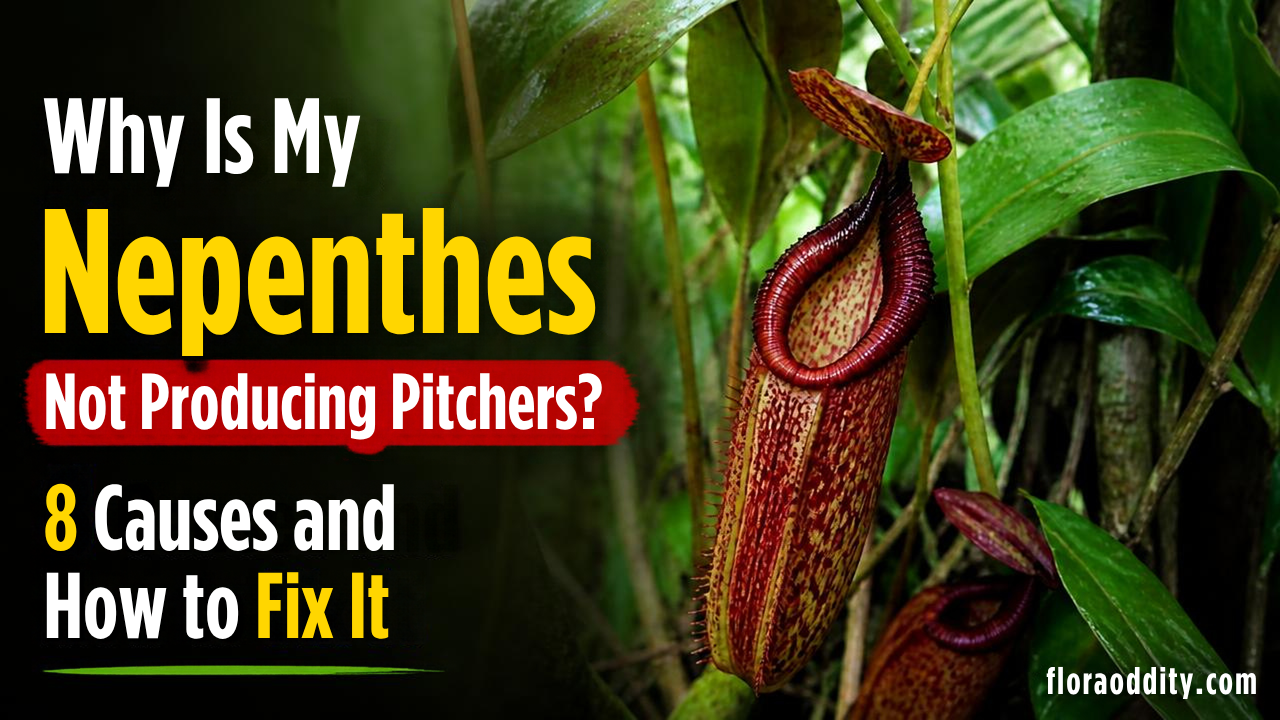
A Nepenthes can keep producing new leaves while barely producing any pitchers. That can be frustrating when the plant still looks healthy and appears to be growing normally.
A lack of pitchers does not automatically mean the plant is dying. A Nepenthes can continue growing leaves even when its current environment is not ideal for pitcher development, so the better question is not simply “what is wrong with my plant?” but “what changed in its growing conditions?”
Start with the basics before making major changes. Check the light, temperature, recent environmental changes, and the condition of the roots and growing medium. Humidity can matter too, but it should not automatically become the first thing you blame.
Why Is My Nepenthes Growing Leaves But No Pitchers?
This is one of the easiest Nepenthes problems to misread.
A plant can keep producing new leaves without producing pitchers at the same pace. Pitchers develop from the tendril at the end of a leaf and go through several stages before becoming recognizable traps, including curving, elongation, inflation, and maturation. Research on Nepenthes rafflesiana and other species shows that pitcher formation is a gradual developmental process rather than something that happens overnight.
That means a Nepenthes can be growing without necessarily pitchering well.
If the new leaves look healthy but pitchers have stopped appearing, don’t immediately assume the plant needs more fertilizer, a humidity dome, or a new pot. Look at the environment first.
The timeline matters too.
A plant that stopped producing pitchers immediately after shipping, repotting, or being moved to another room is a different case from a plant that has been in the same spot for six months and has slowly declined.
Start there.
Watch: Troubleshooting a Pitcherless Nepenthes
Want to see the same problem discussed from a grower’s perspective? Sarracenia Northwest has a video specifically about troubleshooting a pitcherless Nepenthes, covering light, temperature, airflow, root health, acclimation, and tendril support.
Video: Troubleshooting a Pitcherless Nepenthes: 6 Things to Check, Sarracenia Northwest
The 3 Things to Check First
Before you start repotting or building a humidity chamber, check the environmental basics.
1. Is Your Nepenthes Getting Enough Light?
Light is one of the first things worth investigating when a Nepenthes stops producing pitchers.
Sarracenia Northwest lists insufficient light as one of the most common reasons they encounter in pitcherless Nepenthes. Clemson Extension also recommends bright, diffused light and identifies low light as a common reason for poor pitcher production.
This doesn’t mean every Nepenthes needs the exact same amount of direct sun. Species, hybrids, climate, window orientation, and acclimation all matter.
What does matter is whether your plant is spending most of its day in weak light.
A Nepenthes tucked several feet away from a window in a dim room may stay green and continue producing leaves while struggling to develop pitchers. If natural light is limited, a suitable grow light can help.
Make changes gradually, though. A plant that has been sitting in low light can react badly to a sudden jump into intense direct sun.
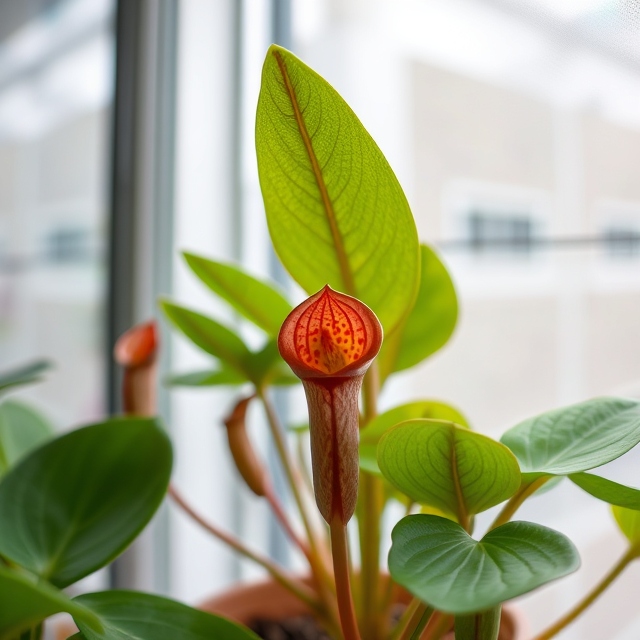
2. Is the Temperature Right for Your Nepenthes?
Not all Nepenthes want the same temperatures.
Lowland species generally tolerate warmer conditions, while many highland species prefer cooler temperatures and, in many cases, cooler nights. Hybrids can have broader tolerances. Clemson Extension and NC State Extension both distinguish among different Nepenthes growing types rather than treating the entire genus as one temperature group.
So before buying a thermometer and chasing a perfect number, figure out what kind of Nepenthes you actually have. Our guide to Nepenthes temperature for highland and lowland plants explains how to tell which type you have and what its nights should look like.
A warm room may be perfectly acceptable for one plant and stressful for another.
Temperature is especially worth investigating when the lack of pitchers comes with slower growth, declining foliage, or a noticeable change after the room conditions changed.
The goal is not to find one magic temperature.
The goal is to make your plant’s environment fit the plant you’re growing.
3. Is It Sitting Near an AC, Heater, or Strong Fan?
Your room can feel comfortable while the plant is sitting directly in a stream of hot or cold air.
Specialist growers specifically recommend checking whether a Nepenthes is positioned near air-conditioning or heating vents. Continuous hot or cold drafts can change the local temperature and moisture conditions around the plant, especially around delicate developing tendrils.
Air movement itself isn’t the problem.
Air movement is not the same thing as a direct draft.
A little airflow around the plant can be useful. A constant blast from an AC vent or heater is another story.
If new tendrils repeatedly dry out or fail near the same environmental conditions, check the plant’s position before assuming something is wrong with the soil.
5 More Reasons Your Nepenthes May Not Be Producing Pitchers
If the basic environmental conditions look reasonable, move down the checklist.
4. The Roots or Potting Medium May Be Stressed
A Nepenthes can have good light and suitable temperatures and still struggle if the root zone is unhappy.
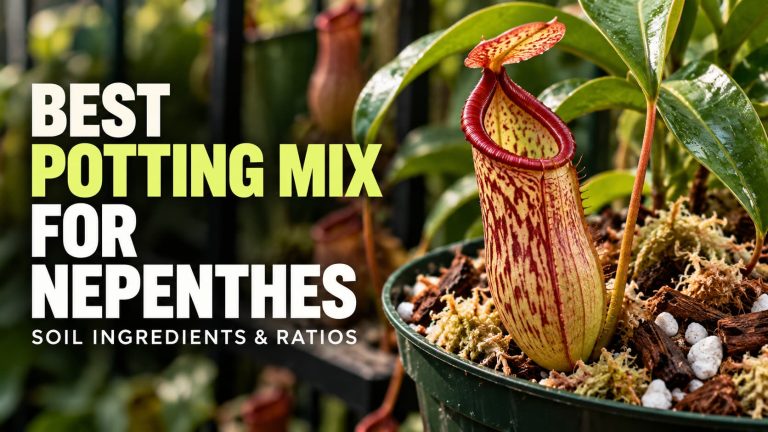
Nepenthes generally benefit from a loose, low-nutrient growing medium that holds moisture without becoming dense and airless. Clemson Extension recommends media using materials such as sphagnum, perlite or pumice, and orchid bark, while also emphasizing good drainage. Ordinary garden soil is not appropriate for Nepenthes.
Look at the medium itself.
Has it become compacted?
Does it stay saturated for a long time?
Does water drain differently than it used to?
Has the material broken down into a dense mass?
These are more useful observations than simply assuming “no pitchers = root rot.”
Watering matters here too. The goal is to keep the medium appropriately moist without leaving the roots in stagnant, waterlogged conditions for extended periods. For a practical routine covering water type, frequency, top watering, bottom watering, and drainage, see How to Water a Nepenthes Indoors: Water Type, Frequency, and Drainage.
For water quality, rainwater, distilled water, or reverse-osmosis water are conservative choices. Specialist guidance also shows that some commonly grown Nepenthes can tolerate water with more dissolved minerals than the strictest carnivorous-plant advice suggests, so tap water should not automatically be blamed for every pitcher problem.
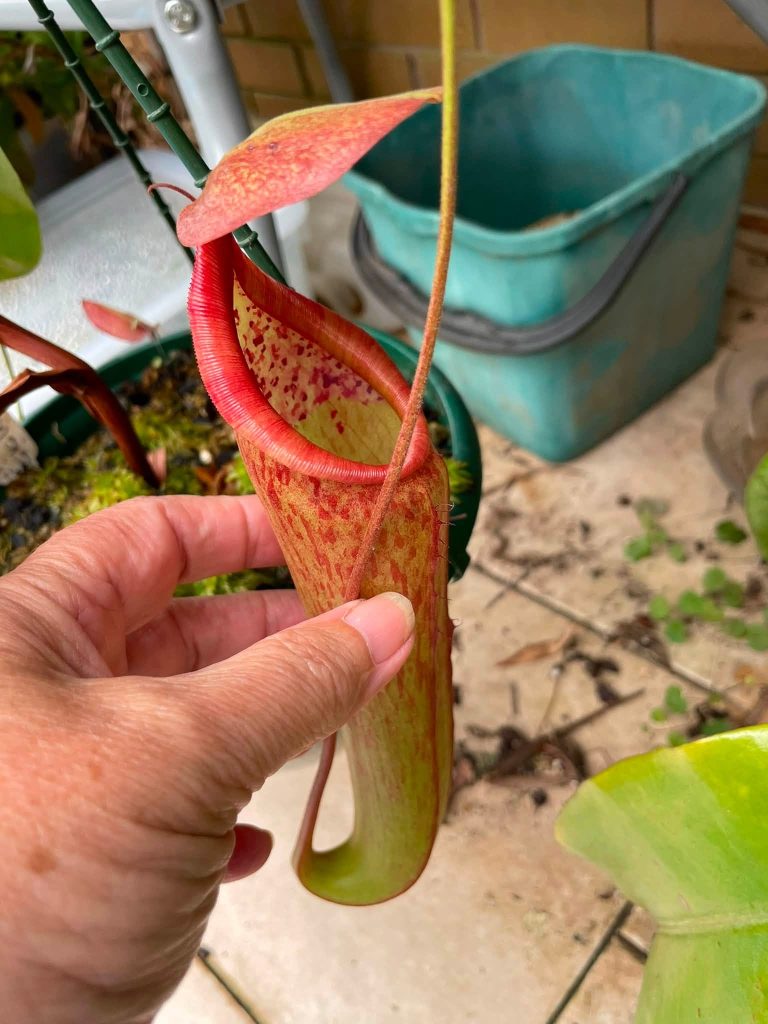
5. Your Nepenthes Is Still Acclimating
Start with the timeline.
Did the problem begin after the plant was shipped?
Did you just bring it home from a nursery?
Did you move it to a different room or window?
Did you repot it?
Any of those changes can temporarily affect pitcher production.
Specialist growers note that Nepenthes can stop or reduce pitcher production while adapting to new environmental conditions, with the recovery period varying between plants.
This is where people often make the problem worse.
A new plant arrives, loses its pitchers, and suddenly gets moved from room to room, placed under a grow light, covered with a humidity dome, repotted, and given a new watering routine.
That’s a lot of change at once.
If the plant is otherwise healthy, stability is often a better starting point than constant intervention.
6. Humidity May Matter, but Don’t Blame It Automatically
Humidity gets blamed for a lot of Nepenthes problems.
It can matter. It just isn’t always the first thing to fix.
Clemson Extension recommends humidity above 60% and identifies low humidity as one possible reason for poor pitcher development.
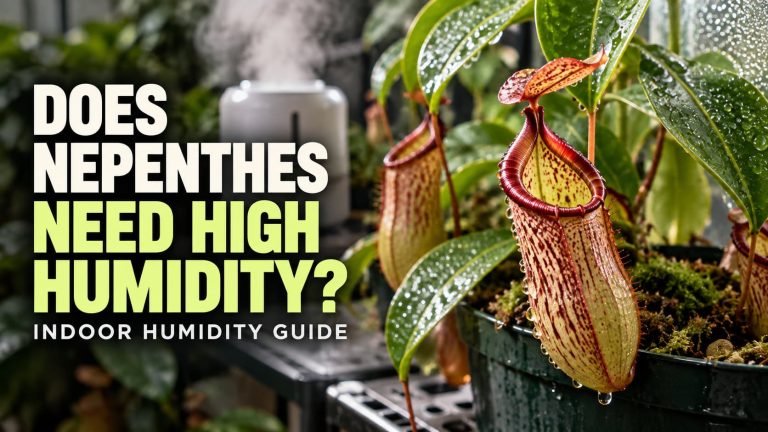
Sarracenia Northwest takes a more flexible position for many commonly cultivated Nepenthes, arguing that plants can acclimate to ordinary household humidity and that light, temperature, watering, and root health should be investigated before humidity is automatically treated as the main cause. They also discuss humidity as a factor that may influence pitcher size. For a deeper look at the humidity question, read Does Nepenthes Need High Humidity? Indoor Humidity Guide.
So the practical takeaway is simple:
Humidity matters, but context matters too.
A very dry room may justify increasing humidity. A commonly grown Nepenthes in a normal household may not need a sealed humidity dome to produce pitchers.
A dome can raise humidity, but it can also reduce airflow and keep the growing medium wet for longer.
If you’re considering one, look at the whole environment instead of treating humidity as a magic switch.
7. Recent Repotting or Root Disturbance May Have Set It Back
Repotting can solve problems.
It can also create a new one.
Clemson Extension recommends minimizing root disturbance when repotting, while specialist growers note that significant root disturbance can temporarily interrupt pitcher development.
This is particularly relevant when the timing lines up:
The plant was making pitchers.
You repotted it.
Pitcher production stopped.
That doesn’t automatically mean your new medium was wrong.
The plant may simply be recovering.
If you recently repotted the plant and the rest of its growth still looks reasonable, resist the temptation to repot it again just because a new pitcher hasn’t appeared yet.
8. A Mature Vining Nepenthes May Benefit From Tendril Support
This is not the first thing to check.
It’s something to consider after the basics look good.
Nepenthes pitchers develop from tendrils at the end of their leaves. Specialist growers have observed that some mature, vining plants appear more likely to develop pitchers when those tendrils encounter nearby support. At the same time, they describe this as a variable factor rather than a universal requirement.
So don’t build a complicated trellis because one tendril failed.
Look at the plant’s growth habit instead.
If your Nepenthes is actively vining, otherwise healthy, and producing long unsupported tendrils, giving those tendrils something natural to rest against is a reasonable experiment.
Don’t force them into position, though. Developing tendrils are easy to damage.
If the vine has grown far beyond its space instead, you can cut it back and root the top as a new plant. Our guide on how to propagate Nepenthes from cuttings explains where to cut and how the parent plant recovers.
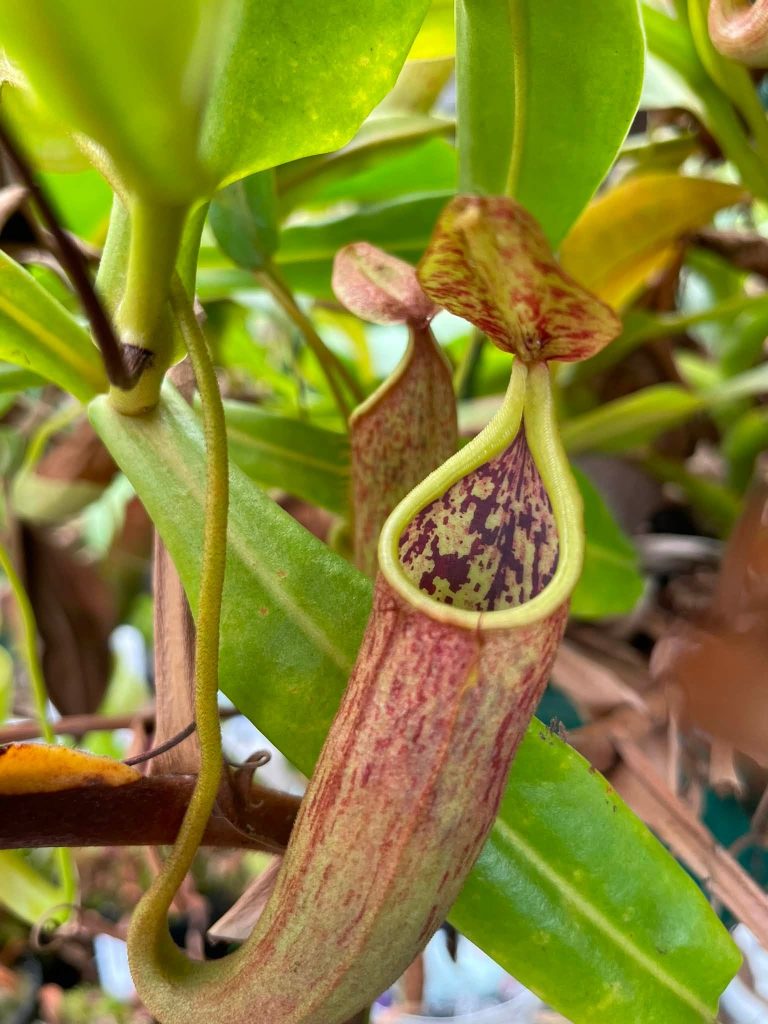
Start With What You Can Actually See
Sometimes the easiest way to troubleshoot a Nepenthes is to start with the symptom.
| What you see | Check first | What to consider |
|---|---|---|
| Healthy green leaves but no pitchers | Light | Is the plant receiving enough useful light? |
| New tendrils repeatedly dry up | Environment | Check light, temperature, drafts, and humidity |
| Problem began after shipping | Acclimation | Keep the environment stable |
| Problem began after repotting | Root disturbance | Avoid repeated repotting |
| Growth slows and older leaves yellow | Temperature / roots | Investigate both |
| Growing medium stays wet for a long time | Root zone | Check drainage and aeration |
| Mature vine keeps growing leaves but produces few pitchers | Overall conditions / support | Recheck the basics |
This table is a starting point, not a diagnosis.
A single symptom can have several causes, and sometimes more than one condition is contributing to the problem.
How to Get Your Nepenthes Producing Pitchers Again
Once you’ve identified the likely problem, fix the biggest issue first.
Don’t overhaul the entire setup.
Step 1: Improve the light
If the plant is clearly growing in weak light, address that before chasing more complicated explanations. Use a brighter location or suitable supplemental lighting, and make major changes gradually.
Step 2: Check the temperature
Find out whether you’re growing a lowland, highland, or hybrid Nepenthes and compare that with the conditions in your room.
Step 3: Remove harsh drafts
Move the plant away from direct AC, heater, or aggressive fan airflow while still allowing reasonable circulation around it.
Step 4: Inspect the root zone
Look at the medium, drainage, moisture level, and overall condition of the root environment before deciding that you need to repot.
Step 5: Keep conditions stable
This matters especially after shipping, moving, or repotting.
Step 6: Evaluate humidity in context
If your room is extremely dry, humidity may deserve attention. If the plant is otherwise doing well in ordinary household conditions, don’t assume a humidity dome is necessary.
Step 7: Give the plant time
This is the part that tests your patience.
Plants don’t respond to environmental changes on a two-day schedule.
And here’s the rule worth remembering:
Change one major variable at a time.
If you replace the soil, move the plant, install a grow light, add a humidifier, and change the watering routine on the same day, you may eventually see improvement. You also won’t know which change actually helped.
How Long Does It Take for a Nepenthes to Produce Pitchers?
Think in weeks, not days.
Pitcher development is a gradual process, and environmental stress can delay the point at which a new pitcher is initiated in the first place. Research has documented multiple stages in pitcher development, while specialist growers report that new pitchers may take several weeks to appear after environmental problems are corrected.
Sarracenia Northwest reports that when inadequate light is the main problem, new pitcher development can sometimes become visible within roughly 4 to 8 weeks after conditions are improved. They also note that recovery can take longer after shipping, root disturbance, or other stress.
That timeframe should be treated as a grower observation, not a guarantee.
Your plant may be faster.
It may be slower.
Species, hybrid, season, previous stress, and growing conditions can all change the timeline.
Is Your Nepenthes Actually Unhealthy?
No pitchers alone aren’t enough to diagnose an unhealthy plant.
The situation is less concerning when the Nepenthes is still producing healthy new leaves and there are no obvious signs of decline.
Be more concerned when pitcher loss comes with other problems such as widespread yellowing, sharply slower growth, persistent root-zone issues, repeated environmental stress, or other visible signs that the plant is deteriorating.
Also remember that old pitchers naturally die.
Clemson Extension notes that mature pitchers can turn brown or black as they reach the end of their lifespan. Losing an old pitcher is not the same thing as failing to produce a new one. If older pitchers on your plant are browning, our guide to why Nepenthes pitchers turn brown or dry up explains when that is normal.
Look at the whole plant, not just the pitchers.
What Growers Report
Forum threads and nursery Q&A posts include many growers dealing with the same problem: a Nepenthes that keeps growing but will not pitcher. Here is what a few of them said changed once pitchers started appearing again.
“In this past month, I’ve installed 18-inch T8 fluorescent lights in my little greenhouse above all my plants and the ones that were doing well are doing better, and the ones that weren’t pitchering are now doing so.”
Anonymous reader, Sarracenia Northwest Grower’s Q&A #71, April 2023
“I had a plant few years back which initially also refused to pitcher. After some months pitcher production resumed and the plant produced a pitcher on every leaf.”
Joachim Danz, Terraforums, May 2004
“From my experience, every time my conditions change suddenly (either humidity drop, temperature, or lighting) my plants take a month or two to adjust and in those times they do not pitcher and the old pitchers die off.”
zcons, Terraforums, January 2019
These reports line up with the causes covered above. The first is a light story: the grower changed the lighting over plants that were growing but not pitchering, and pitchers followed. The other two point to acclimation and stable conditions. A plant that has just arrived or has just had its environment changed may need weeks or months before it pitchers again, which is why the advice here is to fix the biggest issue first, change one major variable at a time, and then give the plant time instead of moving it, repotting it, or adding a humidity dome every time a new tendril fails.
What Not to Do When Your Nepenthes Stops Producing Pitchers
Don’t keep moving it around.
A new window can change light, temperature, airflow, and acclimation all at once.
Don’t repot it every time you get impatient.
Root disturbance can set pitcher production back.
Don’t jump from low light to harsh direct sun.
Increase light gradually.
Don’t assume humidity is the answer.
Humidity may matter, but it isn’t automatically the main problem.
Don’t change everything at once.
One useful correction is easier to evaluate than five simultaneous changes.
Your Nepenthes doesn’t need a panic response.
It needs a better environment and enough time to respond to it.
Frequently Asked Questions
Why is my Nepenthes growing leaves but no pitchers?
Start with light and the recent history of the plant. If it was recently shipped, moved, or repotted, acclimation may also be part of the problem. A Nepenthes can continue producing leaves even when conditions aren’t ideal for pitcher development.
How do I get my Nepenthes to produce pitchers again?
Check light, temperature, drafts, root conditions, and recent environmental changes first. Keep the environment stable and give the plant time to respond before making additional changes.
Does Nepenthes need high humidity to make pitchers?
Humidity can affect Nepenthes growth and pitcher development, but its importance depends on the plant and the rest of the environment. Some extension guidance recommends relatively high humidity, while specialist growers report that many commonly cultivated Nepenthes can acclimate to ordinary household conditions.
How much light does a Nepenthes need?
Nepenthes generally benefit from bright light, but the exact amount of direct sun depends on species, hybrid, climate, and acclimation. Avoid treating one number as a universal requirement for the entire genus.
How long does it take for a Nepenthes to make a pitcher?
There is no universal timetable. Specialist growers report that new pitchers can sometimes become visible within roughly 4 to 8 weeks after certain environmental problems are corrected, but stressed or recently disturbed plants may take longer.
Can repotting stop a Nepenthes from producing pitchers?
Yes, at least temporarily. Root disturbance during repotting can set pitcher development back, particularly when the roots have been heavily disturbed.
Should I use a humidity dome for my Nepenthes?
Not automatically. A dome can raise local humidity, but it can also reduce airflow and keep the growing medium wet for longer. Consider the plant’s species, room conditions, and overall health before using one.
Should I cut off old Nepenthes pitchers?
Old pitchers naturally decline and can turn brown or black. Removing a clearly dead pitcher is reasonable, but an aging pitcher by itself is not evidence that the plant is failing to produce new growth.
Final Thoughts
A pitcherless Nepenthes can look like a problem that needs a dramatic fix.
Start smaller.
Check the light. Check the temperature. Look at what changed. Inspect the root zone. Think about humidity without automatically blaming it. Then give the plant time to respond.
A healthy-looking Nepenthes that is still producing leaves may simply be growing under conditions that aren’t encouraging pitcher development.
The goal isn’t to force a pitcher to appear tomorrow. It’s to give the plant the conditions in which it can produce one naturally.

7 Comments