
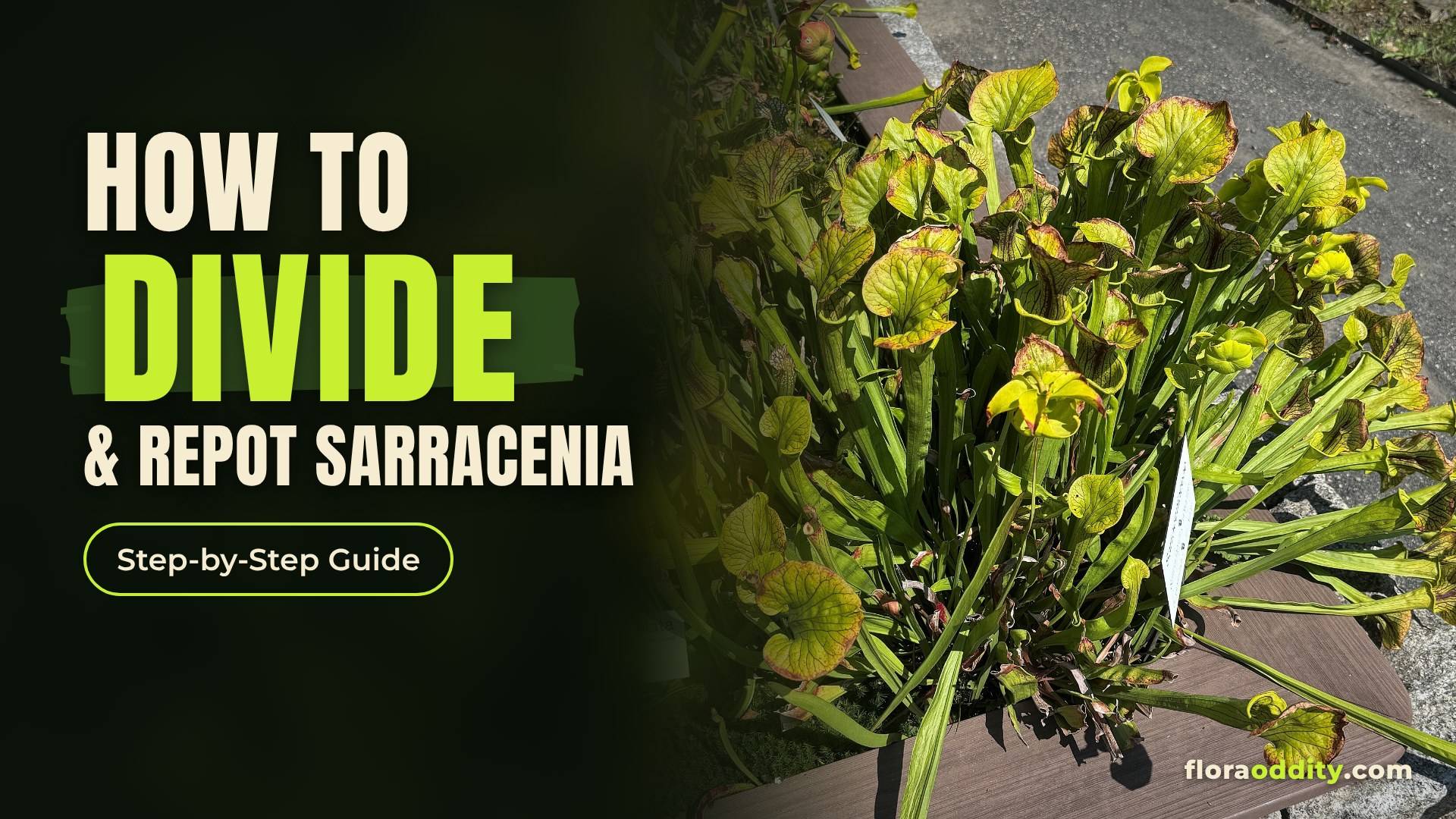
A happy Sarracenia does not stay in its pot for long. It grows from a thick underground stem, the rhizome, which branches and creeps until the plant is pushing against the pot wall and growing down the inside. The International Carnivorous Plant Society (ICPS) says “Well cared for Sarracenia need to be divided about every three years,” so sooner or later every grower has to tip a plant out and break it apart.
The job is simple and the plants are tough. This guide covers when to repot, how to divide Sarracenia into healthy pieces, how deep to plant them, and what recovery looks like. For light, water and dormancy, start with our Sarracenia care guide, and if you are not sure what you are growing, see which Sarracenia do you have.
The Short Answer
Repot or divide Sarracenia every 3 to 4 years, or sooner if the plant has filled its pot, at the end of winter just before new growth starts. Pull the plant out, find the weak, narrow points in the old rhizome and snap or cut it there, aiming for at least three growth points per division as the ICPS recommends. Peel off the old brown leaves, cut away any soft or brown rhizome, and replant each piece in a fresh, fertilizer-free peat mix with the growing point at or just above the soil surface. Put the pot straight back in its water tray and expect a slow first season.

| What you see | Verdict | What to do | Source |
|---|---|---|---|
| Just bought | Leave it | Do not repot a new plant; let it settle in; repot once it outgrows the pot | Barry Rice |
| Roots out of the holes | No rush | No emergency if the pot sits in a water tray; move up a pot size at the next spring repot | Sarracenia Northwest |
| Hit the pot wall | Divide | The rhizome is growing down the inside of the pot; divide just before spring growth starts | ICPS |
| Crowded clump | Divide | Weak growth in the middle, best pitchers at the edge; split into pieces with about three growth points each | ICPS |
| 3 to 4 years in old peat | Repot | Old peat breaks down and drains poorly; repot into fresh, fertilizer-free peat mix | ICPS, Carnivorous Plant Nursery |
| Potting soil or fertilizer | Repot now | Nutrients in the mix kill Sarracenia over time; wash off the old mix and replant right away | Barry Rice, California Carnivores |
| Crowded in midsummer | Wait | Trim floppy or brown leaves now; divide in early spring, or only in half now | Sarracenia Northwest |
| Zone 9 to 10 or greenhouse | Fall option | You can divide as the plants go dormant in late fall; cuts callus over winter, before spring growth | ICPS |
When to Repot or Divide Sarracenia
Not sure if it is time? Our repotting advisor checks the timing for your hemisphere and the signs that a plant has outgrown its pot.
Signs a pot is crowded
The clearest sign is a rhizome that has run out of room. In the ICPS step-by-step guide, John Brittnacher unpots a plant that “had already hit the edge and started growing down.” The nursery Predatory Plants looks for a plant “completely filling the pot” with “several large growth points.”
Crowding also shows in the pitchers. The ICPS says you “will get your best pitchers on the edge of the clump,” while in the middle “the rhizomes have a tendency to grow over each other resulting in weak growth.”
Roots growing out of the drainage holes are not a crisis on their own. Asked about exactly that, Jeff Dallas of Sarracenia Northwest, a specialist nursery, replied: “This is no big deal” for pots in water trays. “It just means that it’s time to increase your pot size.”
How often
The ICPS says division “is necessary every 3 or 4 years for well grown plants.” Sarracenia Northwest says to repot “every few years, or when the plant has outgrown its container.” Carnivorous Plant Nursery adds a soil reason: repot “every few years in a fresh CP soil mix, since the peat breaks down and can create poor drainage.”
Best timing: just before spring growth
On timing, the ICPS is blunt: “The best and only good time of the year to divide Sarracenia is just before the plants start growing in the spring. Watch the plants carefully and at the first hint they are growing, do the divisions.” Plants do survive division at other times, “but it can take them much longer to recover.” Sarracenia Northwest agrees on “Late winter to early spring, just before new growth begins.” For what the end of winter rest looks like, see the dormancy section of our care guide.
The ICPS rhizome rot page, by Mike Wang with John Brittnacher, adds that in USDA zones 7 and 8, where most Sarracenia overwinter outside, “it is probably best to wait to divide the outdoor plants until late winter after the time extended freezes occur.”
The mild-climate exception
Warm-climate growers have another option. The same ICPS page says: “If you live in a mild climate zone such as USDA climate zones 9 and 10 or have your plants in a greenhouse, divide in late fall right when the plants go dormant.” The reasoning is that over a whole winter the cut surfaces callus, so that by spring the plants are “protected better from pathogens and can focus their energy on growth, not healing.”
What about a plant you just bought?
Barry Rice, author of The Carnivorous Plant FAQ, tells new growers who want to repot a new plant just because they feel they should: “well, don’t.” It is already adjusting to your conditions. The exception is a plant in the wrong mix (see step 3 below).
What You Need
To work out how much of each ingredient your pots need, try our soil mix calculator.
Pot size and depth
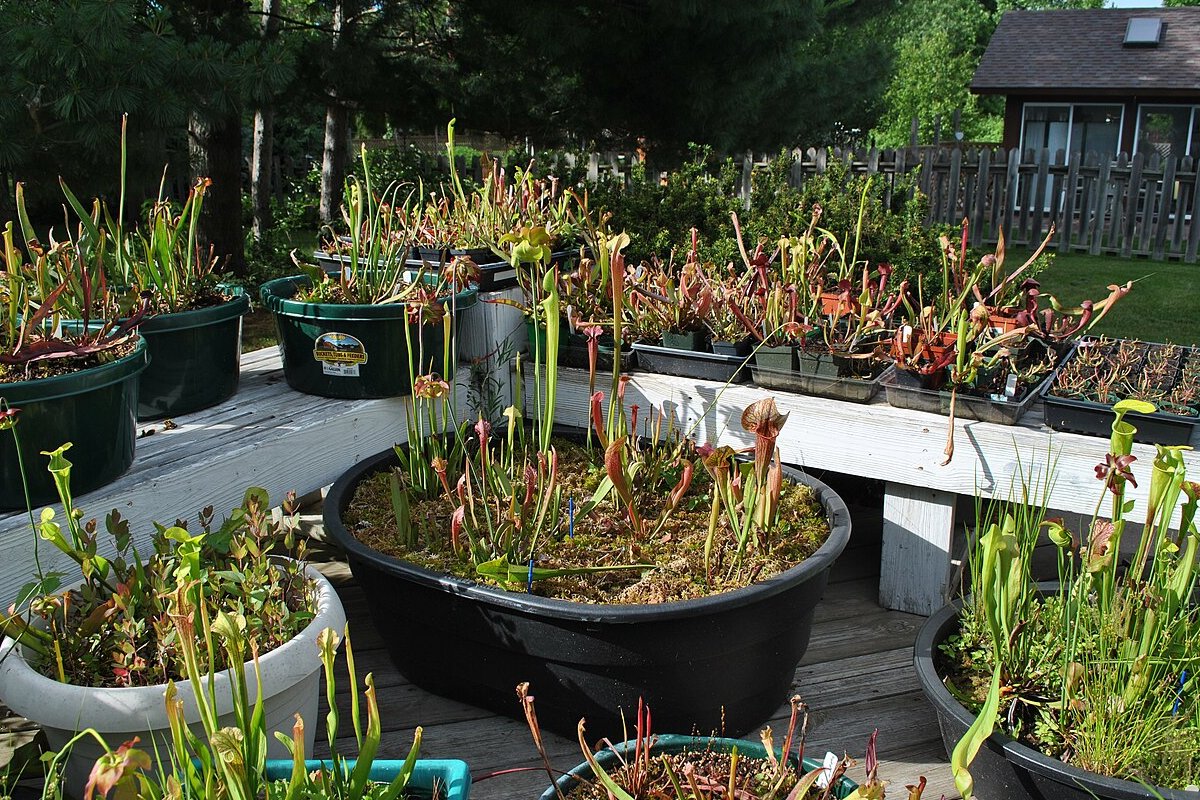
For mature plants, the ICPS says “pots 16 to 20 cm (6 to 8 in) wide work best.” Carnivorous Plant Nursery recommends “a deeper large pot” of 6 to 8 inches (15 to 20 cm) “because of their long roots.” For divisions, Phil Wilson of the UK Carnivorous Plant Society, writing for Tom’s Carnivores, sizes the pot to the rhizome: about 2 to 3 times its length, so the plant has room to make new growth. He suggests about 3 inches (7.5 cm) for small plants and 6 inches (15 cm) for larger ones, and warns that “the plant may struggle if the pot size is too big.”
Pot type and drainage
Rice recommends plastic pots, which “do not accumulate harmful impurities or salts,” with drainage holes “so you can flush water through the pot when necessary.” California Carnivores also accepts glazed ceramic but warns that unglazed terracotta pots “dry the soil out quickly” and may leach salts. To keep peat from washing out, the ICPS lays “some weed block cloth in the bottom of the pot,” and California Carnivores uses long-fibered sphagnum moss.
Soil mix
Every source agrees on peat moss plus a drainage material, with no fertilizer and no ordinary potting soil, whose nutrients and fertilizers, California Carnivores warns, “will kill them over time.” The ratios vary:
- ICPS: “standard 1:1 peat:sand CP mix,” or perlite instead of sand outdoors; its division guide uses 50:50 peat and perlite.
- Sarracenia Northwest: “1 part sphagnum peat moss to 1 part perlite.”
- Phil Wilson (Tom’s Carnivores): “About 3 parts peat or coir to one part perlite,” and “The ratio isn’t that important.”
- Carnivorous Plant Nursery: “3:1 peat:sand.”
- California Carnivores: “four parts fertilizer free peat moss to one part perlite.”
Wilson warns that perlite dust can be harmful: wet it when you open the bag and wear a dust mask.
Water and tools
Have pure water ready: Sarracenia Northwest recommends “rainwater, distilled water, reverse-osmosis water, or tap water below 50 ppm.” Brittnacher also uses “pruning shears and/or a knife,” plastic gloves, and plant tags written with a soft pencil.
Step by Step: Repotting Sarracenia
Use these steps when you only want to move a plant into fresh mix or a bigger pot. Wilson notes that a simple repot follows the same method as a division, “except that you won’t split the rhizome.”
1. Prepare the pot and mix
Moisten the mix with pure water. Wilson fills the pot so the mix is “slightly domed,” then presses it down gently; pressing too hard compacts it.
2. Lift the plant out
Brittnacher’s method is direct: “just grab the leaves and pull the plant out of the pot.” Predatory Plants says a dormant plant “can take a lot of abuse,” and a root-bound one may need “some serious shaking.”
3. Decide how much old soil to remove
If the old mix was good and you are only moving up a pot size, Rice’s “gentle method” keeps the root ball whole: dig a hole about the size of the old pot, set the plant and its soil in, and firm it. He reserves washing the roots clean for problems such as a plant “repotted by some oaf in ‘potting mix’,” fertilizer damage, or pests at the roots. Predatory Plants, which divides at the same time, does wash the soil off, by dunking the plant “repeatedly into a 5-gallon bucket of water” (about 19 litres).
4. Clean the rhizome
Remove dead leaves properly; the ICPS rot page says to “pull them off like you would pull off an artichoke bract.” Division steps 3 and 4 below cover old leaves and rot.
5. Plant at the right depth
Make a hole with your finger “about as deep and as long as the roots,” as Wilson puts it; if it is hard for your finger, it will be hard for the roots. Set the growing point at or just above the surface (see division step 5), firm the mix and add a label.
6. Water in and return to the tray
Predatory Plants top-waters “a few times to settle the soil around their roots.” Then put the pot back into its water tray. Wilson notes that the loose new mix “will draw water in quite quickly,” so check the tray and top it up.
Step by Step: How to Divide Sarracenia
Dividing follows the repotting steps above, with the rhizome split between steps 3 and 5. Rice describes the principle: each new plant needs “a growing tip, a hunk of plant base (usually a rhizome), and its own roots.”
1. Find the weak points
Brittnacher lets “the plant tell me where it wants to be divided”: he grabs large chunks of the clump and works them back and forth “to find an area where the old rhizome is weak or small.” Predatory Plants snaps growth points off “using a bending motion,” and Wilson notes the rhizome “is fairly brittle and will break easily enough.” A very vigorous plant may need pruning shears or a large knife, and the ICPS finds cut points easier to spot once the plant is cleaned.
2. Keep enough growth points per division
The ICPS likes “at least three growth points on each division,” because “The plants recover much better and you have nice pitchers the first year with three growth point divisions. If you divide to single growth points the plants struggle for the first year or two.”
Other growers split smaller. Predatory Plants separates every growth point, making sure “each piece has roots emerging from the bottom,” and Wilson says “You can even pot a rhizome piece without any roots!” The trade-off is the slower recovery the ICPS describes.
3. Clean off old leaves
The ICPS says to “carefully peel off the old leaves,” leaving any that resist, “But do make sure you remove all the old brown leaves,” because “The thatch of leaves at the base is an excellent breeding ground for mealybugs.” Brittnacher then gives the divisions “a hair cut.” Wilson cuts off old pitcher remains for another reason: they “can hide areas of rot in the rhizome.”
4. Inspect for rot and pests
Lay the divisions out and, as the ICPS puts it, “Look for soft spots on the rhizomes and creatures.” Wilson explains that rhizomes “naturally rot from the old end,” which can spread under the stress of a repot. The ICPS rot page is strict: “Cut off dead rhizome ends until all brown material is gone. Even if it’s a little brown spot in the middle surrounded by good tissue, get rid of it.” For more on rot and pests, see common problems in our care guide.
5. Orient the rhizome and set the depth
Carnivorous Plant Nursery compares Sarracenia to irises: “The rhizomes are planted with some top exposure.” Its advice on direction is to “Plant near the edge of the pot with the growing tip pointed to the center of the pot, so that the rhizome has room to grow.”
On depth, Wilson keeps “the main part of the rhizome around soil level” and angles it slightly “so that the growing point is just clear of the soil,” which “minimises the chance of fungal infections.” When a Sarracenia Northwest customer asked whether the rhizome should go above or below the soil, Dallas answered that the existing soil line was “exactly where it should be” and that “The growing point of the rhizome should be above the soil.”
6. Pot up and water
The ICPS fills the pot halfway, sets the plant at its final height, waters, then fills the rest and waters again, adjusting the height as needed. Label every pot.
Aftercare: The First Season
Keep it wet. The ICPS says pots “should always be sitting in about 4 to 6 cm of water” (about 1.5 to 2.5 inches) and that Sarracenia “should never be allowed to dry out.”
Keep it in full sun. Sarracenia Northwest wants “6 or more hours of direct sunlight each day.” When dividing, Dallas of Sarracenia Northwest cuts off all the pitchers so that sunlight can reach the new growth, which he says helps the plant form tall, well-formed pitchers.
Deal with flowers. The ICPS notes that flowers usually appear “slightly ahead of or with the first pitchers.” Dallas says a plant “at least one year from division” can bloom, but on a recent division, “definitely cut the flower off.” Predatory Plants removes emerging flower stalks on new divisions, “since they demand a lot of energy from the newly separated plant.”
Do not fertilize the soil. The ICPS rot page lists soil fertilizer on adult plants as a main cause of rhizome rot. Rice found that transplant-shock products had no effect at all in his “large-scale, controlled experiments.”
What recovery looks like. Wilson says “it will take about a year for the plant to recover,” with pitcher growth and colour “often temporarily reduced.” A three-growth-point division should still give “nice pitchers the first year,” according to the ICPS, whose photo series ends with the plant five months later.
Warning signs. Watch for sudden collapse. Wilson calls any pitchers “that suddenly die” “a sure sign of a problem,” and says a cold, wet spring can make rot more likely. The ICPS advises isolating any sick plant immediately.
Other Ways to Propagate Sarracenia
Division gives plants that are, as Predatory Plants puts it, “genetically identical to the original.” There are a few related methods:
- Rhizome segments. Predatory Plants cuts long pieces of rhizome with no growth points into segments of 2 to 3 inches (5 to 8 cm); “As long as each segment has its own root system, they will produce new growth points.”
- Rhizome cuttings (“nicking”). Carnivorous Plant Nursery uncovers the upper half of a large, healthy rhizome and slices about halfway into it with a sharp, fresh single-edged razor blade, repeating “at several points about 1 inch apart” (2.5 cm). New buds appear at the cuts within a few weeks and can be separated once they have their own roots.
- Leaf pullings. Rice notes that “Some Sarracenia can be propagated via leaf pullings, surprisingly enough.” Carnivorous Plant Nursery says it works “sometimes.”
- Seed. NC State Extension lists division and seed as the recommended methods. Seed is slower: the ICPS says the flowers “do not self pollinate,” so you must pollinate them yourself; the seed needs about 4 weeks of cold, damp stratification; and “It takes at least 4 years to go from a just-pollinated flower to a mature, blooming plant.”
Where Sources Differ
| Topic | One view | Another view | Documented context |
|---|---|---|---|
| Timing | ICPS: “the best and only good time” is just before spring growth | Phil Wilson: spring is best, but “with a bit of luck” virtually any time; Sarracenia Northwest: midsummer is possible if divisions stay large | ICPS says plants survive other times but take longer to recover; Dallas’s midsummer answer was for a crowded S. rubra in USDA zone 8b in July |
| Division size | ICPS: at least three growth points | Predatory Plants: every growth point with roots; Wilson: even rootless pieces | ICPS says single growth points “struggle for the first year or two” |
| Old leaves | ICPS growing guide: as a rule cut off only the brown parts of leaves | Sarracenia Northwest: “cut off all of the pitchers when you divide” | ICPS: plants recover nutrients from old leaves, though its own division walkthrough also gives divisions “a hair cut”; Dallas: cutting lets sunlight reach new growth |
| Old soil on the roots | Rice: keep the root ball in most repots | Predatory Plants: wash all soil off | Rice washes roots only for bad soil, fertilizer damage or root pests; Predatory Plants washes to expose the rhizome for dividing |
| Soil ratio | ICPS, Sarracenia Northwest: about 1:1 | Wilson, Carnivorous Plant Nursery, California Carnivores: 3 or 4 parts peat to 1 | Wilson says the ratio “isn’t that important”; Carnivorous Plant Nursery finds plants “grow better” with more peat |
| Flowers on divisions | Predatory Plants: remove emerging flower stalks | Sarracenia Northwest: cut only on recent divisions; Wilson: mainly on top-heavy pieces | Dallas: plants a year past division have “enough starch reserves” for flowers and leaves |
| Fall division | ICPS: late fall is fine in zones 9 and 10 or a greenhouse | ICPS: in zones 7 and 8, wait until late winter | Both views are from the same ICPS page and depend on climate |
Common Mistakes
- Repotting a new plant straight away. Rice’s advice for a new plant is not to, unless it is in a bad mix.
- Using potting soil or fertilized peat. California Carnivores says the nutrients and fertilizers will kill Sarracenia over time.
- Splitting into single growth points. They survive, but the ICPS says they struggle for a year or two.
- Leaving old leaves and brown rhizome. They shelter mealybugs and hide rot.
- Burying the growing point. Keep the growing point at or just above the soil surface.
- A pot that is far too big. Wilson warns that the plant may struggle.
- Forgetting the tray. Put the pot straight back in its water tray; the ICPS says Sarracenia should never be allowed to dry out.
FAQ: How to Divide Sarracenia
Can I divide Sarracenia in summer?
You can, but it is not ideal. Dallas of Sarracenia Northwest says a midsummer division should be kept as large as possible, ideally just splitting the plant in half, because small pieces may not recover in time for next year’s growth. His preferred plan: trim the plant hard in summer and divide in early spring.
How many growth points should each division have?
The ICPS recommends at least three, because those divisions “recover much better” and give nice pitchers in the first year. Smaller pieces can grow, but more slowly.
Should the rhizome go above or below the soil?
Mostly at soil level, with the growing point just above the surface. Carnivorous Plant Nursery compares it to planting an iris, with some of the top exposed, and Sarracenia Northwest says the growing point “should be above the soil.”
Can I reuse the old soil?
Brittnacher writes in the ICPS guide that “You can reuse the old soil or put it in your garden,” though he used new soil himself. Carnivorous Plant Nursery repots into fresh mix because old peat breaks down and drains poorly.
The Bottom Line
To divide Sarracenia well, wait until the end of winter, when the plant shows the first hint of growth, and work with the rhizome rather than against it: worry the clump apart at its weak points, keep about three growth points per piece where you can, strip the old leaves, and cut away anything soft or brown. Plant each division in fresh, fertilizer-free peat mix with the growing point at the surface, put it straight back in the tray, and give it full sun. Then be patient: Phil Wilson expects about a year for a repotted plant to recover, so judge the job by next season’s pitchers.
Sources & Further Reading
- International Carnivorous Plant Society: Dividing Sarracenia Step-by-Step
- International Carnivorous Plant Society: Growing Sarracenia
- International Carnivorous Plant Society: Sarracenia Rhizome Rot
- International Carnivorous Plant Society: Growing Sarracenia from Seed
- Barry Rice, The Carnivorous Plant FAQ: How do I replant my new carnivorous plant?
- Barry Rice, The Carnivorous Plant FAQ: What kind of pot should I use?
- Barry Rice, The Carnivorous Plant FAQ: How do I propagate my plants by asexual reproduction?
- Sarracenia Northwest: Sarracenia Care
- Sarracenia Northwest: Q&A 134, Can I Divide Sarracenia in Summer?
- Sarracenia Northwest: Q&A 54, Should a Sarracenia Rhizome Go Above or Beneath the Soil?
- Sarracenia Northwest: Q&A 142, Sarracenia Roots Growing Out of the Pot
- Sarracenia Northwest: Q&A 78, Should I Cut Off Sarracenia Flowers?
- Phil Wilson for Tom’s Carnivores: Divide and repot Sarracenia pitcher plants
- Predatory Plants: How to Divide and Repot Sarracenia
- Carnivorous Plant Nursery: Growing Tips for Sarracenia
- Carnivorous Plant Nursery: Propagation
- California Carnivores: American Pitcher Plants (Sarracenia) Growing Tips
- California Carnivores: General Carnivorous Plant Growing Tips
- NC State Extension Gardener Plant Toolbox: Sarracenia
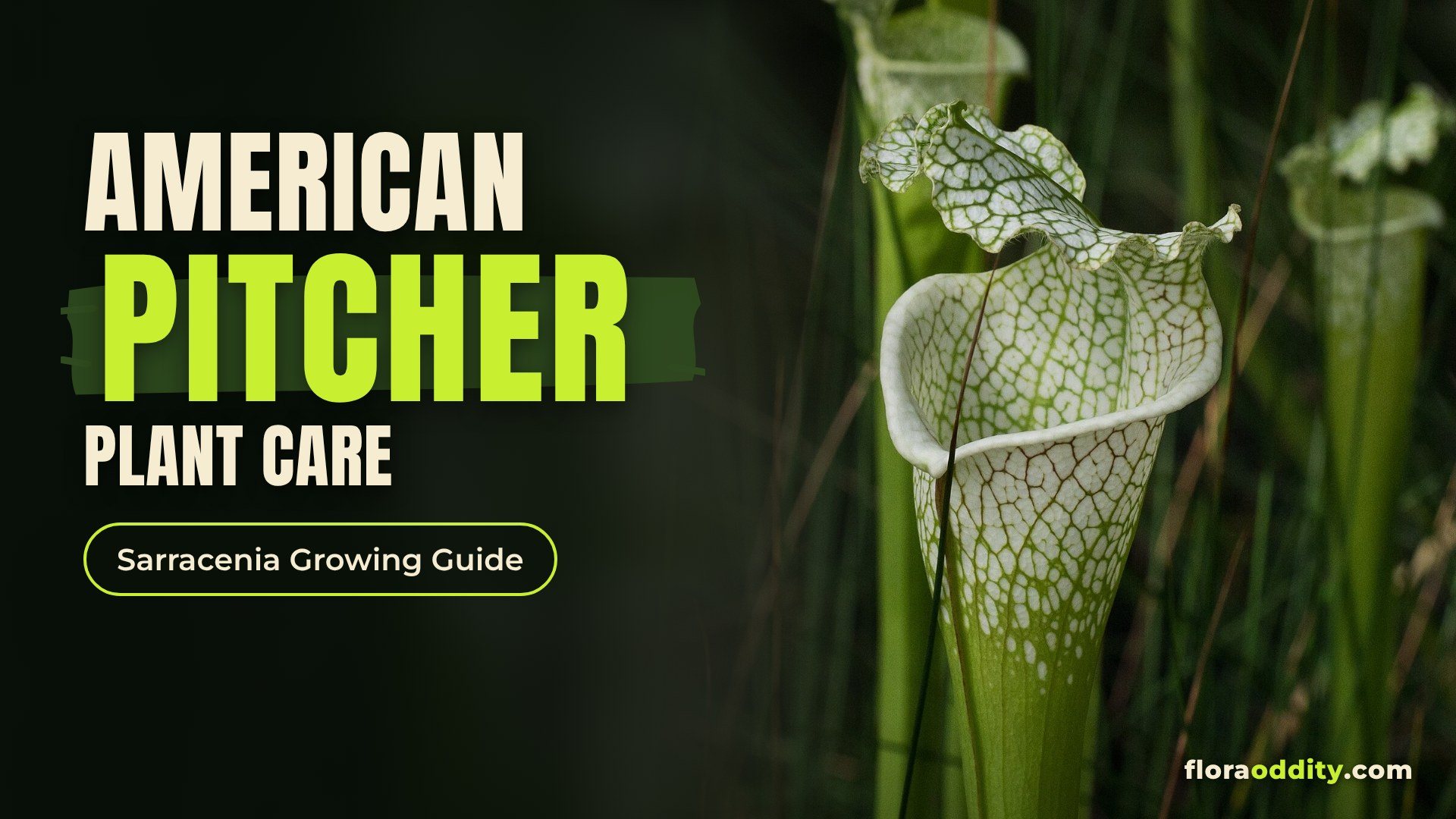
Featured image based on a photo of a pale pitcher plant (Sarracenia alata) by Dguendel via Wikimedia Commons, CC BY 4.0, cropped with a dark gradient and typography added by FloraOddity.
Final articles are editorially reviewed and factual claims are checked against cited sources. Last reviewed: October 2026.
2 Comments