
Few carnivorous plants are as willing to multiply as sundews. The International Carnivorous Plant Society (ICPS) says some Drosera “are so easy to propagate by leaf cuttings you can’t help accidentally doing them,” and Carnivorous Plant Nursery says sundews “are easily propagated from leaf cuttings, root sections, divisions, and seeds.” The catch is that the best method depends on which kind of sundew you grow. A leaf from a Cape sundew can sprout plantlets in a jar of water, while the same trick rarely works on a pygmy or tuberous species.
So before you cut anything, check your plant’s group in our sundew care guide. This guide covers every common way to propagate sundews, step by step.
The Short Answer
For most subtropical sundews, such as D. capensis, take leaf cuttings or root cuttings while the plant is growing well. Float a healthy, dewy leaf tentacle side up in pure water in a closed jar, or lay it on wet peat or sphagnum at very high humidity, and wait anywhere from about a month to five months for plantlets. Root cuttings of thick-rooted species such as D. capensis, D. binata, D. aliciae and D. adelae are faster: plantlets can appear within a few weeks. Seed of subtropical sundews is sown on the surface at about 68 to 77 °F (20 to 25 °C) with no cold spell, while cold temperate seed needs about 4 weeks of cold first. Pygmy sundews are propagated from gemmae in late autumn and early winter, and tuberous sundews from seed or by dividing tubers while they are dormant.
Which Method Suits Which Sundew
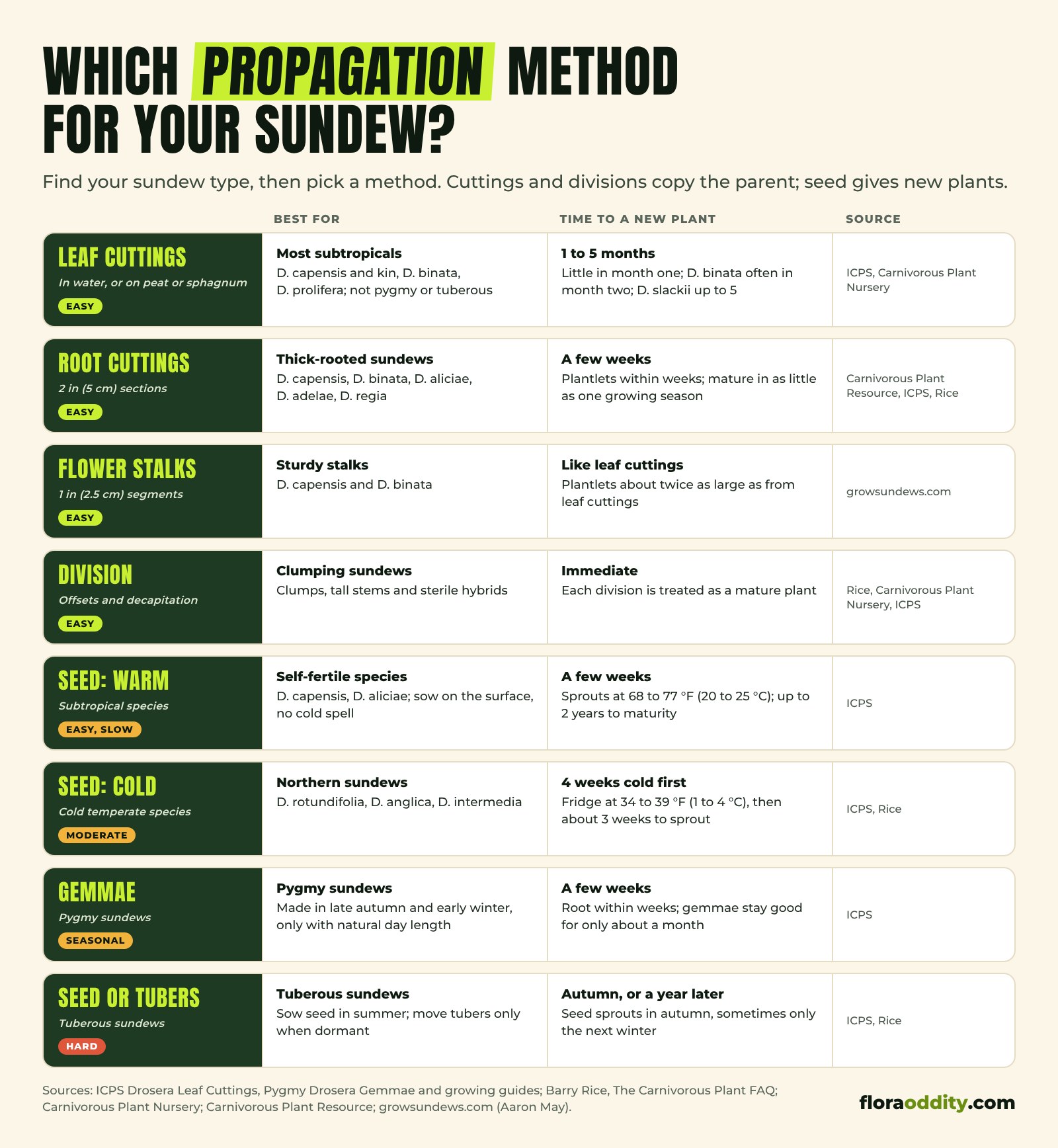
The ICPS sums up the speed order for subtropical sundews: “Root and stem cuttings will give you new mature plants relatively quickly. Leaf cuttings are not as quick but faster than seeds.” Every cutting or division gives an exact copy of the parent, while seed gives new individuals.
| Method | Best for | Time to a new plant | Difficulty | Source |
|---|---|---|---|---|
| Leaf cuttings (in water, or on peat or sphagnum) | Most subtropicals: D. capensis and kin, D. binata, D. prolifera; not pygmy or tuberous | 1 to 5 months: little in month one; D. binata often in month two; D. slackii up to 5 | Easy | ICPS, Carnivorous Plant Nursery |
| Root cuttings (2 inch, 5 cm, sections) | Thick-rooted sundews: D. capensis, D. binata, D. aliciae, D. adelae, D. regia | A few weeks: plantlets within weeks; mature in as little as one growing season | Easy | Carnivorous Plant Resource, ICPS, Rice |
| Flower stalk cuttings (1 inch, 2.5 cm, segments) | Sturdy stalks: D. capensis and D. binata | Like leaf cuttings; plantlets about twice as large as from leaf cuttings | Easy | growsundews.com |
| Division (offsets and decapitation) | Clumping sundews: clumps, tall stems and sterile hybrids | Immediate: each division is treated as a mature plant | Easy | Rice, Carnivorous Plant Nursery, ICPS |
| Seed, warm (subtropical species) | Self-fertile species: D. capensis, D. aliciae; sow on the surface, no cold spell | A few weeks: sprouts at 68 to 77 °F (20 to 25 °C); up to 2 years to maturity | Easy, slow | ICPS |
| Seed, cold (cold temperate species) | Northern sundews: D. rotundifolia, D. anglica, D. intermedia | 4 weeks cold first: fridge at 34 to 39 °F (1 to 4 °C), then about 3 weeks to sprout | Moderate | ICPS, Rice |
| Gemmae (pygmy sundews) | Pygmy sundews: made in late autumn and early winter, only with natural day length | A few weeks: root within weeks; gemmae stay good for only about a month | Seasonal | ICPS |
| Seed or tubers (tuberous sundews) | Tuberous sundews: sow seed in summer; move tubers only when dormant | Autumn, or a year later: seed sprouts in autumn, sometimes only the next winter | Hard | ICPS, Rice |
Leaf Cuttings
Leaf cuttings work for most rosette and forked-leaf sundews. The ICPS says they produce “exact clones of the parent plant” and “tend to produce mature plants quicker than from seed.” They are also the only way to copy a sterile hybrid: the ICPS shows Drosera x hybrida leaf cuttings in jars of water as “the only way to propagate this sterile hybrid.”
Choosing and cutting the leaf
Take cuttings when the plant is growing vigorously. The ICPS recommends leaves “that are fully open with lots of dew,” probably the best 3 or 4 leaves on each plant. Cut the leaf off along the petiole, the non-dewy stalk, with a razor blade or fine scissors. Long leaves can be cut into segments, and wide leaves cut lengthwise for more plantlets.
Method 1: Floating in water
The ICPS calls pure water “the cleanest medium for leaf cuttings.” Float the leaves tentacle side up in about 0.4 inch (1 cm) of distilled or reverse osmosis water in a small jar with a lid or plastic wrap, or seal them in a test tube. If the water turns cloudy, change it.
Method 2: On peat or sphagnum
You can also use live sphagnum, dried long-fibred sphagnum, peat, peat and sand, or sand. The ICPS says the leaves must be kept very wet and partly covered by the medium, in a bag or sealed container that keeps humidity at 100%. Carnivorous Plant Nursery lays the whole leaf right side up on moist, finely chopped green sphagnum and holds it flat with cheesecloth or toothpicks.
Light, warmth and waiting
Give the cuttings plenty of light without roasting them. The ICPS keeps them no closer than 12 inches (30 cm) to fluorescent lights, and Carnivorous Plant Nursery wants a warm but not hot place. Label and date every jar or pot.
Then wait. The ICPS says “Nothing much is going to happen for the first month or so.” D. filiformis and D. binata “may explode out fairly quickly the second month,” while D. slackii can sit for 5 months. Do not give up “if there is any green or red left on the leaves.” Plantlets may appear in surprising places: the ICPS saw D. spatulata sprout “Right out of the center of the leaf,” usually one plant per leaf, while D. prolifera sprouted near the edges even from leaves “that look like toast!”
Root Cuttings
Root cuttings are the quickest route for sundews with thick roots. Rice says they work “for many Drosera, especially those with thick ropy roots,” and the ICPS recommends them for D. regia, whose leaf cuttings are “particularly difficult.” Carnivorous Plant Resource says root cuttings can give mature plants “within as little as one growing season” and work well on rosetted subtropicals, D. regia, Cape sundews and forked sundews. The growsundews.com site, written by grower Aaron May, lists D. adelae, D. admirabilis, D. binata, D. capensis and D. falconeri, and says pygmy and annual sundews will not work. Carnivorous Plant Nursery adds that D. aliciae “easily makes leaf and root cuttings.”
- Pick the time. Carnivorous Plant Resource suggests the end of a dormancy period or early in the growing season, ideally when you are repotting anyway.
- Choose healthy roots. Unpot the plant and look for roots that are black with white tips. Leave plenty of roots on the parent. Aaron May warns that the plant should have at least a 2 inch (5 cm) root, or you may kill it.
- Cut sections. Carnivorous Plant Resource cuts the roots into 2 inch (5 cm) pieces with a knife or sharp shears.
- Plant them. Lay the pieces horizontally on the plant’s usual mix and cover them with 1/4 to 1/2 inch (0.6 to 1.3 cm) of soil. Aaron May says easy species such as D. adelae, D. aliciae and D. capensis can be buried an inch or more deep “and they will still pop up,” while fussier species do better on the surface. A root laid flat gives many small plants; a root planted upright gives “1 or 2 much larger plants.”
- Keep it humid, bright and out of the sun. Use a tray with a humidity dome and bright, indirect light. Carnivorous Plant Resource warns that direct sun risks “cooking your root cuttings.” Within a few weeks, plantlets should start to appear.
Flower Stalk Cuttings
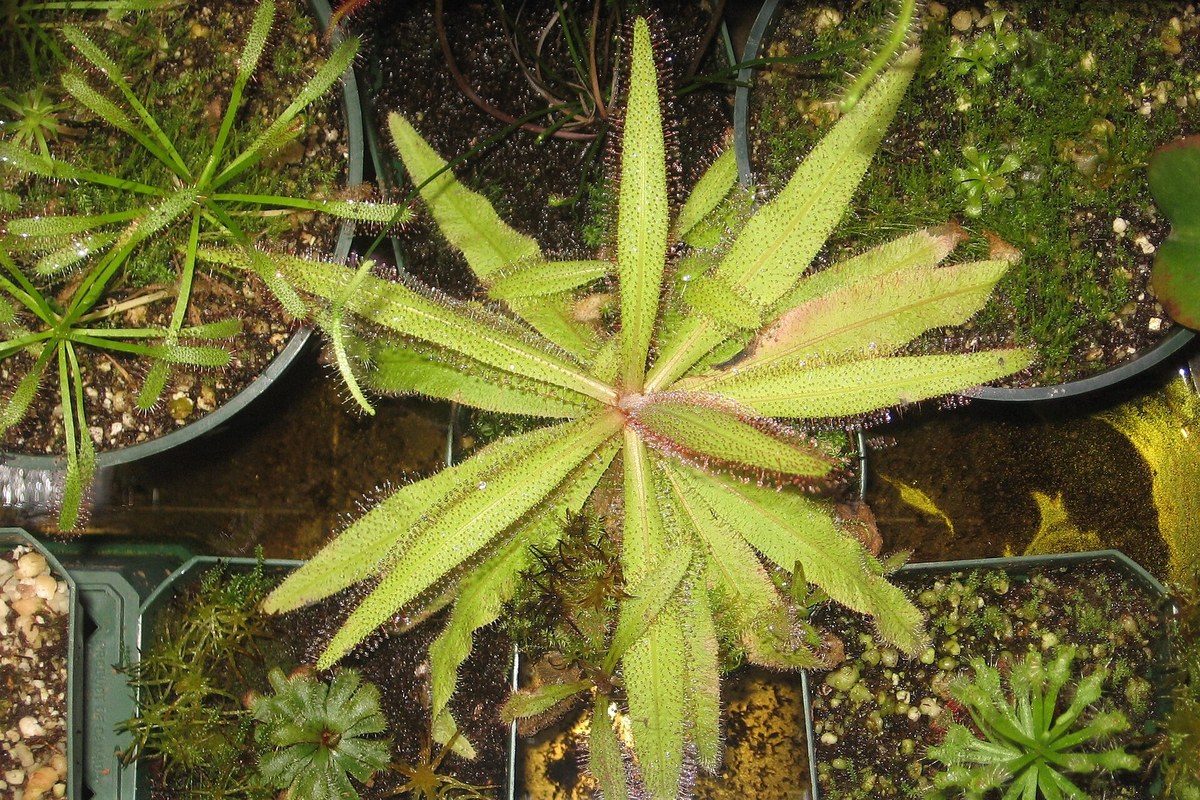
Flower stalks of the bigger sundews can be treated like leaves. Aaron May says the stalk “must be from a sundew that produces larger, sturdier stalks (i.e. D. binata or D. capensis),” cut into segments of 1 inch (2.5 cm) or longer. He reports that plantlets from flower stalk cuttings are “twice as large as normal leaf cuttings from the same” plant.
Some sundews also make plantlets on their flower stalks without help. Rice calls this false vivipary: it is abnormal on D. intermedia or D. anglica but “absolutely normal” for D. prolifera. Carnivorous Plant Nursery says that once such a plantlet has roots, it can be removed carefully and potted up.
Division, Offsets and Stem Cuttings
Clumping sundews divide themselves. Rice says plants that make daughter plants at the base can be separated and treated “as mature specimens.” Carnivorous Plant Nursery notes that D. aliciae “often produces clumps of plants from it roots.” Aaron May lifts the whole rootball, pulls the plants apart, and uses a razor where they are fused.
Carnivorous Plant Nursery also describes “decapitation”: cut the plant off at or just below the soil, press the top firmly into fresh mix, and the top roots while the old roots grow a new plant. Stem cuttings suit tall, stem-forming sundews: Aaron May roots the cut top of a D. madagascariensis stem in moist medium in a sealed container. Rice calls stem cuttings the usual method for Nepenthes, covered in our guide to propagating Nepenthes cuttings.
Growing Sundews From Seed
The easy subtropicals seed themselves. Carnivorous Plant Nursery says D. capensis can become “a wonderful ‘weed'” and that D. aliciae is self-fertile. Not every plant will set seed alone, though: the ICPS says most cultivated D. binata are sterile or self-incompatible.
Subtropical seed: no cold needed
Sow the seed on the surface of a wet peat and sand mix or sphagnum. The ICPS says “Don’t bury the seeds,” and to mist the surface lightly after sowing. Put the pot in a plastic bag under lights at about 68 to 77 °F (20 to 25 °C). The ICPS says the seeds “should germinate in a few weeks,” and that it “can easily take two years to get mature plants.”
Temperate seed: give it a winter
Rice explains that seeds of Drosera “from lands where snow falls each winter” must experience a cold spell to germinate well. The ICPS gives two options. The simplest is to sow in autumn and leave the pots outside; this is required for D. anglica, which needs bright light during stratification. Otherwise, mix the seed with wet, finely chopped sphagnum in a small bag and keep it in the refrigerator, between 34 and 39 °F (1 and 4 °C), for 4 weeks, or 6 to 8 weeks for D. linearis. Then spread the seed and moss over a pot of 50:50 peat and sand. In the ICPS example, stratified temperate seed “germinated in three weeks.”
Pygmy Sundews: Gemmae
Pygmy sundews make gemmae, tiny modified leaves with a growth bud and the stub of a root. The ICPS calls them “the easiest and for some hybrids the only way” to propagate pygmies, which it says are impractical from leaf cuttings. Plants produce gemmae in late autumn and early winter, but only with “sufficient seasonal light cues”; under a constant light cycle in a terrarium, they will not make them.
- Prepare tall pots. The ICPS uses 3.5 inch (9 cm) square pots 4 inches (10 cm) tall, filled with peat and 50% to 75% sand or perlite. Choose the pot the plants will live in for good, because pygmies have “one very long, very fragile root” and generally die if it breaks.
- Collect the gemmae. Tip the pot on its side and comb the gemmae into a scoop with forceps.
- Sow them. Place them on the surface, no closer than 0.4 inch (1 cm) apart, and lightly spray, or cover with a thin layer of sand first. High humidity for the first few weeks helps.
- Do not wait. The ICPS says gemmae stay good for only about a month: “They dry out and die quickly.”
A few weeks after planting, the red root stub grows into the soil and the small leaves start to look like real sundew leaves.
Tuberous Sundews
Tuberous sundews are the hardest group. The ICPS calls leaf cuttings impractical and says the tuberous species “are best done by seed or sterile culture.” Seed of winter-growing species must be sown in summer or early autumn, and many need warm stratification: in the northern hemisphere, sow by the first week of August and keep the surface damp. The ICPS says cold stratification “is NOT effective” here. In one ICPS account, seeds needed a month of daily highs above 86 °F (30 °C), then germinated when the weather cooled to around 64 °F (18 °C). Hard seeds of D. stolonifera and D. gigantea germinate better after light scarification with 100 grit sandpaper.
Use deep pots, about 6 inches (16 cm) deep, with 1:2 peat and sand, and if nothing comes up, the ICPS says, “do not throw out the pot!” Try again next winter. Established plants can be multiplied by tubers: Rice notes they “sometimes make daughter tubers below ground,” and the ICPS says tubers can be dug and replanted only while dormant, a month after die-back, at their original depth of about 2 to 4 inches (5 to 10 cm).
Caring for Baby Sundews
Potting plantlets from water. When plantlets have a few leaves, the ICPS plants them in their usual mix, such as peat and sand, and buries them “slightly with pure sand.”
Hardening off. Carnivorous Plant Resource removes the humidity dome after a few leaves appear and moves the plants into direct light, then gives the roots a few months before repotting. Carnivorous Plant Nursery says to acclimate new plants slowly to normal conditions.
Seedlings. The ICPS suggests leaving seedlings in their bags until they are big enough not to be killed by fungus gnat larvae, and transplanting them with fine forceps if moss or algae take over. Pygmy and tuberous seedlings are the exception: leave them where they are.
Feeding, not fertilizing. “Do not put fertilizer of any kind in the soil,” the ICPS says. Once seedlings are big enough, offer soaked dried bloodworms on dewy leaves; see how to feed a Venus flytrap for soaking. The ICPS says the hardest part is reaching that size, but “Once you can do that the plants should grow quite quickly.” Remember that species such as D. binata and the temperate sundews still need their normal dormancy once established.
Where Sources Differ
| Topic | One view | Another view | Why they may differ |
|---|---|---|---|
| Best leaf cutting medium | ICPS: pure water in jars or test tubes is cleanest, and leaves last longer | Carnivorous Plant Nursery: lay the leaf on chopped live sphagnum, pinned flat | Both methods are in use; the ICPS simply rates pure water as the cleanest medium |
| Where plantlets appear | Carnivorous Plant Nursery: “along the leaf margins” | ICPS: D. spatulata sprouts from the centre, usually one plant per leaf | It varies by species; the ICPS saw D. prolifera sprout at the edges |
| Pygmy leaf cuttings | ICPS: impractical; use gemmae | Aaron May: “great success” with leaf pullings of over 5 pygmy varieties | Pullings must include the stipule, and both agree gemmae are easier |
| Cold stratification length | ICPS: about 4 weeks; 6 to 8 for D. linearis | Carnivorous Plant Nursery: 6 to 8 weeks on one page, “3-4 months” on another | Species differ; the ICPS sowing guide allows 4 to 8 weeks |
| Root cutting depth | Carnivorous Plant Resource: cover with 1/4 to 1/2 inch (0.6 to 1.3 cm) of soil | Aaron May: surface for fussy species; easy ones can go an inch or more deep | Hardy species like D. capensis tolerate deeper burial |
Common Mistakes
- Taking leaf cuttings of pygmy or tuberous sundews. The ICPS says the thin leaves “tend not to make sprouts.” Use gemmae, seed or tubers.
- Using tap water. Float cuttings in distilled or reverse osmosis water, and change it if it turns cloudy.
- Throwing out cuttings too early. Some species take 5 months; keep any leaf that still shows green or red.
- Putting sealed containers in direct sun. The ICPS warns of “roasted seedlings,” and Carnivorous Plant Resource of cooked root cuttings.
- Transplanting pygmy plants. Their single long root breaks easily, so plant gemmae where they will stay.
- Cold-treating tuberous seed. These seeds want a warm summer spell, not a fridge.
FAQ: Propagating Sundews
What is the fastest way to propagate sundews?
Root cuttings or divisions, for species that allow them. The ICPS says root and stem cuttings give “new mature plants relatively quickly,” and Carnivorous Plant Resource calls root cuttings “the most effective way to propagate mature sundews quickly, followed by leaf cuttings, then traditionally sown seed.”
Can you propagate sundews in water?
Yes. The ICPS floats leaves tentacle side up in about 0.4 inch (1 cm) of distilled or reverse osmosis water in a closed jar or test tube, then pots up the plantlets once they have a few leaves.
Do sundew seeds need cold stratification?
Only seed of cold temperate species such as D. rotundifolia, D. anglica and D. intermedia. Subtropical seed is sown straight away at about 68 to 77 °F (20 to 25 °C), and tuberous seed needs a warm summer spell instead.
The Bottom Line
To propagate sundews, match the method to the group. Subtropical and forked-leaf sundews root readily from leaf cuttings in pure water or on wet peat or sphagnum, and even faster from thick root cuttings; flower stalks and divisions work too. Seed of subtropical species needs only warmth and humidity, while temperate seed needs about four weeks of cold first. Pygmy sundews are grown from fresh gemmae each autumn and winter, and tuberous sundews from summer-sown seed or dormant tubers.
Sources & Further Reading
- International Carnivorous Plant Society: Drosera Leaf Cuttings
- International Carnivorous Plant Society: Pygmy Drosera Gemmae Step-by-Step
- International Carnivorous Plant Society: Growing Subtropical Drosera
- International Carnivorous Plant Society: Growing Drosera binata
- International Carnivorous Plant Society: Growing cold temperate Drosera
- International Carnivorous Plant Society: Growing pygmy Drosera
- International Carnivorous Plant Society: Growing tuberous Drosera
- International Carnivorous Plant Society: Drosera Seed Scarification
- International Carnivorous Plant Society: Sowing Carnivorous Plant Seeds Step-by-Step
- Rice, B. The Carnivorous Plant FAQ: How do I propagate my plants by asexual reproduction?
- Rice, B. The Carnivorous Plant FAQ: How do I stimulate seeds to germinate?
- Carnivorous Plant Nursery: Propagation
- Carnivorous Plant Nursery: Growing Tips for Sundews
- Carnivorous Plant Nursery: Drosera capensis
- Carnivorous Plant Nursery: Drosera aliciae
- Carnivorous Plant Resource: Propagating Drosera via root cuttings
- May, A. growsundews.com: Propagating Sundews
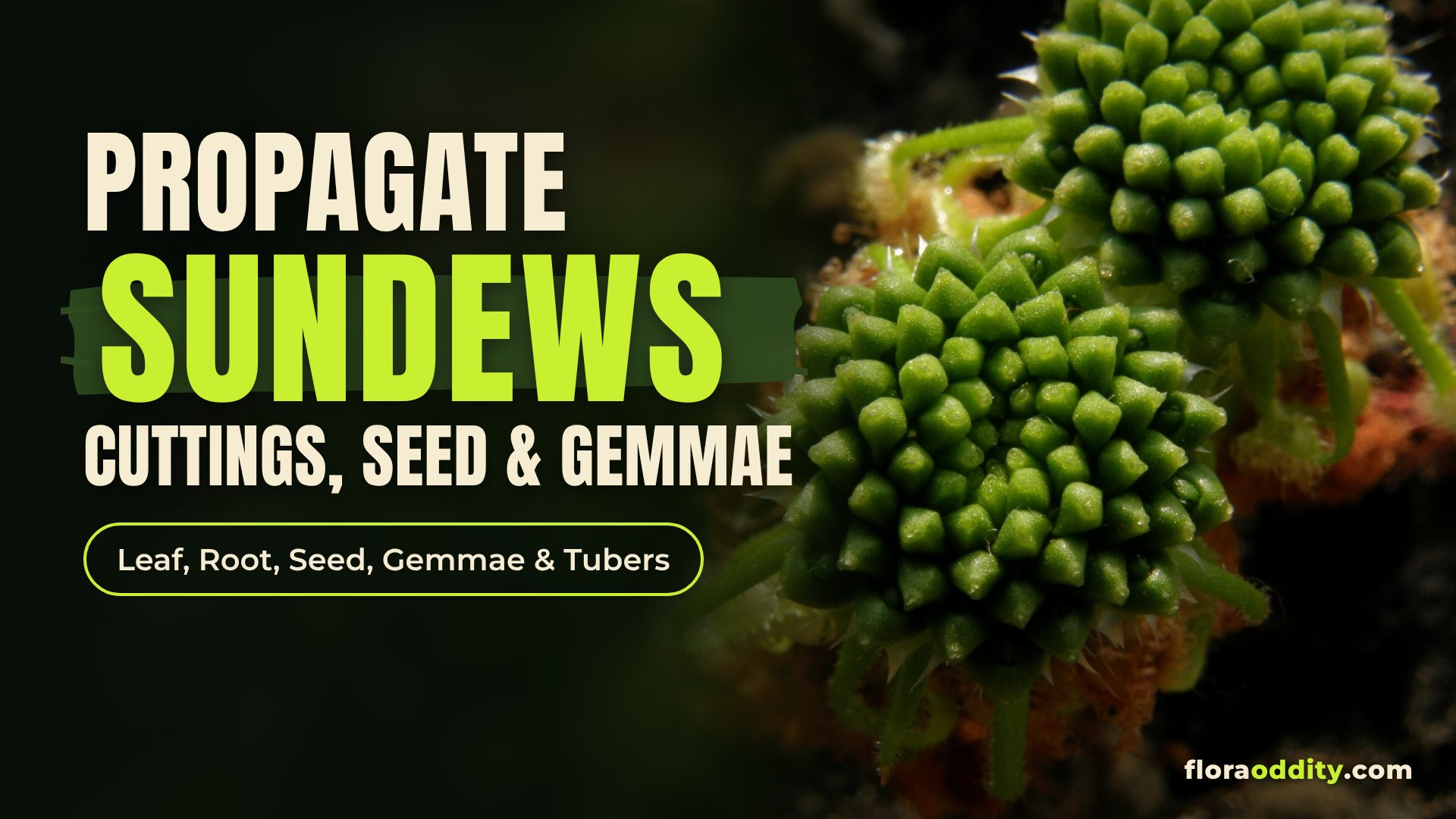
Featured image based on a photo of pygmy sundew gemmae (Drosera scorpioides) by Rosťa Kracík via Wikimedia Commons, CC BY 3.0 CZ, cropped with a dark gradient and typography added by FloraOddity.
Final articles are editorially reviewed and factual claims are checked against cited sources. Last reviewed: October 2026.




One Comment