
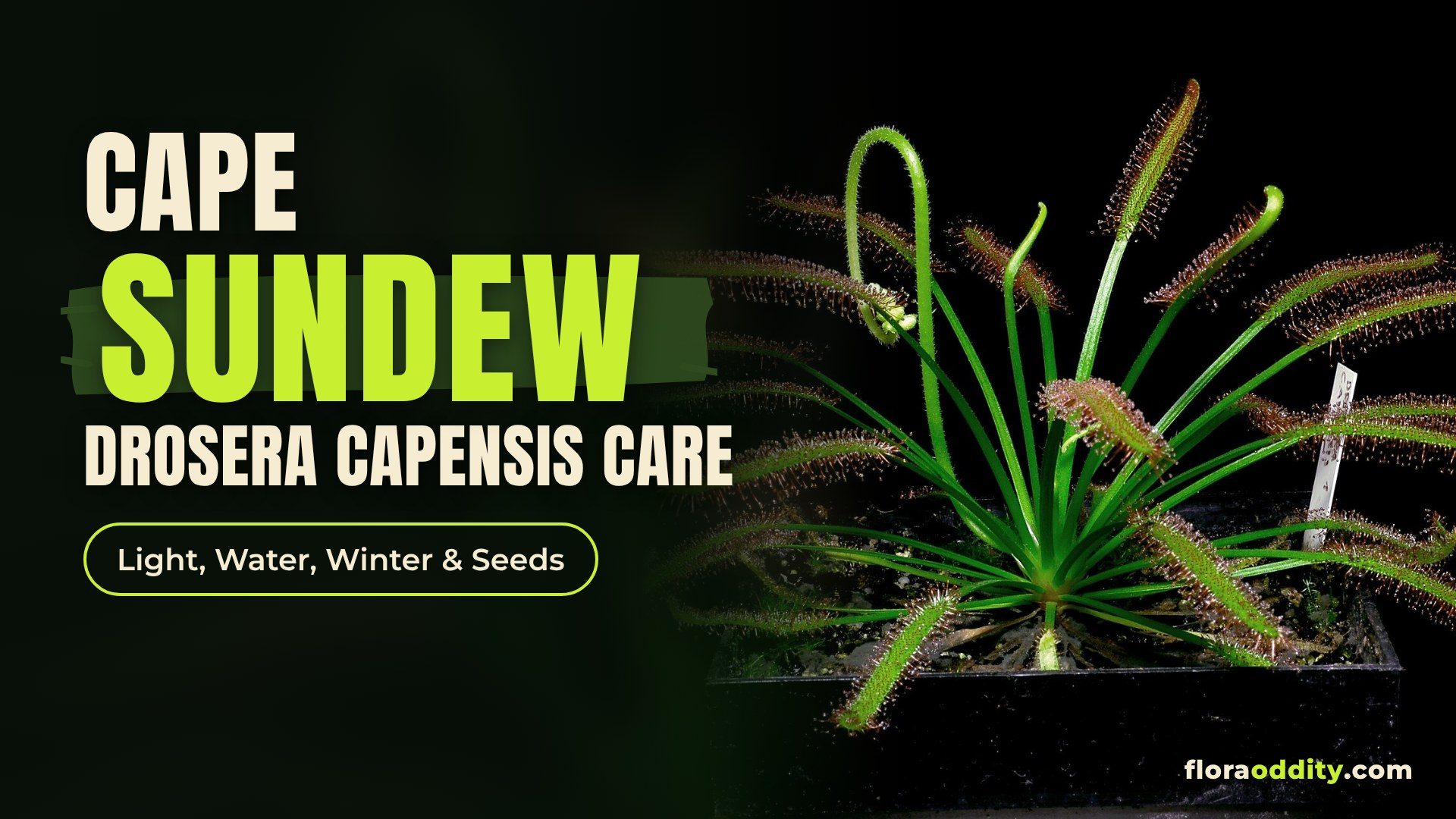
The Cape sundew is the plant most people mean when they say “a sundew.” Aaron May, who writes the growsundews.com grow guides, calls Drosera capensis “the most common sundew in cultivation, since it is so easy to grow (once it is given favorable conditions).” Carnivorous Plant Nursery rates it “Very Easy” and describes long, strap-like leaves “loaded with red tentacles.” It comes from wet bogs in the Cape region of South Africa, and it forgives a lot.
Cape sundew care is still worth getting right, because a happy plant looks completely different from a struggling one. This guide covers one species and its common forms. If you are not sure your plant is a Cape sundew, start with which sundew do you have in our general sundew care guide.
The Short Answer
Give a Cape sundew full sun or strong grow lights, and stand its pot in a tray of distilled, rain or reverse osmosis water so the peat-based soil never dries out. California Carnivores says it is happiest at 40 to 80 °F (4 to 27 °C), wants cooler nights than days, and needs no dormancy, although growth slows in winter and a frost kills the leaves back to the roots. Humidity is not critical; Aaron May suggests at least 50%. Outdoors it catches its own food; indoors, growers either feed insects or, like California Carnivores, mist the leaves with a weak foliar fertilizer once a month. Never fertilize the soil. Expect plenty of flowers and seedlings: Carnivorous Plant Nursery warns it can become “a wonderful ‘weed'” in a collection.
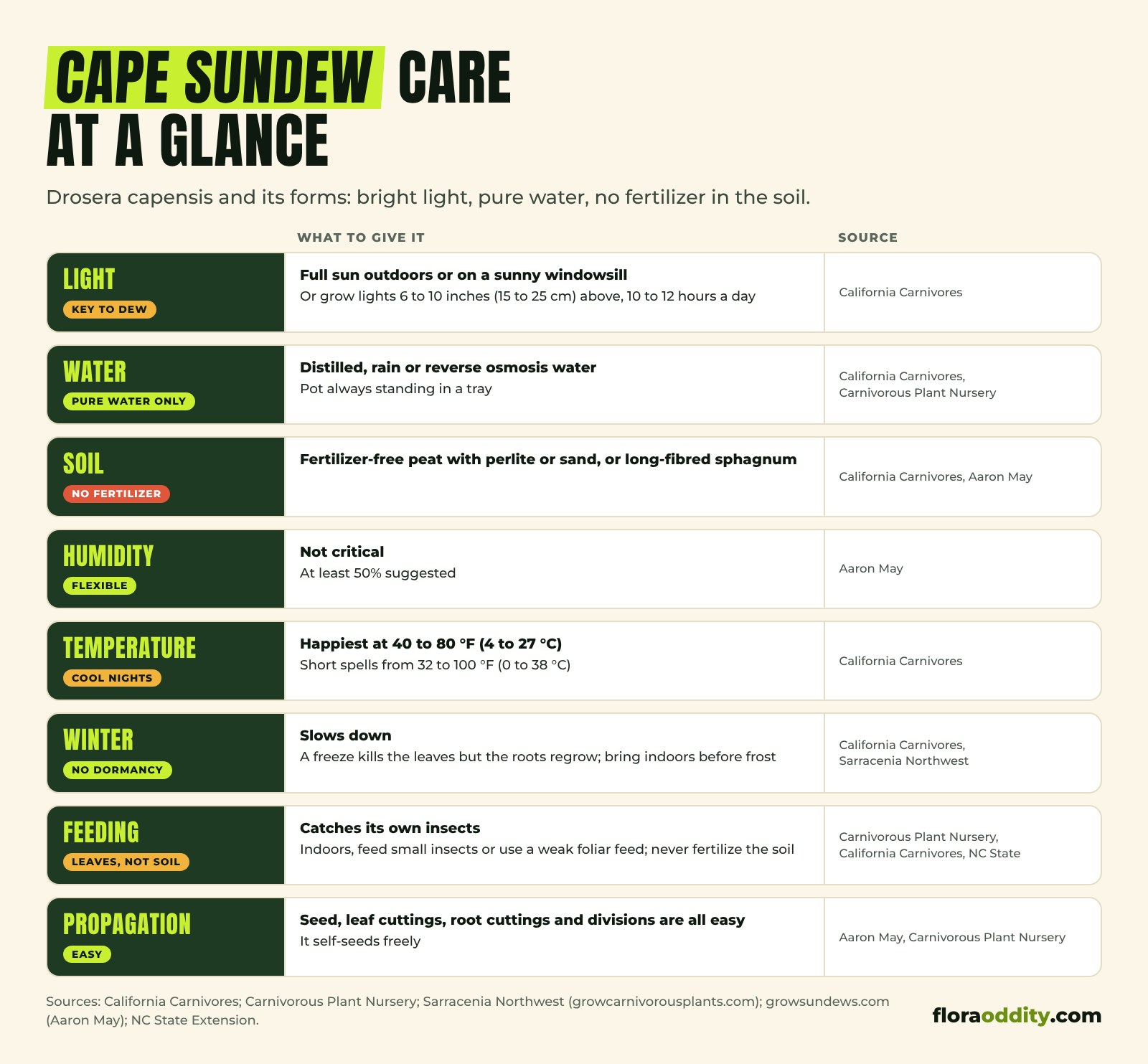
| Need | Key point | What to give it | Source |
|---|---|---|---|
| Light | Key to dew | Full sun outdoors or on a sunny windowsill; or grow lights 6 to 10 inches (15 to 25 cm) above, 10 to 12 hours a day | California Carnivores |
| Water | Pure water only | Distilled, rain or reverse osmosis water; pot always standing in a tray | California Carnivores, Carnivorous Plant Nursery |
| Soil | No fertilizer | Fertilizer-free peat with perlite or sand, or long-fibred sphagnum | California Carnivores, Aaron May |
| Humidity | Flexible | Not critical; at least 50% suggested | Aaron May |
| Temperature | Cool nights | Happiest at 40 to 80 °F (4 to 27 °C); short spells from 32 to 100 °F (0 to 38 °C) | California Carnivores |
| Winter | No dormancy | Slows down; a freeze kills the leaves but the roots regrow; bring indoors before frost | California Carnivores, Sarracenia Northwest |
| Feeding | Leaves, not soil | Catches its own insects; indoors, feed small insects or use a weak foliar feed; never fertilize the soil | Carnivorous Plant Nursery, California Carnivores, NC State |
| Propagation | Easy | Seed, leaf cuttings, root cuttings and divisions are all easy; it self-seeds freely | Aaron May, Carnivorous Plant Nursery |
Meet the Cape Sundew and Its Forms
A typical plant grows into a small, bushy clump. California Carnivores says Cape sundews grow to about 6 inches (15 cm) tall, “although some forms can be slightly larger,” and that older plants build up a thick black or brown stem and may “flop over and grow sideways.” Its leaves turn over quickly: the lower ones die from the base upwards while new leaves keep coming from the top. That is normal, and the dead leaves can be cut off.
Carnivorous Plant Nursery lists many forms in the trade, “red, white, narrow leaf, broad leaf, wide leaf, and giant,” and adds: “All are unofficial cultivars.” Three are worth knowing:
- Typical form. Green leaves with red tentacles and rosy-pink flowers, according to Carnivorous Plant Nursery.
- ‘Alba’ or white form. California Carnivores says ‘Alba’ “lacks red pigment (anthocyanin), so its tentacles aren’t red, and the flowers are white.” Carnivorous Plant Nursery describes it as an “all-over limey green” plant, slightly smaller than the typical form. Aaron May finds its tentacles turn light pink under strong light.
- Red forms. California Carnivores says its red form from De Kom, South Africa, turns bright red in full sun, grows slightly more slowly than other Cape sundews and has darker pink flowers on shorter stalks. In winter, it adds, these plants “can lose their red pigment and look quite green” until longer days return.
Care is the same for all of them, with one temperature exception for ‘Alba’ covered below.
Light: Windowsill or Grow Light
Light is the first thing to get right. California Carnivores asks for full sun and says that indoors on a windowsill the plant needs direct sunlight “for most of the day.” Its care notes say it plainly: “IF YOUR SUNDEW IS NOT PRODUCING DEW, IT MOST LIKELY NEEDS MORE SUNLIGHT.”
On a windowsill. Choose your sunniest window. Sarracenia Northwest, which sells Cape sundews through growcarnivorousplants.com, says “this plant grows best year round in a sunny windowsill.” Its white-leaf variety page is more cautious, recommending partial sun and “Avoid hot sunlight.”
Under grow lights. California Carnivores suggests hanging grow lights 6 to 10 inches (15 to 25 cm) above the plants on a 10 to 12 hour day. Aaron May grows his under T8 tubes on a 16 hour day. Both work; the point is strong, close light.
Outdoors. California Carnivores says outdoor plants “will enjoy a great deal of sun,” but in very hot places such as Arizona they need morning sun only or shade cloth. Move a plant outside gradually, over a day or two, and expect a few leaves to burn back at first; new leaves adjust to the sun. Outdoor plants may be smaller and more colourful, because the light is more intense.
Water and the Tray Method
Use only distilled, rain or reverse osmosis water. NC State Extension’s rule for sundews is to “always use rainwater or distilled water for irrigation,” and Sarracenia Northwest asks for low-mineral water of “50 ppm or less.”
The easiest way to keep the soil wet is the tray method. California Carnivores says Cape sundews should always sit “in a few inches of distilled, rain, or reverse osmosis water” and can stand in a deep saucer of water all the time. Carnivorous Plant Nursery keeps a shallower 1/2 to 1 inch (1.3 to 2.5 cm) of water in the tray through the growing season. Either way, refill the tray before it runs dry.
Aaron May notes that Cape sundews cope with drier soil fairly well, but he also warns that if the soil dries out completely in warm weather, the growth above ground will die. The tray takes that risk away.
Soil and Pots
Cape sundews are not fussy about soil, as long as it has no fertilizer in it. Aaron May has grown them in 1 part peat to 1 part sand, in pure long-fibred sphagnum, and in 1 part sphagnum to 1 part perlite, and advises rinsing the media first. California Carnivores uses four parts fertilizer-free peat moss to one part perlite, while Sarracenia Northwest uses equal parts peat moss and perlite for its white-leaf form. NC State Extension describes most sundews growing well in “a nutrient-poor, peat/sand mix.” California Carnivores warns that regular potting soil will kill carnivorous plants over time because of its nutrients and fertilizers.
Pick a reasonably deep pot. Aaron May recommends 4 inches (10 cm) or taller because the plant can grow a long, branching root system. California Carnivores suggests repotting every 1 to 3 years and sizing up only a few inches at a time. It also says not to repot a newly arrived plant for at least a year, and not in spring or summer. A swampy smell from fresh peat, it adds, is normal and not a sign of trouble.
Humidity
Humidity matters less for this species than for many sundews. Aaron May’s verdict is “not much needed. I’d recommend at least 50%.” Carnivorous Plant Nursery calls it “an excellent terrarium plant,” and California Carnivores lists a terrarium under lights as one way to grow it, so that is an option if your room air is very dry.
Temperature, Winter and Frost
California Carnivores says Cape sundews tolerate a wide range but are happiest at 40 to 80 °F (4 to 27 °C), and can take anything from freezing to 100 °F (38 °C) “only for short periods.” Aaron May has grown them well at 45 to 90 °F (7 to 32 °C).
They also like a cooler night. California Carnivores says the species “does need a nighttime drop in temperatures of 10-20 degrees,” which is a drop of about 10 to 20 °F (6 to 11 °C). If you live somewhere tropical with warm nights, it recommends the ‘Alba’ form, which can cope without that drop.
No true dormancy
Carnivorous Plant Nursery lists “Dormancy: No,” and California Carnivores agrees that Cape sundews “do not need a dormancy.” They still respond to winter. Carnivorous Plant Nursery says that in cooler temperatures the plant “stops growing, but holds its traps,” and California Carnivores says many plants slow down or grow smaller. Indoors on a bright windowsill or under lights, you can simply keep growing it all year, which is what Aaron May recommends. Plants that do take a seasonal rest are covered in the dormancy section of our sundew guide; the Cape sundew is not one of them.
Frost and freezing
Sarracenia Northwest puts it clearly: “Cape sundews are not truly hardy.” It treats them as “cool-growing tropicals” and keeps them in a greenhouse in the 50s °F (10 to 15 °C) at night and the upper 60s °F (about 19 to 21 °C) by day in winter. Its white-leaf page says to “always protect from frost.”
The roots are tougher than the leaves, though. California Carnivores says a brief freeze kills the leaves back, but the plants regrow “readily from the roots” once daytime temperatures climb above 40 °F (4 °C). Sarracenia Northwest once forgot a pot of red Cape sundews outdoors; the pot froze solid during a week of 25 °F (minus 4 °C) weather, and the plants still came back from the roots in spring. It treats that as a lucky single case: “How much of a freeze they can withstand? We don’t know.” Carnivorous Plant Nursery reports a similar pattern in its zone 6 outdoor bog boxes, where the plant dies back in autumn and returns in spring.
So the safe plan in any area with frost is to bring the pot indoors to a bright, cool window for winter.
Feeding
Outdoors, Cape sundews feed themselves. California Carnivores says they catch fungus gnats, fruit flies and occasionally house flies, and adds: “When grown outdoors, they will catch plenty of food.” Carnivorous Plant Nursery says the leaves roll over the prey in about 30 minutes and digestion takes a few days.
Indoors, there are two approaches:
- Insects. Carnivorous Plant Nursery says plants indoors or in a terrarium “will benefit from supplemental feedings using wingless fruit flies or other very small insects,” and that sundews need feeding only a few times a month. Aaron May feeds his Cape sundews once every two weeks “for rapid, robust growth and flower production.”
- Foliar fertilizer. California Carnivores sprays MaxSea on the leaves once a month, diluted to 1/4 teaspoon per US gallon (3.8 litres) of water, on “the foliage only.”
Keep fertilizer out of the soil in every case. NC State Extension says simply “Do not apply fertilizers,” and California Carnivores tells growers to avoid pouring its foliar feed through the soil. Do not remove the dried insect remains either; California Carnivores says they “often serve as a lure to other insects.”
Flowering and Self-Seeding
Cape sundews flower freely. Carnivorous Plant Nursery describes rosy-pink flowers on “tall, multi-flowered scapes,” with one or two opening each day for several weeks, most heavily in summer. White forms have white flowers.
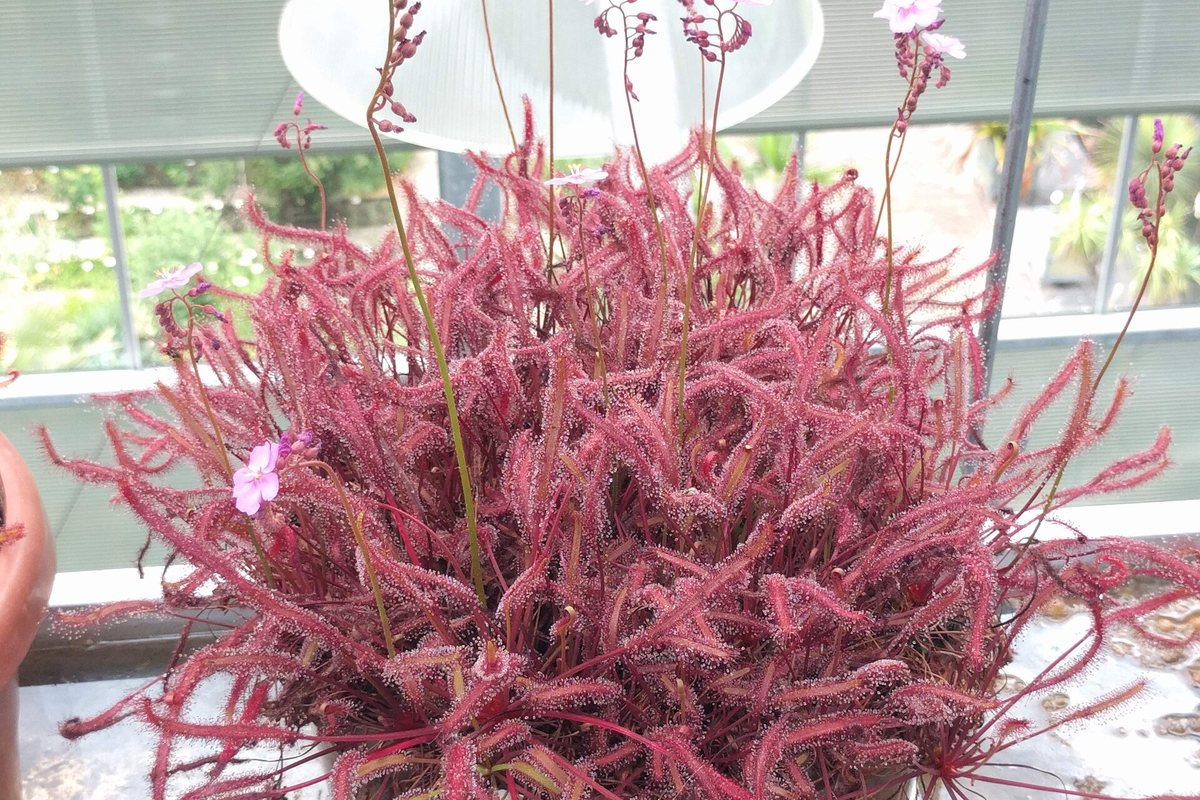
There is no need to pollinate them. California Carnivores says Cape sundews spread “by dropping seeds from their abundant flowers in their pots, which do not need to be pollinated.” Aaron May has counted around 1,000 to 2,000 seeds per stalk on well-fed plants and says the species is “commonly known to become a weed in sundew collections.” Expect seedlings to come up around the parent plant.
If you do not want a collection full of Cape sundews, cut off the flower stalks before the seed pods ripen. If you do want more plants, Carnivorous Plant Nursery says the seed can be sown immediately or stored cool and dry “for a year or more.”
Easy Propagation
Few carnivorous plants are easier to multiply. Aaron May rates each method:
- Seed: “extremely easy. no cold stratification required.” A plant can flower from seed in a little over a year if fed often.
- Leaf cuttings: “very easy.” Floating leaves on water works well for the typical, red and albino forms.
- Root cuttings: “Extremely easy.” The roots are long and thick; he once raised a plant from a root segment left in his water tray for 2 months.
- Divisions: “very easy,” because self-sown plants form clumps and the species copes well with root disturbance.
Carnivorous Plant Nursery adds that its capensis seed comes from open pollination in its collection, so forms grown side by side may cross.
Common Problems
No dew. Most often this is light. A new plant may also arrive dry: California Carnivores says shipping can strip the dew and that it can take a few weeks to return, and if there is still none after four weeks, “you may need to increase light.” Our guide to a sundew not making dew works through every cause in order.
Dying back. Lower leaves dying is normal leaf turnover. If the whole top dies after a freeze, drought or stress, keep the pot wet and bright. California Carnivores says “Capensis can regrow from the roots quite readily, so if your crown dies, keep nurturing it.”
Green instead of red. Red forms fade in winter light, according to California Carnivores, and regain colour in spring or under longer days.
Burnt leaves outdoors. A few scorched leaves are normal after the move into full sun.
Aphids. Sarracenia Northwest answered a grower whose Cape sundews were being killed by aphids. Its advice was a pyrethrin spray aimed at the crown, where the aphids gather, “but not the leaves,” repeated several times 2 to 3 days apart, and checking other houseplants as the source.
Where Sources Differ
| Topic | One view | Another view | Why they may differ |
|---|---|---|---|
| Does it form a winter bud? | Aaron May: forms a hibernaculum if kept at about 35 to 38 °F (2 to 3 °C) or less; growth resumes at 40 °F (4 °C) | Sarracenia Northwest: it “won’t die down to a winter resting bud (hibernacula)” like temperate sundews | Both agree it needs no rest; May describes what his plants did when chilled, not a requirement |
| Window light | California Carnivores: full sun, direct sunlight most of the day | Sarracenia Northwest (white-leaf form): partial sun, “Avoid hot sunlight” | California Carnivores also suggests morning sun only in very hot places such as Arizona |
| Water depth in the tray | California Carnivores: “a few inches,” a deep saucer | Carnivorous Plant Nursery: 1/2 to 1 inch (1.3 to 2.5 cm) | Both keep the soil wet at all times |
| Hardiness zones | Carnivorous Plant Nursery plant page: zones 8 to 11 (7 to 12) | Same nursery’s seed page: zones 7 to 9 (6 to 10) | Listings vary; treat it as frost-tender and bring it in |
| Indoor feeding | California Carnivores: monthly MaxSea foliar feed | Carnivorous Plant Nursery: small insects a few times a month; NC State: no fertilizers | All keep fertilizer out of the soil |
Common Mistakes
- Using tap or bottled mineral water. Use distilled, rain or reverse osmosis water.
- Keeping it in a dim room. California Carnivores says a sundew without dew most likely needs more sun.
- Throwing it out after it dies back. California Carnivores says the roots regrow “quite readily,” so keep the pot wet.
- Leaving it outdoors through a hard frost. It sometimes survives, but no source treats that as reliable.
- Letting the tray dry out in summer. A completely dry pot in warm weather kills the top growth.
- Letting every flower set seed if you do not want seedlings in every pot.
FAQ: Cape Sundew Care
Is a Cape sundew good for beginners?
Yes. Carnivorous Plant Nursery calls it “a great beginner’s plant,” and Sarracenia Northwest calls its white-leaf form “Great for the first-time grower.”
Does a Cape sundew need dormancy?
No. Carnivorous Plant Nursery and California Carnivores both say it needs none, though it slows down in cool winter conditions.
Can a Cape sundew survive frost?
Its leaves will not. California Carnivores says it takes a brief freeze and regrows from the roots, but Sarracenia Northwest says it is “not truly hardy,” so bring it indoors before frost.
What is the difference between ‘Alba’ and the typical Cape sundew?
‘Alba’ lacks red pigment, so its tentacles are white or pale pink rather than red, and its flowers are white. California Carnivores also recommends it for warm climates without cool nights.
The Bottom Line
Good Cape sundew care comes down to bright light, a tray of pure water and a fertilizer-free peat mix. Keep it at roughly 40 to 80 °F (4 to 27 °C) with cooler nights, skip dormancy, protect it from frost, and let it catch insects or feed it lightly. Expect fast leaf turnover, lots of flowers and plenty of seedlings, and if the top ever dies back, give the roots time before you give up.
Sources & Further Reading
- May, A. growsundews.com: Drosera capensis varieties, the Cape Sundew
- Carnivorous Plant Nursery: Drosera capensis
- Carnivorous Plant Nursery: Drosera capensis, White Form
- Carnivorous Plant Nursery: Cape Sundew Seeds
- Carnivorous Plant Nursery: Growing Tips for Sundews
- California Carnivores: Drosera capensis ‘narrow leaf’
- California Carnivores: Drosera capensis ‘alba narrow leaf’
- California Carnivores: Drosera capensis “Red Form, De Kom, RSA”
- California Carnivores: Sundews (Drosera) Growing Tips
- Sarracenia Northwest: Q/A #10, Can Drosera capensis Handle an Overnight Frost?
- Sarracenia Northwest: Q/A #30, Aphids on Drosera capensis
- Sarracenia Northwest: Drosera capensis, White Leaf
- NC State Extension Gardener Plant Toolbox: Drosera
Featured image based on a photo of a Cape sundew (Drosera capensis) by Michal Rubeš via Wikimedia Commons, CC BY 3.0 CZ, cropped with a dark gradient and typography added by FloraOddity.
Final articles are editorially reviewed and factual claims are checked against cited sources. Last reviewed: October 2026.

One Comment