
Browse a specialist nursery’s ant plant section and you will find a dozen names that look almost identical: Hydnophytum this, Myrmecodia that, sometimes with “cf.” or “aff.” in the middle. Some of those names are no longer accepted by botanists, and at least one label has been used for a different species entirely.
This guide sorts out the ant plant species you are most likely to be offered: how to tell the two main genera apart, then what each species looks like, where it grows wild, how big it gets, and how the nurseries that sell it rate it. For the basics of watering, mix and light, see our ant plant care guide; this article is about choosing the right plant in the first place.
The Short Answer
For a first ant plant, the safest choices are the species specialist nurseries stock and rate as easy: Hydnophytum formicarum, Hydnophytum moseleyanum (often sold as H. papuanum), Myrmecodia tuberosa and Myrmecodia beccarii. Araflora labels all four “Easy”, and Jungle Leaves says M. tuberosa and M. beccarii are among the easiest Myrmecodia to keep. Hydnophytum has a spineless or nearly spineless tuber and many slender branches; Myrmecodia usually has a ridged, spiny tuber and one or a few thick stems. High-mountain species such as Myrmecodia lamii are a different proposition and are not stocked by the nurseries we checked.
Hydnophytum or Myrmecodia? How to Tell Them Apart
Lok and Tan of the National University of Singapore list five genera of these tuberous ant plants: Anthorrhiza, Hydnophytum, Myrmecodia, Myrmephytum and Squamellaria. Hydnophytum and Myrmecodia make up most of the ant plant listings at the two specialist nurseries we checked, Jungle Leaves and Araflora.
The botanical revisions of Myrmecodia by Huxley and Jebb (1993) and of Hydnophytum by Jebb and Huxley (2019) give the features that separate them. Check three things on any plant you are thinking of buying.
1. The tuber surface. The Hydnophytum revision says tuber spines are “usually absent”, occasionally root-like or small and tubercle-like. In Myrmecodia the tuber is often ridged, and the spines, where present, can be simple, branched or star-shaped.
2. The stems. Myrmecodia stems are, in the revision’s words, “solitary or few, little or unbranched, thick”, with internodes about as long as they are wide. Hydnophytum stems are usually numerous, branched, woody and slender, and they can hang or stand upright.
3. Where the flowers sit. Myrmecodia flowers are sunk into paired pits in the stem called alveoli, and the stem often carries shield-shaped plates called clypeoli. Jungle Leaves explains that the leaves grow from the front of the clypeoli and the flowers emerge from the alveoli between them. Hydnophytum flowers sit in the leaf axils, usually without a stalk.
There are exceptions. The Hydnophytum revision notes that H. moseleyanum tubers occasionally carry tubercle-like spines up to 0.2 in (0.5 cm) long, and the Myrmecodia revision describes M. beccarii as having several freely branched stems. Look at all three features together rather than relying on one.
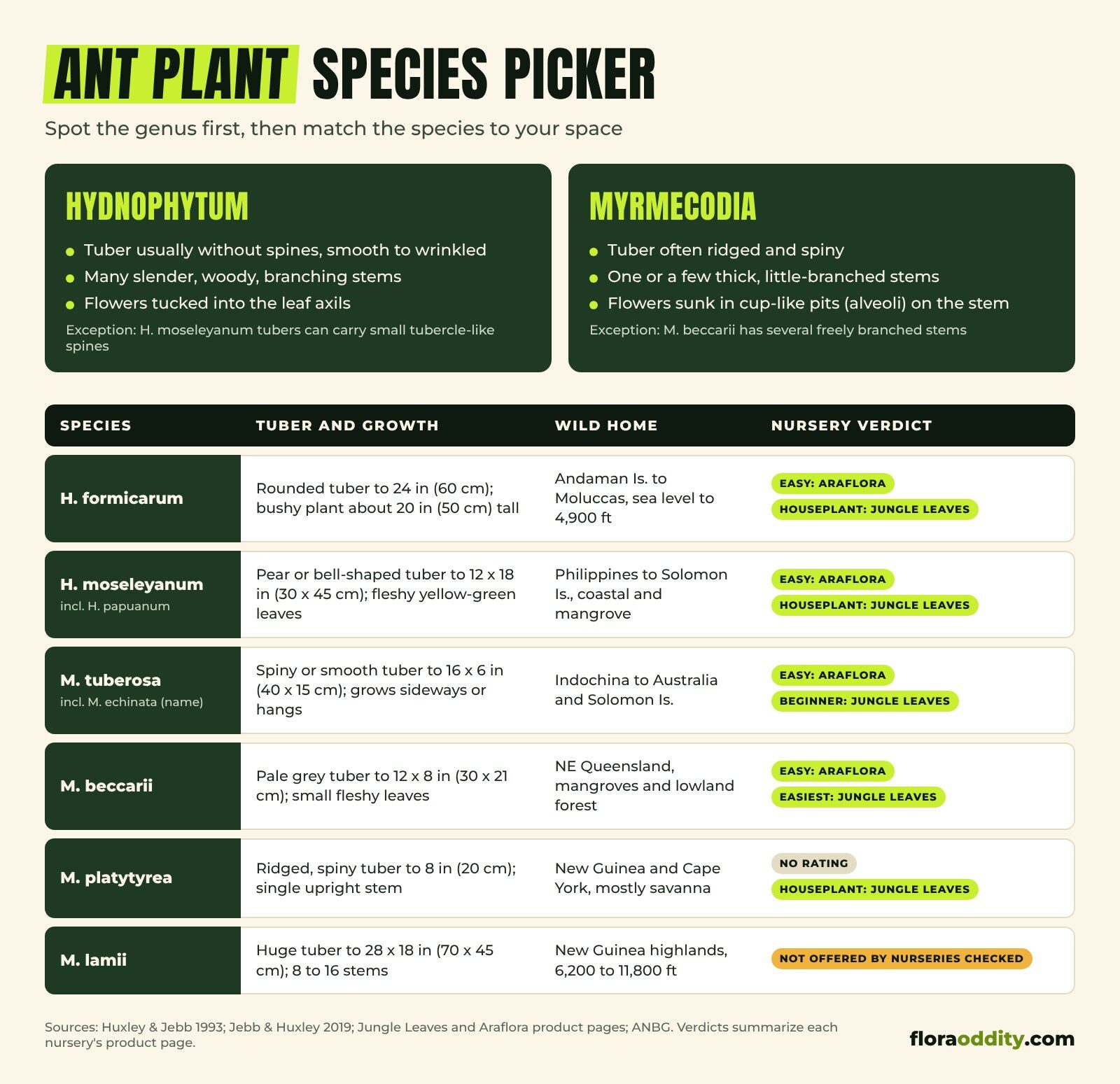
| Species | Genus | Tuber surface | Native range | Size in the wild | Nursery-rated difficulty |
|---|---|---|---|---|---|
| H. formicarum | Hydnophytum | Smooth to wrinkled, usually spineless | Andaman Islands to the Moluccas | Tuber to 24 in (60 cm) across | “Easy” (Araflora) |
| H. moseleyanum (incl. H. papuanum) | Hydnophytum | Smooth, sometimes small tubercles | Philippines to the Solomon Islands | Tuber to 12 x 18 in (30 x 45 cm) | “Easy” (Araflora) |
| M. tuberosa | Myrmecodia | Variable, usually spiny | Indochina and the Philippines to Australia and the Solomon Islands | Tuber to 16 x 6 in (40 x 15 cm) | “Easy” (Araflora); “good ant plant for beginners” (Jungle Leaves) |
| M. beccarii | Myrmecodia | Short spines on mounds, no entrance holes | Northeast Queensland, Australia | Tuber to 12 x 8 in (30 x 21 cm) | “Easy” (Araflora); “one of the easiest Myrmecodia species” (Jungle Leaves) |
| M. platytyrea | Myrmecodia | Spines on ridges or mounds | New Guinea and the Cape York area | Tuber to 8 in (20 cm) long | No rating; “very rewarding vivarium plant” (Jungle Leaves) |
| M. lamii | Myrmecodia | Dense spine clusters at the base, bristles above | High mountains of western New Guinea | Tuber about 28 x 18 in (70 x 45 cm) | Not listed by the nurseries we checked |
Wild sizes are maximums from the botanical revisions; potted plants stay far smaller.
The Species, One by One
Hydnophytum formicarum
This is the type species of the genus. LLIFLE notes that ant plants are rarely grown by amateurs but that H. formicarum “is one of the more common species cultivated, at least in Europe.” The Hydnophytum revision describes a rounded to flattened tuber up to 24 in (60 cm) across, with a smooth to rough grey or brown surface, and lance-shaped to elliptic leaves with a blunt tip. The species is defined broadly: the revision folds 15 former species into it, so plants from different islands can look quite different.
In the wild it grows from the Andaman Islands, Myanmar and Thailand through Malaysia, Borneo, Java, the Philippines and Sulawesi to the Moluccas, but the revision says it is “apparently absent from the New Guinea mainland”. Habitats include mangrove swamp, savannah forest and especially heath forest on nutrient-poor soils, from sea level to about 4,900 feet (1,500 m).
In a pot it stays much smaller. Jungle Leaves says the caudex typically stays under 4 inches (10 cm) tall but can grow more than 12 inches (30 cm) wide, with a branching plant about 20 inches (50 cm) tall. Their tip for separating it from H. moseleyanum is the leaf veins: 6 to 12 parallel veins in H. formicarum against only about 3 to 4 in H. moseleyanum.
Grower verdict: Araflora rates it “Easy” and suggests 68 to 86 °F (20 to 30 °C) as ideal, adding that it does well at 59 to 68 °F (15 to 20 °C). Jungle Leaves calls it “one of the few ant plants that, after acclimatization, are also suitable as a houseplant.”
Hydnophytum moseleyanum (and H. papuanum)
If you see Hydnophytum papuanum for sale, you are looking at this species. The Hydnophytum revision lists H. papuanum as a synonym of H. moseleyanum, along with some 20 other names, because leaf shape varies so much from one population to the next. Jungle Leaves says the same on its product page: the species “now also includes H. papuanum.”
The revision describes a rounded to bell-shaped, green to silvery grey tuber up to 12 x 18 in (30 x 45 cm), with numerous branching stems up to 3.3 feet (1 m) long. The giveaway is the foliage: fleshy, yellowish green leaves on very short stalks, with a pale triangle often running from the stalk up the midrib. It is a coastal plant, “common in mangrove swamps and other coastal forests, rarely to 400 m” (about 1,300 feet), found from the Philippines through North Maluku and New Guinea to the Solomon Islands.
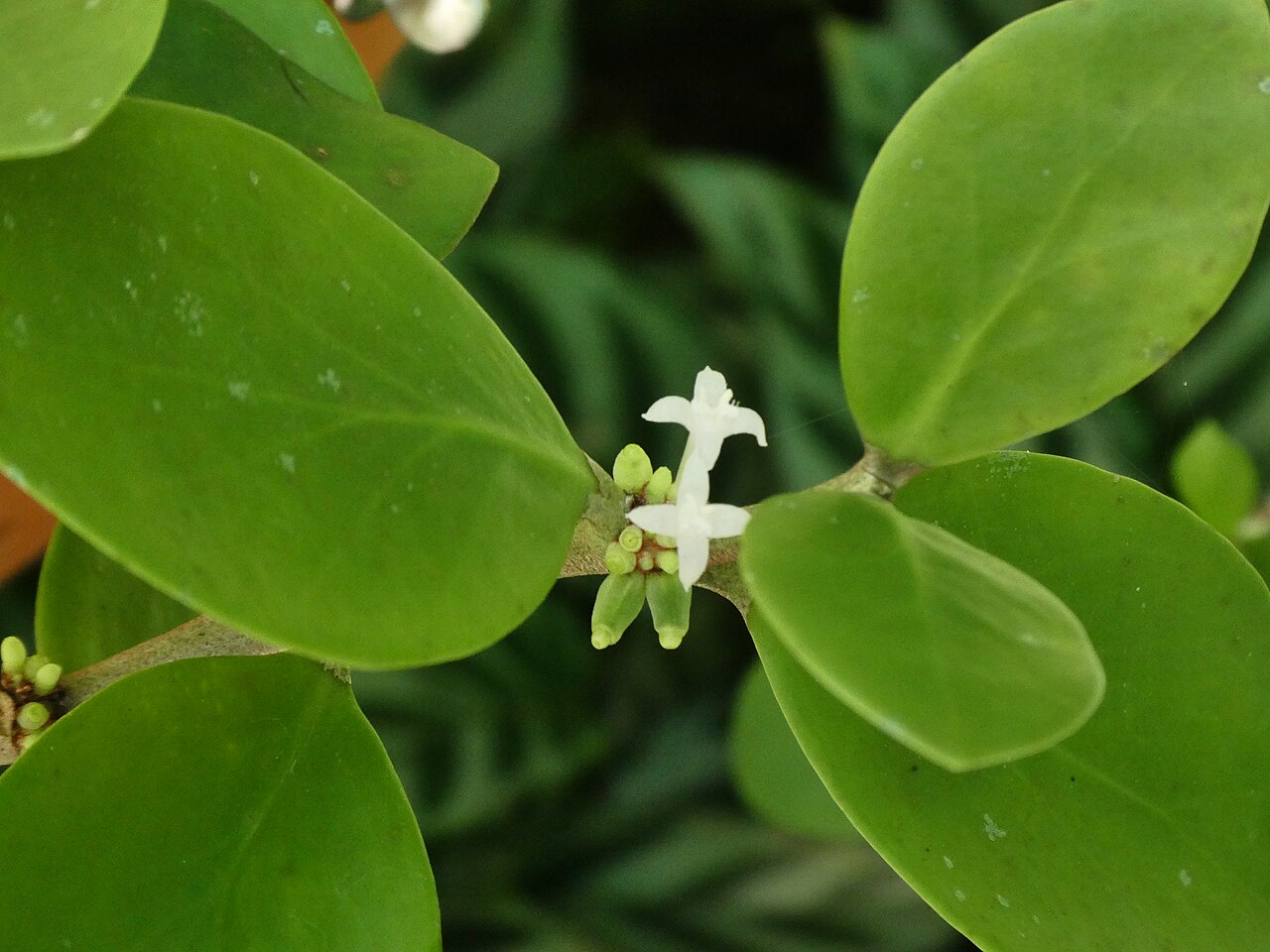
Grower verdict: Araflora rates its H. papuanum “Easy”, asks for a minimum of 61 °F (16 °C), humidity above 60%, and bright indirect light because direct sun “could scorch the leaves”. Jungle Leaves describes a plant that can top 28 inches (70 cm) and suits a houseplant after acclimatization.
Myrmecodia tuberosa
M. tuberosa is the catch-all of the genus. Huxley and Jebb extended it to cover “the whole variable continuum from Indochina and the Philippines to Australia and the Solomon Islands” and treated it as an ochlospecies: one species made of many local forms that do not fall neatly into subspecies. Their synonym list runs to more than 20 names, including M. echinata and M. salomonensis, which some sellers still use.
Their description allows a tuber from 0.8 x 2.4 in (2 x 6 cm) to 16 x 6 in (40 x 15 cm), with spines present or absent, and leaves up to 18.5 x 5.5 in (47 x 14 cm). NParks Flora & Fauna Web records it on trees in mangrove, lowland to montane, swamp and riverine forest up to about 8,200 feet (2,500 m).
Jungle Leaves points out that the elongated caudex grows horizontally or hangs in nature, and that the plant should be supported in that position. Very old specimens, they say, can have a caudex up to 30 inches (75 cm) long.
Grower verdict: Jungle Leaves calls it “one of the easiest Myrmecodia to care for” and “a good ant plant for beginners”, best in a terrarium or plant cabinet but able to live as a houseplant after acclimatization. Araflora rates it “Easy” and gives 72 to 82 °F (22 to 28 °C) and about 75% humidity as its preferred range.
Myrmecodia beccarii
The Australian ant plant breaks the usual Myrmecodia pattern. The Myrmecodia revision describes a pale grey tuber up to 12 x 8 in (30 x 21 cm) with short, stout spines under 0.2 inch (0.4 cm) on mounds, no pores or entrance holes on the surface, and “several, freely branched” stems. It calls the species “distinctive in its small fleshy leaves”, 3.5 to 4.7 inches (9 to 12 cm) long.
The Australian National Botanic Gardens (ANBG) says it is endemic to Australia and “only occurs in the mangroves and lowland forests found around Cairns and northern Cape York”. The revision adds coastal Melaleuca savanna to its habitats.
Grower verdict: Jungle Leaves calls it “one of the easiest Myrmecodia species to care for” and says it “tolerates dry conditions better than other members of the genus”. Araflora rates it “Easy” and suggests around 79 °F (26 °C) in a greenhouse with about 75% humidity. The ANBG says it thrives in a night and day range of the “low 20°s to low 30°s” (the page gives no unit; read as Celsius, that is roughly 70 to 90 °F) and that the plants “should dry out between waterings, however not too much otherwise they will wilt.”
Myrmecodia platytyrea
Its tuber is the classic spiny ant plant: globose to cylindrical, up to 8 inches (20 cm) long, grey or brown, with stout spines on ridges or mounds. The Myrmecodia revision describes a single unbranched stem (occasionally a few) with well-developed clypeoli rimmed by a dense fringe of spines, and leaves 4.7 to 7.9 inches (12 to 20 cm) long.
The revision calls it “commonest in savanna areas of southern Papua New Guinea”, also found in lowland forest. Of its two subspecies, subsp. antoinii covers the more seasonally dry south and east of the range, including the Torres Strait islands and Cape York.
Grower verdict: No difficulty rating from the nurseries we checked. Jungle Leaves offers a plant as Myrmecodia aff. platytyrea, calls it “a very rewarding vivarium plant”, and says it can be grown as a houseplant after acclimatization.
Myrmecodia echinata: a name to check
“Myrmecodia echinata” still appears on labels, but the Myrmecodia revision lists M. echinata Gaudich. as a synonym of M. tuberosa, and LLIFLE and NParks do the same. Jungle Leaves offers a useful warning: it received a plant labelled M. echinata, but writes “Our plants are certainly not M. tuberosa” and says they resemble M. platytyrea much more. If you buy an “echinata”, treat the name as a lead, not an identification.
Myrmecodia lamii
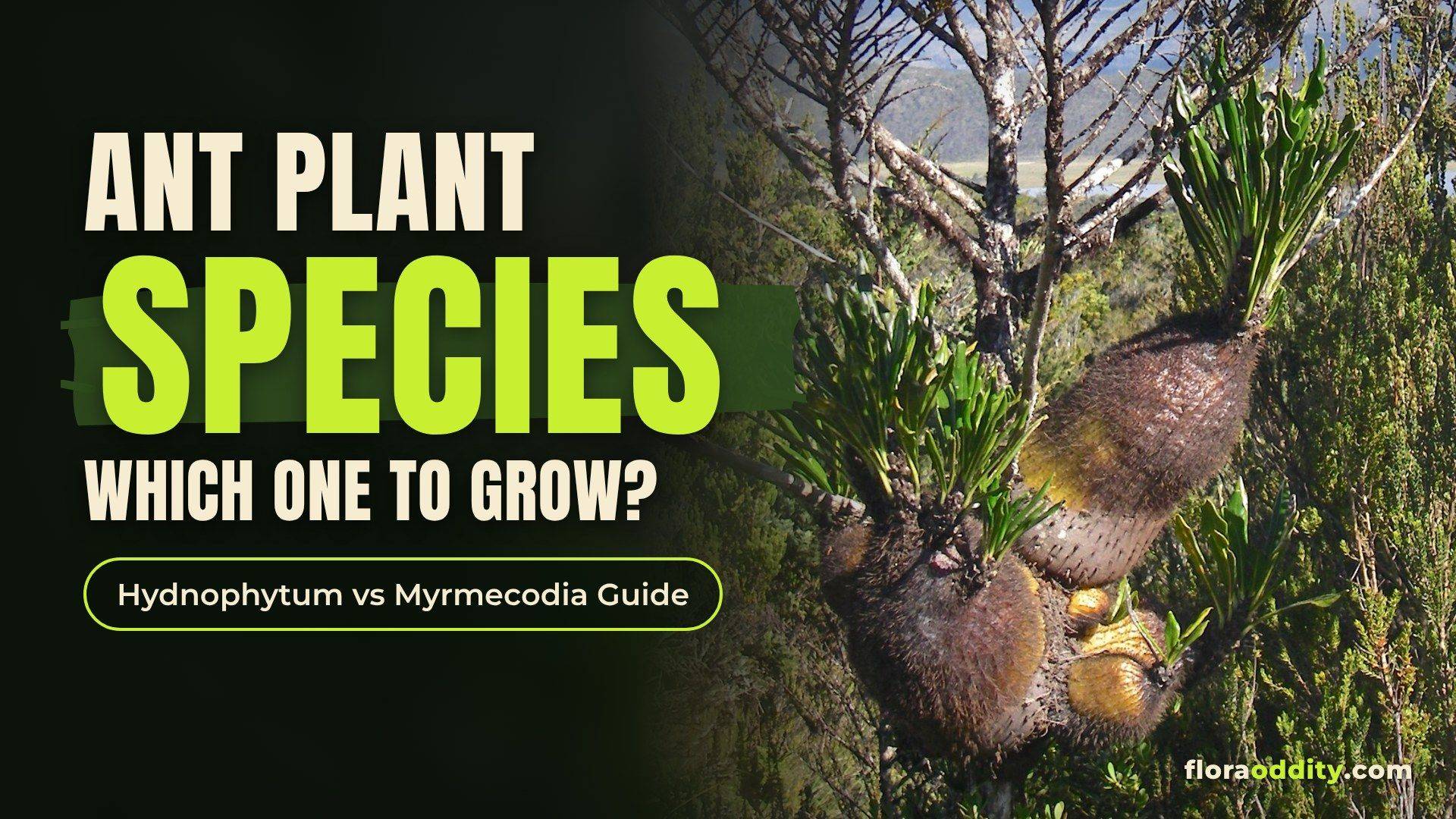
M. lamii is the giant of the group. The revision describes a tuber about 28 x 18 inches (70 x 45 cm), often projecting sideways, with dense clusters of thick spines at the base and finer bristles above, 8 to 16 stems up to about 3.3 feet (100 cm) long, and clypeoli with broad grey wings. It grows “epiphytic in medium or stunted forest, or terrestrial, especially above the tree-line”, at 6,200 to 11,800 feet (1,900 to 3,600 m) in western New Guinea; the type specimen was collected at Lake Habbema. The plant in our featured image was photographed in the wild near Lake Habbema.
Grower verdict: Neither Jungle Leaves nor Araflora lists it, and we found no published care rating. Its mountain home, often above the tree line, is very different from the coastal mangroves where H. moseleyanum and M. beccarii grow.
What about Myrmephytum?
Myrmephytum is a separate small genus; the Hydnophytum revision notes that three of its five species come from mainland New Guinea. Jungle Leaves offers one as Myrmephytum ‘longissimum’, is candid that this is a nomen nudum (a name without a formal description), and recommends it for “any larger terrarium or grow tent”.
Where Sources Differ
Names. Many trade labels follow old names. The revisions sink H. papuanum into H. moseleyanum and M. echinata and M. salomonensis into M. tuberosa. Araflora still lists “Hydnophytum papuanum” and “Hydnophytum cf. mosleyanum” as separate products.
Difficulty. Nursery ratings and reference sites do not agree. Araflora rates every ant plant we looked at “Easy”. LLIFLE, on the other hand, says of both H. formicarum and M. tuberosa that they “can be tricky to grow well” and are quick to drop leaves if they dry out or get cold, and notes that M. tuberosa is “rarely cultivated by amateur growers”. Read any rating as one grower’s experience, not a guarantee.
Water. LLIFLE says M. tuberosa “needs lots of water”, while NParks lists its water preference as “Little Water, Occasional Misting”. NParks is rating the plant for landscaping in Singapore, not for a pot indoors, so the two describe different settings.
Stems of M. beccarii. The revision and the ANBG describe several or multiple stems, while Jungle Leaves says its plants usually have “only one main stem” until very old.
H. formicarum’s tuber. LLIFLE calls it “not spiny” with smooth bark and gives a diameter to 10 inches (25 cm); Araflora calls it “rough, with ridges”; the revision covers both surfaces with “smooth to rugose” and allows up to 24 inches (60 cm).
How to Choose Your First Ant Plant
- Decide where it will live. For a windowsill, pick a species a nursery describes as suitable as a houseplant: H. formicarum, H. moseleyanum, M. tuberosa or M. beccarii. Jungle Leaves recommends a terrarium or plant cabinet for M. tuberosa and for its young M. beccarii, with a move into the house after acclimatization.
- Match the plant to your habits. Lok and Tan, citing earlier work by Huxley, describe Hydnophytum as able to withstand much drier conditions than Myrmecodia. If you sometimes forget to water, start with Hydnophytum or with M. beccarii, the Myrmecodia Jungle Leaves says copes best with dry conditions.
- Check the name against the accepted names above, especially “papuanum” and “echinata”.
- Plan for the adult shape. M. tuberosa grows sideways or hangs, and the revision gives H. moseleyanum stems up to 3.3 feet (1 m) long.
Once you have chosen, our ant plant care guide covers watering around the caudex, and if you later get ripe berries, see how to grow ant plants from seed.
Common Mistakes When Buying
- Trusting the label completely. Synonyms and “cf.” or “aff.” names are common, and one nursery openly says a plant it received as M. echinata more closely resembles M. platytyrea.
- Expecting a big caudex right away. Jungle Leaves ships young plants in pots of about 2 inches (5 to 5.5 cm), and Araflora lists its starter plants at 2 to 3 inches (5 to 8 cm) tall.
- Buying for spines alone. Spiny does not always mean Myrmecodia, and some M. tuberosa forms are smooth. Check the stems and flower pits too.
- Ignoring the wild habitat. M. lamii grows at 6,200 to 11,800 feet (1,900 to 3,600 m), often above the tree line, while H. moseleyanum and M. beccarii are plants of coasts and mangroves.
FAQ: Ant Plant Species
What is the easiest ant plant species for beginners?
Based on nursery ratings, H. formicarum, H. moseleyanum, M. tuberosa and M. beccarii, all rated “Easy” by Araflora.
Is Hydnophytum papuanum a real species?
Not any more, according to the 2019 Hydnophytum revision, which treats it as a synonym of H. moseleyanum. Plants are still sold under the old name.
Which ant plants have spiny tubers?
Myrmecodia platytyrea, M. lamii and many forms of M. tuberosa have clearly spiny tubers, while M. beccarii has only short spines under 0.2 inch (0.4 cm). Hydnophytum tubers usually have no spines.
How many ant plant species are there?
The revisions recognize 55 Hydnophytum species and 26 Myrmecodia species. Only a handful are regularly in cultivation.
The Bottom Line
Most ant plants for sale belong to two genera you can tell apart by the tuber, the stems and the flower pits. For a first plant, choose one of the four that specialist nurseries stock and rate as easy: Hydnophytum formicarum, H. moseleyanum (sold also as H. papuanum), Myrmecodia tuberosa or M. beccarii. Check labels against current names, plan for the adult shape, and treat mountain species such as M. lamii as a separate challenge.
Sources & Further Reading
- Huxley, C. R. and Jebb, M. H. P. (1993). The tuberous epiphytes of the Rubiaceae 5: A revision of Myrmecodia. Blumea 37: 271 to 334
- Jebb, M. H. P. and Huxley, C. R. (2019). The tuberous epiphytes of the Rubiaceae 7: A revision of the genus Hydnophytum. Blumea 64: 23 to 91
- Lok, A. F. S. L. and Tan, H. T. W. (2009). Tuberous, epiphytic, rubiaceous myrmecophytes of Singapore. Nature in Singapore 2: 231 to 236
- Australian National Botanic Gardens: Myrmecodia beccarii, Growing Native Plants
- NParks Flora & Fauna Web: Myrmecodia tuberosa
- LLIFLE Encyclopedia: Hydnophytum formicarum
- LLIFLE Encyclopedia: Myrmecodia tuberosa
- Jungle Leaves: Hydnophytum formicarum
- Jungle Leaves: Hydnophytum moseleyanum
- Jungle Leaves: Myrmecodia tuberosa
- Jungle Leaves: Myrmecodia beccarii
- Jungle Leaves: Myrmecodia aff. platytyrea
- Jungle Leaves: Myrmephytum ‘longissimum’ Nabire
- Araflora: Hydnophytum formicarum ‘Starter’
- Araflora: Hydnophytum papuanum ‘Starter’
- Araflora: Hydnophytum cf. mosleyanum
- Araflora: Myrmecodia tuberosa ‘L’
- Araflora: Myrmecodia beccarii
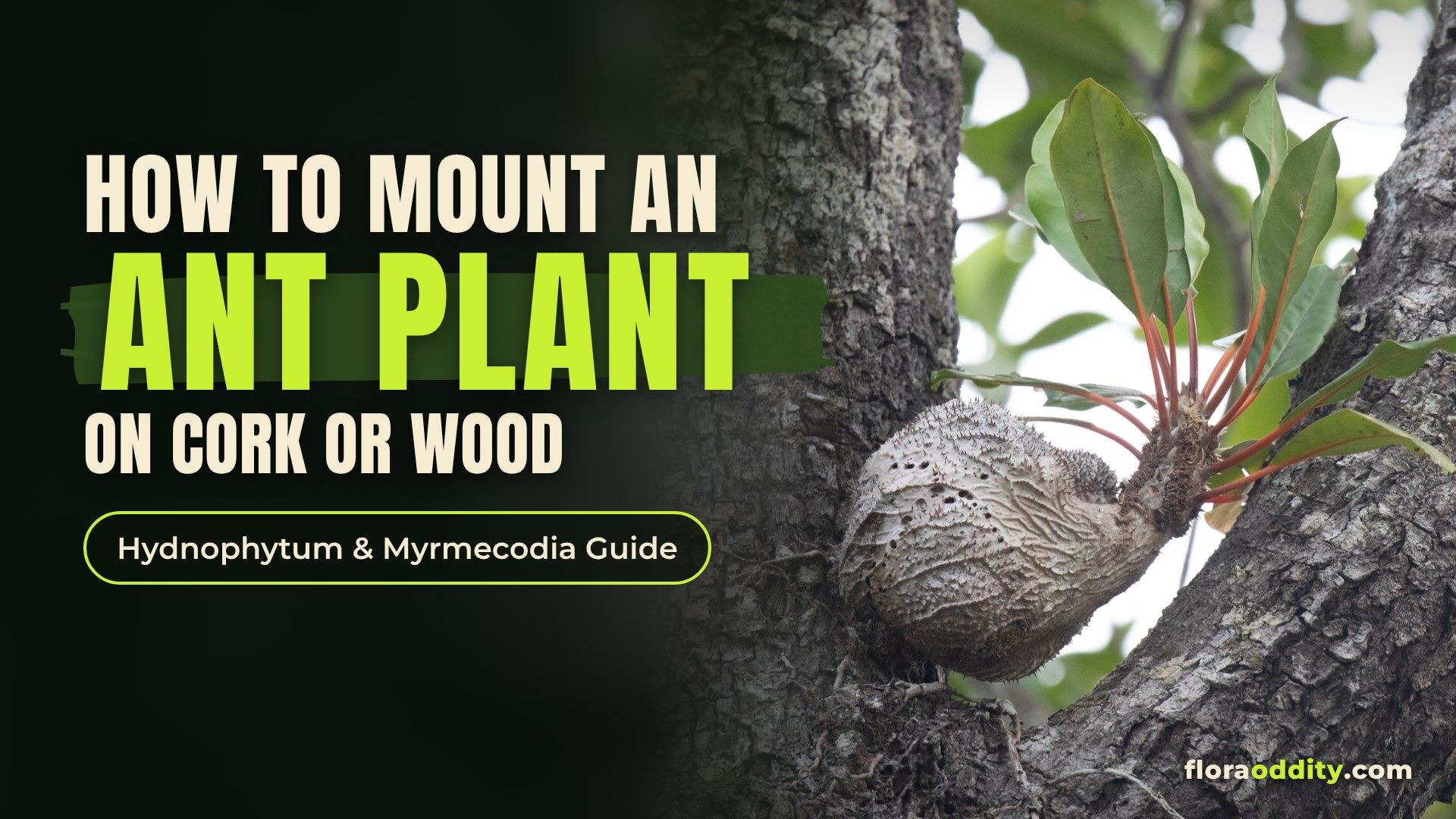
Featured image based on a photo of Myrmecodia lamii near Lake Habbema, Papua, by desertnaturalist via Wikimedia Commons, CC BY 4.0, with cropping and typography added by FloraOddity.
Final articles are editorially reviewed and factual claims are checked against cited sources. Last reviewed: October 2026.
One Comment