
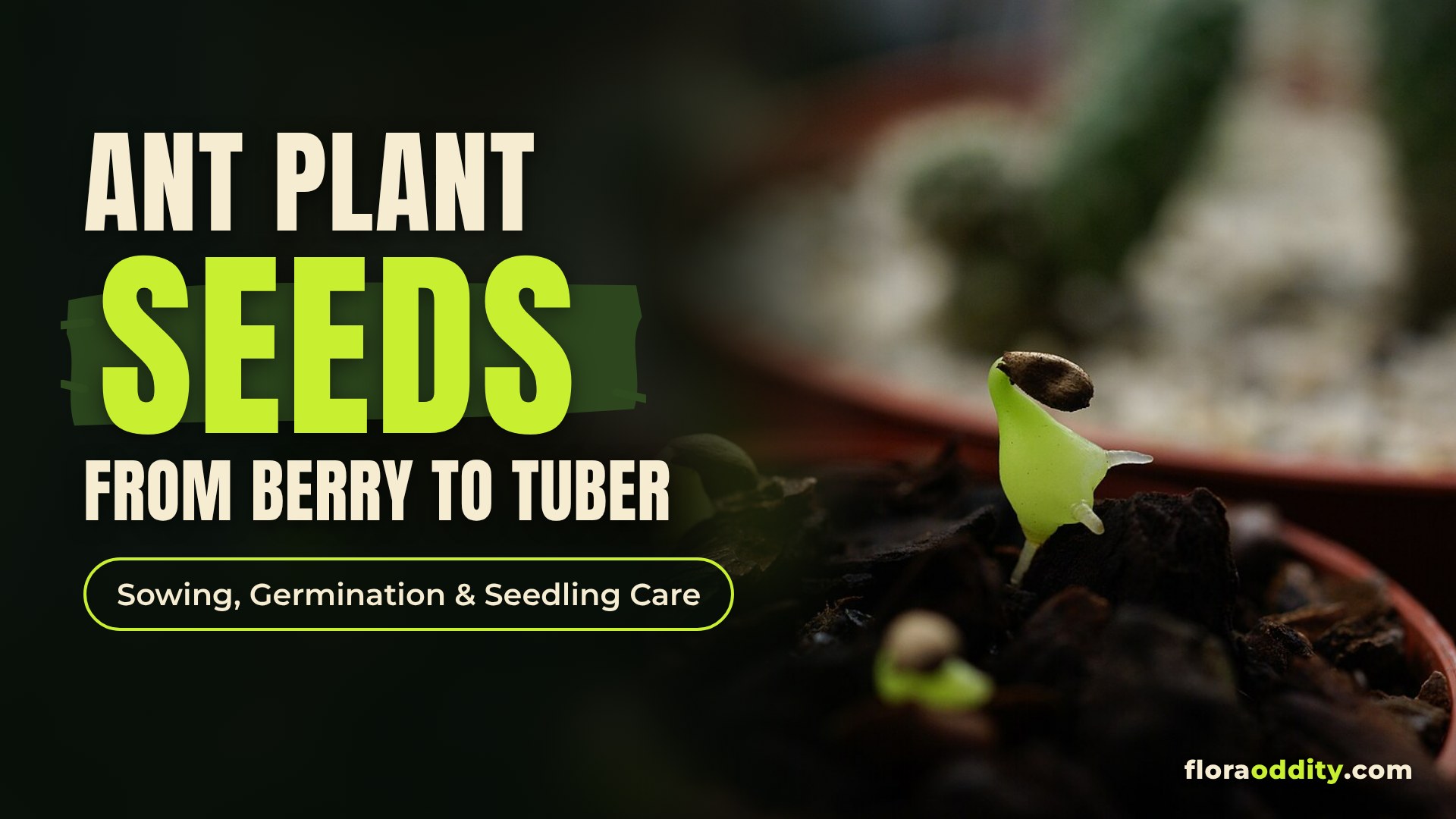
Every ant plant with a proper swollen base began as a seed, squeezed out of a small orange or red berry. Within days of germinating, that seed starts building the hollow base that makes these plants so strange, which is why raising Hydnophytum and Myrmecodia from seed is such a rewarding project: you get to watch the tuber form from the very beginning.
There is one hard rule, though: the seed has to be fresh. This guide covers where ant plant seeds come from, why they lose viability so quickly, how to clean and sow them, and what a seedling does in its first months, including the moment a hidden chamber opens to the outside. Every timeline below comes from a named source, and where sources disagree, we say so.
The Short Answer
Sow ant plant seeds as soon as the berries are ripe. Squeeze the seeds out, rinse off the sticky pulp, and lay them on the surface of a moist, open mix without covering them. Keep the surface constantly moist and the seedlings warm. LLIFLE reports that fresh seed germinates within a week and often within 24 hours, with the tuber starting to swell almost immediately. In a controlled study, Tsukaya and Ohtake found that the first internal cavity formed around 11 to 15 weeks after sowing, with the entrance hole opening only afterwards, all without ants. Pot up gently, because the roots are brittle.
Where Ant Plant Seeds Come From
Self-pollinating flowers and small berries
According to Lok and Tan of the National University of Singapore, both Hydnophytum and Myrmecodia are self-pollinated and form fruit without pollinator visits. LLIFLE’s entry for Hydnophytum formicarum adds that the flowers produce fruit and seed easily. So a single flowering plant can give you berries without a partner or hand pollination. In a 2010 TerraForums thread, the member swords described a flowering Myrmecodia echinata as self-fertile and reported orange berries swelling one day after posting photos of the flowers. That is a single case, but it fits the botanical literature.
In Myrmecodia, the fruit hides at first. The revision of Myrmecodia by Huxley and Jebb (1993) describes a sweet, fleshy fruit that develops inside the alveolus, the small pocket in the stem where the flowers sit, and is pushed out when mature. The Australian National Botanic Gardens notes that ripe Myrmecodia beccarii fruit protrudes from the alveoli and can be white, red, orange or pink.
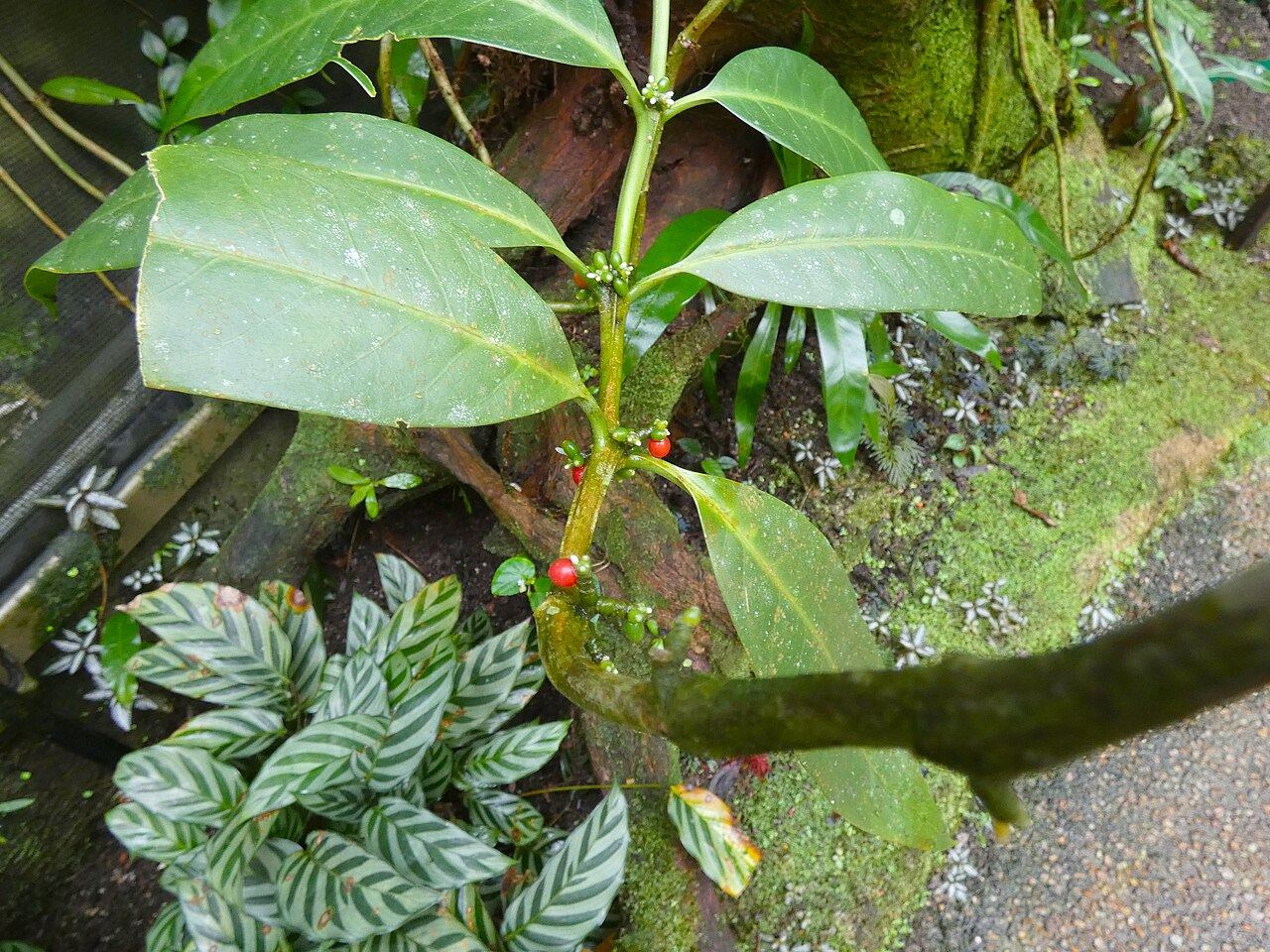
How many seeds are in each berry?
Each berry holds only a few seeds. Botanical descriptions count them as pyrenes, and each pyrene holds one seed.
| Plant | Fruit | Seeds per fruit | Source |
|---|---|---|---|
| Hydnophytum (genus) | Green to yellow when unripe, orange or red when ripe; mostly 5 to 12 mm (about 1/5 to 1/2 inch) | Usually 2 | Jebb and Huxley 2019 |
| Hydnophytum formicarum | Narrowly ellipsoid, 4 to 7 mm (about 1/6 to 1/4 inch) | 1 to 3 | Lok and Tan 2009 |
| Myrmecodia (genus) | Sweet, fleshy; white, yellow, orange or red | Usually 4 to 6 (range 2 to 10) | Huxley and Jebb 1993 |
| Myrmecodia tuberosa | Yellow, orange red to pink, about 7 mm (about 1/4 inch) | 4 (LLIFLE); 3 to 8 in the Singapore form | LLIFLE; NParks; Lok and Tan 2009 |
If you want a tray of seedlings, collect several fruits, especially from a Hydnophytum.
How seeds travel in the wild
In nature, a seed has to end up on a branch. The Hydnophytum revision by Jebb and Huxley (2019) describes the fruit flesh as glutinous and sweet and suggests it is probably bird dispersed. Lok and Tan describe both genera as mainly ant dispersed, with ants leaving seeds in tunnels along the bark, and they also saw flowerpeckers eating the fruit. Singapore’s NParks Flora & Fauna Web lists both ants and small fruit-eating birds for Myrmecodia tuberosa. Either way, the seed germinates in a damp crack on bark, and your sowing tray is trying to copy that spot.
Why Ant Plant Seeds Must Be Fresh
LLIFLE states that the seeds remain viable for a very short time and must be sown immediately after harvesting. In a 2014 TerraForums thread, the member Cthulhu138, who had sown several Hydnophytum and Myrmecodia species, advised sowing within days of harvesting the fruit, and another member reported that seed received by post had started germinating inside the envelope.
That detail explains the problem. Ant plant seeds do not wait for a season; they are ready to grow the moment they leave the fruit. Drying, storage or a slow parcel all cost you seedlings. If you buy seed, ask when the fruit was picked and sow on the day it arrives.
How a Seedling Builds Its Tuber
The swollen base is not a root. Jebb and Huxley note that the tuber of this whole group of plants appears to develop from the hypocotyl, the short stem section between the seed leaves and the root. Lok and Tan, summarizing C. R. Huxley’s 1978 work, describe the hypocotyl swelling to about 0.5 cm (about 1/5 inch) wide as the tuber begins.
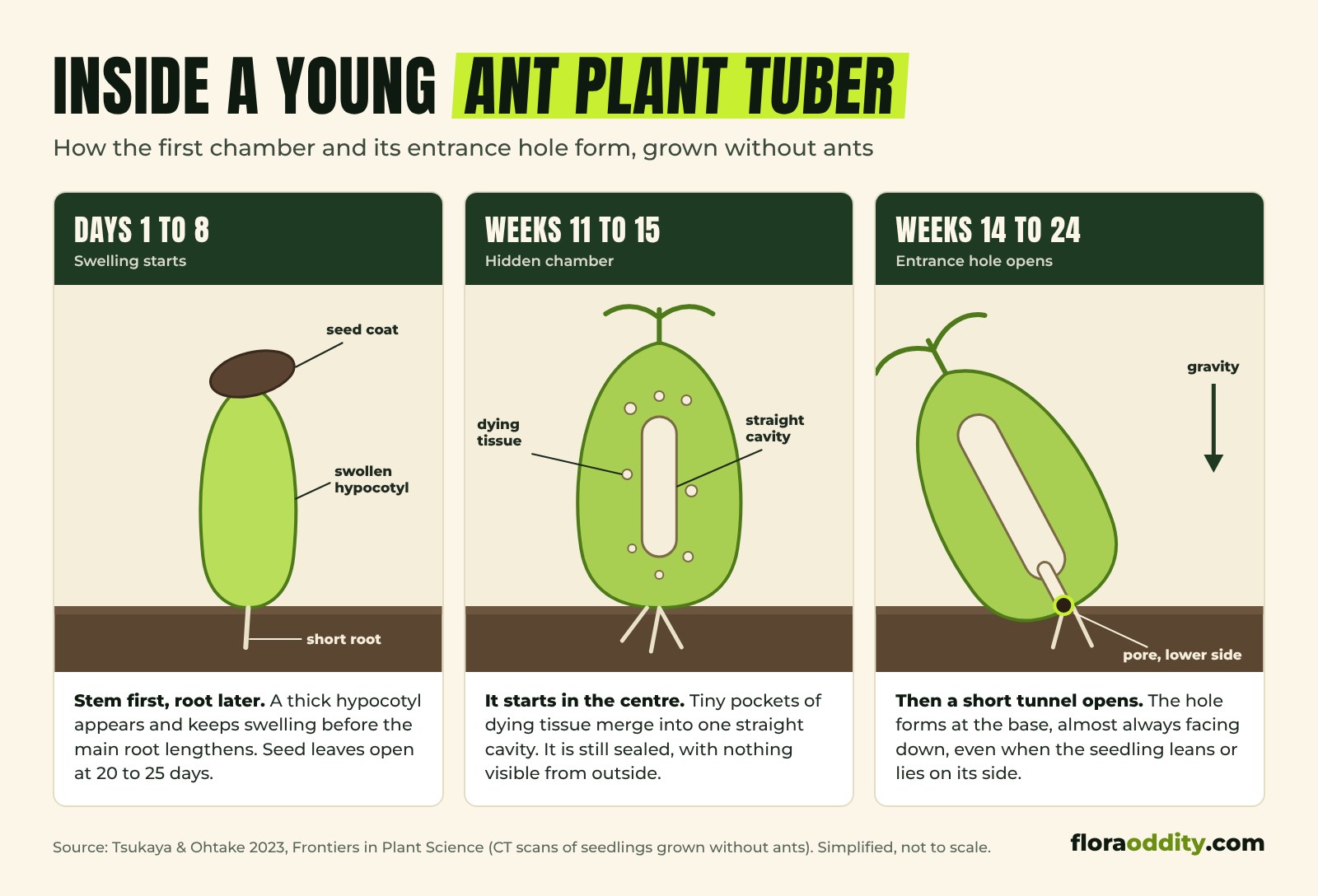
The most detailed account of what happens next comes from Hirokazu Tsukaya and Yutaka Ohtake of the University of Tokyo, who followed seedlings with X-ray CT scans in a 2023 study in Frontiers in Plant Science. They grew four species, including Hydnophytum moseleyanum and Myrmecodia tuberosa, from fresh seed without ants.
In Hydnophytum moseleyanum, a thick hypocotyl appeared one day after sowing and kept thickening before the main root started to lengthen. The seed leaves opened 20 to 25 days after sowing. Then the shoot tip paused: the first pair of true leaves became visible to the naked eye only more than three months after sowing, which the authors link to the seedling putting its resources into the swelling hypocotyl.
Inside, the first cavity started in the centre of the hypocotyl as tiny pockets of dying tissue that made it sponge-like, then merged into one large, straight cavity. In the Hydnophytum seedlings this took place between 11 and 15 weeks after sowing. Only once the cavity was complete did a short tunnel grow outwards to open the entrance hole. Two findings matter for growers. The cavity emptied completely without ants, because the dead cells dried up into thin layers. And the hole formed at the base, almost always on the lower side, even when seedlings were laid on their sides. The authors note that a downward-facing hole keeps rain out of the developing chamber.
Seed-to-tuber timeline
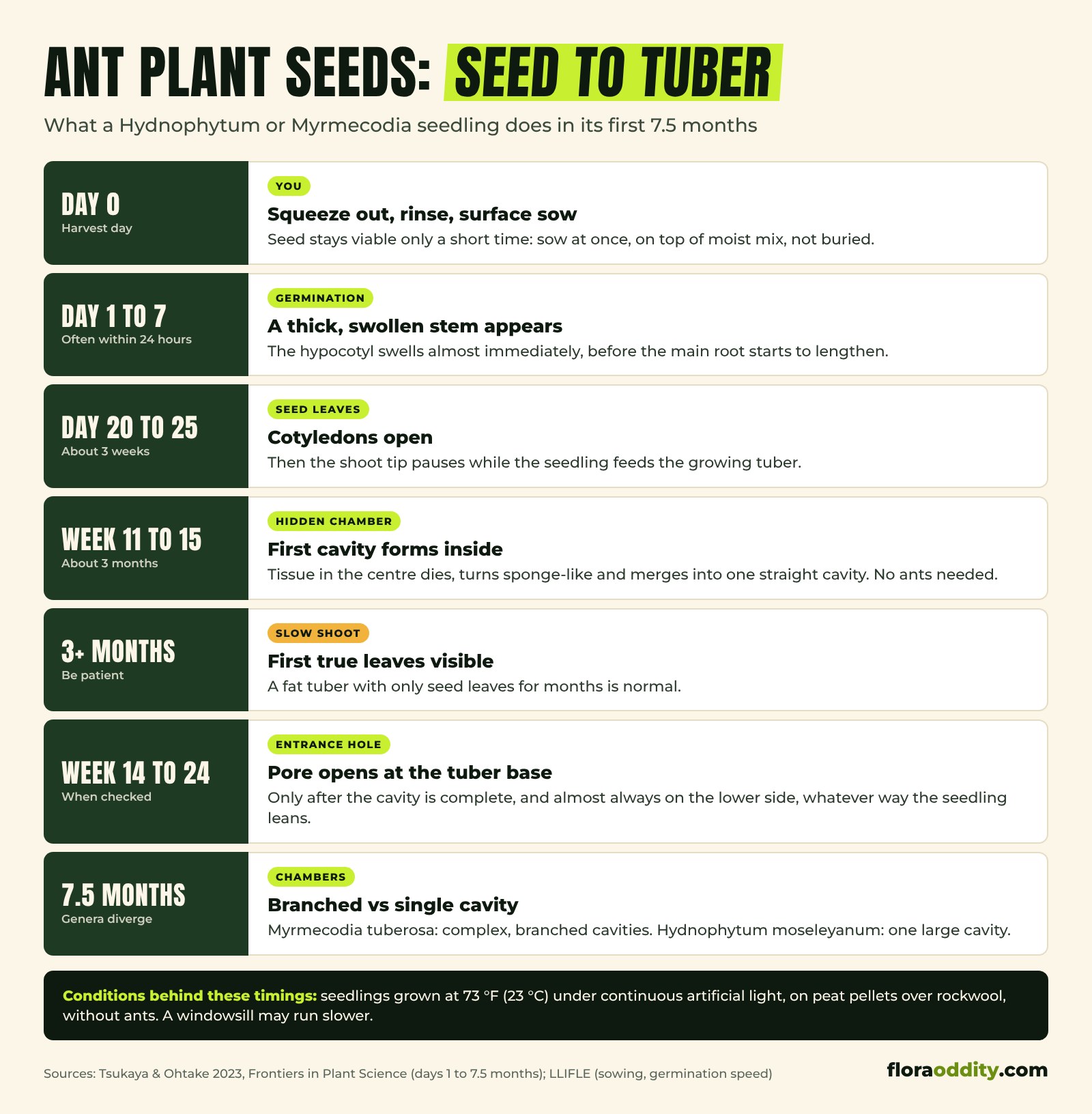
The timeline above, as a list:
- Day 0: Ripe berry harvested; seeds cleaned and laid on moist mix (LLIFLE).
- Within a week, often within 24 hours: Germination, with the tuber swelling almost immediately (LLIFLE).
- Days 1 to 8: Thick hypocotyl emerges and keeps swelling before the main root lengthens (Tsukaya and Ohtake, Hydnophytum moseleyanum).
- Days 20 to 25: Seed leaves open (Tsukaya and Ohtake).
- Weeks 11 to 15: First cavity forms inside the hypocotyl, starting from the centre (Tsukaya and Ohtake, Hydnophytum).
- More than 3 months: First pair of true leaves becomes visible (Tsukaya and Ohtake).
- Weeks 14 to 24: When checked at this age, entrance holes had opened at the tuber base, usually on the lower side (Tsukaya and Ohtake).
- 7.5 months: Myrmecodia tuberosa has branched cavities; Hydnophytum moseleyanum has one large cavity (Tsukaya and Ohtake).
These timings come from seedlings grown at 73 °F (23 °C) under continuous artificial light. A windowsill with cooler nights and shorter days may run slower.
How to Sow Ant Plant Seeds, Step by Step
- Pick ripe fruit. Wait until Hydnophytum berries are orange or red, and until Myrmecodia fruits have pushed out of their pockets.
- Prepare the tray first. Have a pot of moist mix ready before you open the fruit, so the seeds never sit around drying.
- Squeeze out the seeds. Press the berry and the small seeds slide out. In a single TerraForums case, swords squeezed five seeds from a Myrmecodia echinata berry and misted the pulp off before sowing.
- Remove the pulp. Rinse or mist away the sweet, sticky flesh, as swords did in that TerraForums case.
- Lay the seeds on the surface. LLIFLE advises laying them on the surface and not burying them, and notes that they germinate equally well in light and darkness. What matters is contact with moist mix, the way a seed sits on damp bark.
- Keep the surface constantly moist. The Australian National Botanic Gardens says the main thing when propagating Myrmecodia beccarii from seed is to keep the substrate moist.
- Keep it warm. LLIFLE says ant plants need warmth all year. The only exact seedling figure we found is the 73 °F (23 °C) used by Tsukaya and Ohtake.
- Watch for the swelling. A healthy seedling shows a fat little stem base within days. That is the tuber starting.
What to sow them on
The sources use quite different materials, which suggests constant moisture matters more than the exact medium:
- Peat pellets on rockwool: used by Tsukaya and Ohtake.
- Live sphagnum moss: the TerraForums grower with Myrmecodia echinata reported four seeds germinating two days after sowing on it. One grower, one batch.
- Peat and perlite, or an orchid mix: LLIFLE says peat and perlite works but rates an open mix of sphagnum moss, chopped fir bark and perlite as the best combination for ant plants.
- Tree bark: the Australian National Botanic Gardens notes that seeds germinate readily along tree stems in its glasshouses.
Our guide to the best potting mix for Nepenthes explains how sphagnum, peat and perlite each handle water.
Where the Sources Disagree
How long seeds stay viable. LLIFLE and TerraForums growers say sow at once. Wikipedia’s Myrmecodia article, citing a 1974 study by D. H. Janzen in Sarawak, states that the seeds can survive passage through a gut and months of desiccation, then germinate when wetted. We could not open the original paper, so treat that with caution. Even if some seeds survive drying in the wild, every cultivation source we read favours fresh seed.
Who spreads the seeds. Lok and Tan say mainly ants, Jebb and Huxley suggest birds for Hydnophytum, and NParks lists both. These likely reflect different species and places. For growers the lesson is the same: the seed is built to germinate on bark, not to wait in soil.
Whether ants make the first chamber. Lok and Tan, after C. R. Huxley’s 1978 work, describe the dead tissue being removed by the ants to form the first cavity. Tsukaya and Ohtake found that the cavity empties on its own in ant-free seedlings and suggest ants may only clear leftover tissue in nature. Huxley and Jebb also note that the plants can be cultivated readily without ants and form apparently normal, chambered tubers.
How fast seedlings grow. LLIFLE says seedlings grow rapidly if kept constantly moist. In a 2014 TerraForums thread about Myrmephytum beccarii, a close relative, the member SubRosa reported 60% germination from 10 seeds, then lost half of those seedlings, possibly to damping off, and another member called their seedlings very slow. The long pause before the first true leaves, observed by Tsukaya and Ohtake, may explain both views: the tuber swells quickly, but the leafy shoot takes months.
Caring for Ant Plant Seedlings
The first few months
Keep the mix evenly moist while the seedlings are small, which both LLIFLE and the Australian National Botanic Gardens stress. Watch for damping off, which SubRosa suspected in the TerraForums case above, and remove any seedling that collapses at the base.
Light should be bright but gentle. LLIFLE recommends bright light with some protection from midday sun. A bright window without midday sun, or a grow light, works well. If the seedlings seem to stall after the seed leaves open, be patient: the true leaves can take more than three months.
Potting up
No source we found gives a fixed age for moving seedlings on. As one data point, Cthulhu138 sowed seeds around mid June 2014 and wrote in early December that the seedlings had put on decent size and needed repotting. When you pot up:
- Disturb the roots as little as possible. LLIFLE warns that the roots are very brittle, and notes that new roots can grow from any part of the tuber touching moist mix.
- Move each seedling with its plug of mix rather than teasing roots apart.
- Choose a free-draining pot. The Australian National Botanic Gardens recommends terracotta or open mesh orchid pots for Myrmecodia beccarii.
- Keep the tuber on the surface. It is a stem, not a root.
- Do not worry about which way it leans. Tsukaya and Ohtake found the entrance hole forms at the base, facing down, whatever the angle.
From there, move gradually to adult care, covered in our ant plant care guide.
Why not take cuttings instead?
LLIFLE notes that stem cuttings root and grow but do not produce a tuber, and Jebb and Huxley report that Hydnophytum cuttings develop into shrubs without forming one. Because the tuber starts in the seedling’s hypocotyl, seed is the only way to get it.
Common Mistakes
- Storing seed. Sow on the day you harvest or receive it.
- Burying the seeds. LLIFLE specifically advises against it.
- Leaving the pulp on. The sweet, sticky flesh is best rinsed off.
- Letting the surface dry out. Constant moisture matters most at this stage.
- Picking unripe fruit. Wait for colour, and for Myrmecodia fruits to emerge from their pockets.
- Ripping seedlings apart when potting up. Move them with their mix.
- Expecting quick leaves. A fat tuber with two seed leaves for months is normal.
FAQ: Growing Ant Plants from Seed
How long do ant plant seeds take to germinate?
LLIFLE reports germination within a week and often within 24 hours for fresh seed, and Tsukaya and Ohtake saw a thick hypocotyl emerge one day after sowing.
Can I store ant plant seeds?
It is not recommended. LLIFLE says the seeds must be sown immediately after harvesting. Wikipedia reports a 1974 study suggesting some seeds survive drying, but no cultivation source we read recommends storing them.
Do seedlings need ants to form their chambers?
No. Tsukaya and Ohtake grew their seedlings without ants and watched the first cavity form and empty on its own.
When does the hole in the tuber appear?
Only after the internal cavity is complete. When Tsukaya and Ohtake checked their seedlings 14 to 24 weeks after sowing, the holes had formed at the tuber base, usually on the lower side.
Can one plant produce seed on its own?
Yes. Lok and Tan describe both genera as self-pollinated, so a single flowering plant can provide its own berries.
The Bottom Line
Growing ant plants from seed is less about technique than timing. Pick ripe fruit, clean off the pulp, and lay the seeds on a moist surface the same day. Keep them warm and evenly moist, and a swollen stem base should appear within days. Then be patient: in Tsukaya and Ohtake’s study, the first hidden chamber took around 11 to 15 weeks to form and the true leaves more than three months to show. Handle the brittle roots gently when you pot up, and you will have watched an ant plant build its strange home from scratch, no ants required.
Sources & Further Reading
- Lok, A. F. S. L. and Tan, H. T. W. (2009). Tuberous, epiphytic, rubiaceous myrmecophytes of Singapore. Nature in Singapore 2: 231 to 236
- Tsukaya, H. and Ohtake, Y. (2023). Cavity and entrance pore development in ant plant hypocotyls. Frontiers in Plant Science 14: 1234650
- Huxley, C. R. and Jebb, M. H. P. (1993). The tuberous epiphytes of the Rubiaceae 5: A revision of Myrmecodia. Blumea 37: 271 to 334
- Jebb, M. H. P. and Huxley, C. R. (2019). The tuberous epiphytes of the Rubiaceae 7: A revision of the genus Hydnophytum. Blumea 64: 23 to 91
- LLIFLE Encyclopedia: Hydnophytum formicarum
- LLIFLE Encyclopedia: Myrmecodia tuberosa
- Australian National Botanic Gardens: Myrmecodia beccarii, Growing Native Plants
- NParks Flora & Fauna Web: Myrmecodia tuberosa
- TerraForums: My ant plants (2014)
- TerraForums: Myrmephytum beccarii seedling (2014)
- TerraForums: Leperous ant plant (2010)
- Wikipedia: Myrmecodia
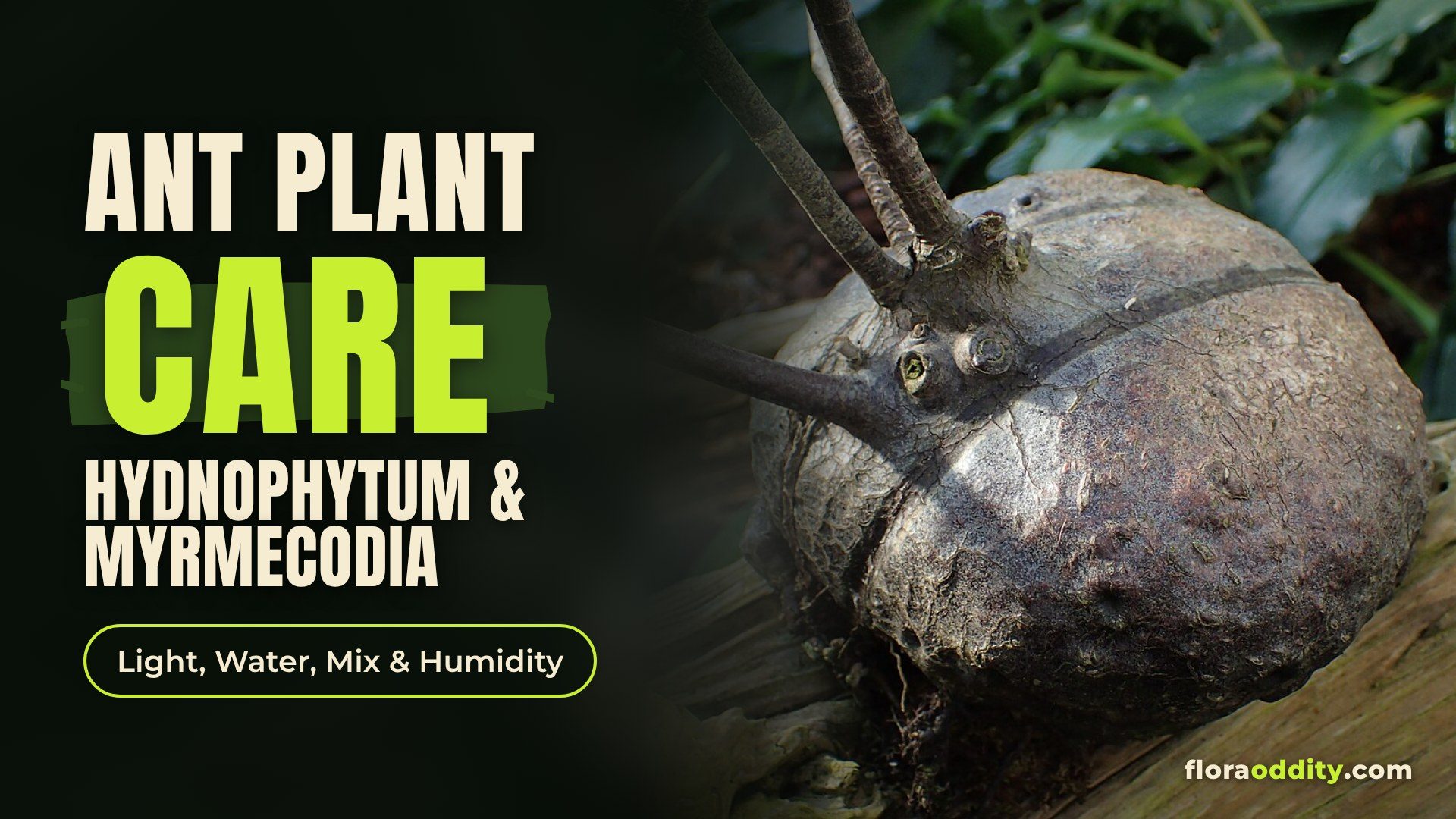
Featured image based on a photo of Myrmecodia tuberosa seedlings by Frederick Depuydt via Wikimedia Commons, CC BY-SA 4.0, with cropping and typography added by FloraOddity; the featured image is shared under the same license.
Final articles are editorially reviewed and factual claims are checked against cited sources. Last reviewed: October 2026.
3 Comments